
Non-FictionInformativeEducational
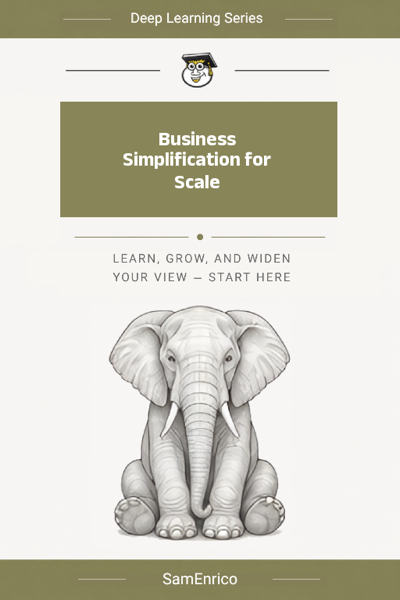
Business Simplification for Scale eBook
A Coursebook on Business Simplification for Scale
by Mack Pat
A Coursebook on Business Simplification for Scale
Formats
Free sample
Chapter 1: The Bottleneck Is You...--– The first time Sarah fainted at her desk, no one noticed for four hours.Her organic skincare company had grown from 200,000to200,000 to 200,000to2 million in eighteen months. By every external metric, she was a success story. She had been featured in a glossy magazine. Investors were calling. Her mother bragged about her at bridge club.But on that Tuesday afternoon in October, Sarah’s body told a different story.
She had been running on four hours of sleep for six months. She was personally approving every refund, editing every Instagram caption, calming every angry customer, and making every hiring decision. She was the only person who knew how to reconcile the merchant account. She was the only person who had the password to the email marketing platform. She was the only person who understood the inventory spreadsheet—a sprawling, color-coded monster that lived on her personal laptop and had never been shared with anyone.When she collapsed, her team kept working.
The refund queue grew. The Instagram post went out late. A customer complaint sat unanswered. But no one could step into her role because no one knew what her role actually was. She had never documented a single process.
She had never trained a backup. She had built a business that could not breathe without her.When she woke up in the emergency room, a doctor asked her a simple question: “If you had to take six weeks off, would your company survive?”Sarah couldn’t answer. Not because she didn’t know. But because the answer was too terrifying to say out loud.She had not built a scalable enterprise. She had built a very demanding job that was slowly killing her.This is the single most common failure mode in scaling.
It is not market failure. It is not product-market fit. It is not competition. It is the founder themselves, standing in the doorway of their own growth, blocking every attempt at scale.You are the bottleneck. And that is the good news.The Great Confusion: Technician vs.
Architect Most business owners start for a beautiful reason: they are skilled at something. They bake excellent bread. They write elegant code. They design beautiful spaces. They sell with uncommon charisma.
They have a craft, and they love it, and they decide to turn that craft into a livelihood.This is the Technician’s Trap.The technician wakes up early, goes to the bakery, and bakes bread. That is what they know. That is what they are comfortable with. When the business grows, the technician bakes more bread. When a customer complains, the technician fixes it personally.
When a supplier fails, the technician calls them personally. Every problem is solved by applying more of the technician’s own skill, time, and energy.But here is the cruel math: a technician’s output is linear. One person can only bake so many loaves. One person can only write so much code. One person can only sell so many subscriptions.
Linear output cannot produce exponential growth. And yet, most founders continue to operate as if working harder—longer hours, more caffeine, fewer weekends—will somehow bend the laws of physics.Michael Gerber, in his classic The E-Myth Revisited, identified this problem decades ago. He observed that most small businesses are started by technicians who, at a certain point of growth, find themselves trapped. They cannot step back because no one else knows how to do the work. They cannot step forward because they are drowning in the work.
They have created a cage made of their own competence.The alternative is the Architect.The architect does not bake bread. The architect designs a bakery that bakes bread. The architect does not write code. The architect designs a development process that produces code. The architect does not sell.
The architect designs a sales system that sells.The architect asks a different set of questions. Not “how do I do this task better?” but “how do I make this task repeatable by someone else?” Not “how do I fix this problem?” but “how do I design a system that prevents this problem from occurring again?” Not “how do I grow?” but “how do I build a machine that grows without me?”This distinction—working IN the business versus working ON the business—is the foundational binary of every scaling journey. Every entrepreneur I have ever worked with knows this distinction intellectually. Almost none of them live it consistently. The pull of the familiar, the comfort of competence, the dopamine hit of solving a problem yourself—these forces are powerful.
They will keep you trapped in the technician’s role for years, long after your intuition tells you that something is wrong.The Franchise Prototype Mindset Here is the mental model that finally broke Sarah free: the Franchise Prototype.Imagine that your goal is not to run one successful bakery, one software company, one consulting firm. Your goal is to build the prototype for 5,000 identical locations. Five years from now, a franchisee in Ohio—someone who has never tasted your bread, never met your customers, never felt your passion—will need to open their doors and produce exactly the same result as you do today.That franchisee does not have your intuition. They do not have your relationships. They do not have your history.
They have only what you leave them: systems, checklists, training materials, and documented processes.Now ask yourself: if that franchisee arrived tomorrow, could they run your business? Do you have a training manual? Do you have documented standard operating procedures? Do you have a playbook for every recurring decision? Or do you have a head full of tribal knowledge and a team of people who constantly need to “ask Sarah”?The Franchise Prototype mindset transforms every decision.
When you hire, you stop asking “is this person talented?” and start asking “does this person fit the system I am building?” When you create a process, you stop asking “does this work for me?” and start asking “can a reasonably intelligent stranger follow this on their first day?” When you solve a problem, you stop asking “how do I fix this now?” and start asking “how do I design a system that makes this problem impossible to occur again?”This is not about actually franchising your business. Most businesses should not become franchises. This is about adopting the discipline of franchisability. It is about building a business that is replicable, teachable, and scalable. Because if your business cannot be replicated by a stranger, it cannot be scaled by you.The Bottleneck Diagnosis Now let us turn the lens inward.
The most painful truth in this entire book is this: you are the primary constraint on your own growth.Not the market. Not the competition. Not the economy. Not your team. You.Every business has a bottleneck—a single point in the system that limits the throughput of the entire operation.
In a factory, the bottleneck might be a slow machine. In a software company, the bottleneck might be a server limit. In a founder-led business, the bottleneck is almost always the founder themselves.Why? Because the…
This is the end of the free sample. Get the eBook to keep going. Buy now
About this book
Details
- Author
- Mack Pat
- Publisher
- SamEnrico
- Language
- English
- Genre
- Non-Fiction, Informative, Educational
- Released
- 2026-05-08
- Pages (approx.)
- 139
- Available as
- eBook, Audiobook

Read better in the ZLOADR app
Your eBooks on your phone or tablet. Sign in with your SamEnrico account and start reading.
More by Mack Pat
 Calisthenics Advanced Skills GuideMack Pat$11.99
 Hungarian Green Incentives HandbookMack Pat$11.99
 UK Electric Heat Pump Grant GuideMack Pat$11.99
 The Six Month Sleep GuideMack Pat$11.99
 Innocence Project Arizona CasesMack Pat$11.99
 The Ghost in the Machine: How a Teen Hacker Brought the Internet to Its KneesMack Pat$11.99
 Love in the Time of Spreadsheets: The Unlikely Romance of Bill Gates and Melinda FrenchMack Pat$11.99
 How to Start a Motor Vehicle Body Manufacturing BusinessMack Pat$11.99
 Understanding Chromosome 18, Trisomy 18qMack Pat$17.99
 Time Management PDP GuideMack Pat$12.99
 ITA to PR Timeline GuideMack Pat$12.99
You may also like
 Hong Kong Handover 1997Dunn Johnnie$11.99
 Zumba For Postnatal Recovery CourseNeal Christian$11.99
 Zumba for BeginnersLadner Nikia$11.99
 YouTube Comment Mining GuideHumes Pandora$12.99
 Worry Box MeditationCarlin Rudy$11.99
 Workplace Stress MeditationNguyen Lynn$11.99
 Workplace Stress and Sleep RepairHawley Ivory$11.99
 Workplace Perfectionism CureDelaney Jeffry$11.99
 Workplace Injustice Anger GuideWallen Isabelle$11.99
 Work Addiction and Burnout LinkGreenwood Ester$11.99
 Women in Yoga and WellnessBeattie Galina$11.99
 Women in Stand Up ComedyChun Evangeline$11.99