
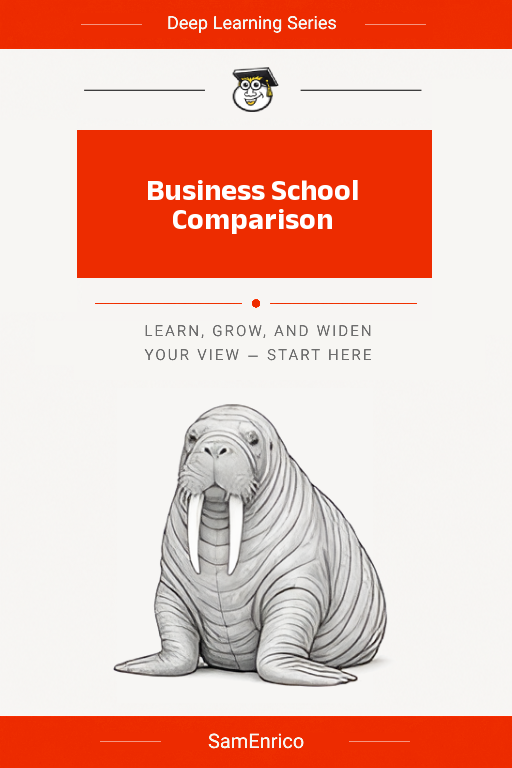
Non-FictionStudent's ShortcutBusiness
Business School Comparison eBook
Compare UK business schools (LBS, Warwick), US (Ha
Compare UK business schools (LBS, Warwick), US (Harvard, Stanford), and Australia (UNSW, Melbourne).
Formats
Free sample
Chapter 1: The Ranking Trap--Every year, one hundred thousand ambitious professionals make the same expensive mistake. They open the Financial Times Global MBA Ranking, scroll to the top ten, and decide their future based on a number. Not a strategy. Not a fit analysis. A number.This is not hyperbole.
The MBA application industry has built a billion-dollar ecosystem around the false promise that higher rank equals better outcome. Admissions consultants charge five thousand dollars to help you "crack the top seven." Test prep companies promise that a twenty-point GMAT increase will lift you from the second tier to the first. Alumni brag about their school's position as if they personally calculated the weighted average.And yet, buried in the fine print of every ranking methodology, there is a confession that no one reads: the weights are arbitrary.The Financial Times gives forty percent of its score to alumni salary increases—but only salaries measured three years after graduation, not ten. The Economist used to weight "opening new career opportunities" at thirty percent, but they defined that as the number of recruiters on campus, not the quality of placements. US News & World Report gives twenty-five percent to peer assessment surveys, which are essentially popularity contests among deans who have never met you.This chapter is not another takedown of rankings.
Plenty of bloggers have done that. Instead, this chapter is a cognitive intervention. It will expose the hidden biases that make smart people trust bad data. It will introduce the signal‑vs‑noise framework for reading any ranking critically. And it will give you a simple, repeatable method to build your own decision matrix—one that replaces the ranking industry's arbitrary weights with your actual priorities.By the end of this chapter, you will never look at a top‑ten list the same way again.
More importantly, you will stop asking "which school is best?" and start asking the only question that matters: "which school is best for me, given my specific bottleneck?"The Cognitive Biases That Ruin School Choice Before we talk about rankings, we need to talk about your brain. Because the ranking industry does not succeed because of good data. It succeeds because of predictable flaws in human judgment.Anchoring Bias: The First Number You See Becomes the Truth In the 1970s, psychologists Daniel Kahneman and Amos Tversky demonstrated a simple experiment. They spun a wheel of fortune rigged to land on either ten or sixty‑five. Then they asked participants: "What percentage of African nations are members of the United Nations?" The group who saw the wheel land on ten guessed twenty‑five percent on average.
The group who saw sixty‑five guessed forty‑five percent on average. The random number anchored their judgment.This is exactly what happens when you open the FT ranking. The first school you see—Harvard, Stanford, Wharton—becomes your anchor. Every other school is compared to that anchor, not evaluated on its own merits. You think: "Warwick is number fifteen, so it must be worse than Harvard." But worse at what?
Worse for a private equity associate in New York? Yes. Worse for a supply chain manager in Birmingham who needs a part‑time MBA while working at Jaguar Land Rover? Not remotely.The anchoring bias explains why applicants from outside the United States obsess over Harvard even when Harvard makes zero sense for their goals. The anchor has been set.
And the ranking industry knows this—which is why they pay millions to ensure their ranking is the first one you see.Availability Heuristic: Why You Overestimate Harvard Graduates The availability heuristic is another cognitive shortcut. You judge the likelihood of an event by how easily examples come to mind. This is why people overestimate shark attacks and underestimate heart disease. Sharks make headlines. Heart disease does not.Apply this to business schools.
When you think of Harvard Business School graduates, you think of billionaires, cabinet secretaries, Fortune 500 CEOs. These stories are everywhere. They are in case studies, Linked In influencer posts, and Hollywood movies. They are available to your memory.When you think of UNSW graduates, what comes to mind? Unless you live in Sydney, probably nothing.
Not because UNSW graduates are unsuccessful, but because their success is not amplified by the global media ecosystem. UNSW alumni run major Asia‑Pacific divisions of global banks. They hold senior roles in Australian superannuation funds managing trillions. But these stories do not appear in your feed. So your brain concludes they do not exist.The availability heuristic creates a systematic bias toward US schools in global perception.
It is not reality. It is media distribution.Confirmation Bias: You Find Evidence for the Decision You Already Made Once you have a preferred school in mind, confirmation bias takes over. You seek out data that supports your choice and ignore data that contradicts it. Read a blog post about how Harvard changed someone's life? You bookmark it.
Read a forum thread about a Harvard graduate struggling to find a job? You dismiss it as an outlier.This is why alumni testimonials are almost worthless. Of course graduates say their school was worth it. Admitting otherwise would mean admitting they made a three‑hundred‑thousand‑dollar mistake. You would say the same thing.The combination of anchoring, availability, and confirmation bias means that most applicants are not choosing a school.
They are being chosen by a narrative—a narrative constructed by marketing departments, ranking publications, and their own unconscious minds.How Rankings Actually Work (The Dirty Secrets)To break free from the ranking trap, you need to understand what rankings measure. Spoiler: it is not your future success.The Weighting Game Is Arbitrary Every ranking begins with a decision about what to measure. The Financial Times gives twenty percent to "salary increase" (weighted by pre‑MBA salary, which advantages candidates who earned little before business school). The Economist used to give ten percent to "percentage of faculty with doctorates" (which has no correlation with teaching quality). QS gives forty percent to "academic reputation" (surveys of academics who have never taught you).Here is the secret: there is no correct set of weights.
The ranking companies choose weights that produce a stable, marketable top ten year after year. If Harvard ever fell to number fifteen, the ranking would lose credibility. So the weights are subtly adjusted to ensure the usual suspects remain on top.This is not conspiracy. It is commercial reality. Rankings are products.
Products are designed to sell. A ranking that showed UNSW above Harvard would be laughed at—not because it is impossible, but because it violates customer expectations.Gaming the Metrics Schools are not passive recipients of rankings. They actively game the system.US schools game salary metrics. How? By encouraging graduates to accept high‑paying but short‑lived roles in investment banking and consulting.
These jobs inflate the three‑year salary numbers that rankings love. Whether graduates are happy five years later—burned out, laid off, or miserable—does not appear in the methodology.UK schools game international diversity metrics. The FT rewards schools with high percentages of international students and faculty. So LBS and Warwick recruit aggressively from one hundred countries. This is…
This is the end of the free sample. Get the eBook to keep going. Buy now
About this book
Details
- Author
- Coffin Christena
- Publisher
- SamEnrico
- Language
- English
- Genre
- Non-Fiction, Student's Shortcut, Business
- Released
- 2026-06-01
- Pages (approx.)
- 144
- Available as
- eBook, Audiobook

Read better in the ZLOADR app
Your eBooks on your phone or tablet. Sign in with your SamEnrico account and start reading.
More by Coffin Christena
 Daily Prioritization RoutineCoffin Christena$11.99
 Managing Remote ProcrastinationCoffin Christena$11.99
 Cloud Sky VisualizationCoffin Christena$11.99
 Validating Grief GuideCoffin Christena$11.99
 Detox Nausea and Vomiting ControlCoffin Christena$11.99
 DBT for Shame ReductionCoffin Christena$11.99
 Blue Zone Pet Ownership GuideCoffin Christena$11.99
 French Revolutionary Wars GuideCoffin Christena$11.99
 The 444-Day Silence: The Munich Massacre and the Forgotten NegotiationsCoffin Christena$11.99
 Orpheus: The Lament of Lost ElysiumCoffin Christena$11.99
 How to Start a Novelties Made of Plastic Business (Beginners Guide)Coffin Christena$11.99
 Service Providers Guide to Auto TowingCoffin Christena$11.99
You may also like
 Hong Kong Handover 1997Dunn Johnnie$11.99
 Zumba For Postnatal Recovery CourseNeal Christian$11.99
 Zumba for BeginnersLadner Nikia$11.99
 YouTube Comment Mining GuideHumes Pandora$12.99
 Worry Box MeditationCarlin Rudy$11.99
 Workplace Stress MeditationNguyen Lynn$11.99
 Workplace Stress and Sleep RepairHawley Ivory$11.99
 Workplace Perfectionism CureDelaney Jeffry$11.99
 Workplace Injustice Anger GuideWallen Isabelle$11.99
 Work Addiction and Burnout LinkGreenwood Ester$11.99
 Women in Yoga and WellnessBeattie Galina$11.99
 Women in Stand Up ComedyChun Evangeline$11.99