
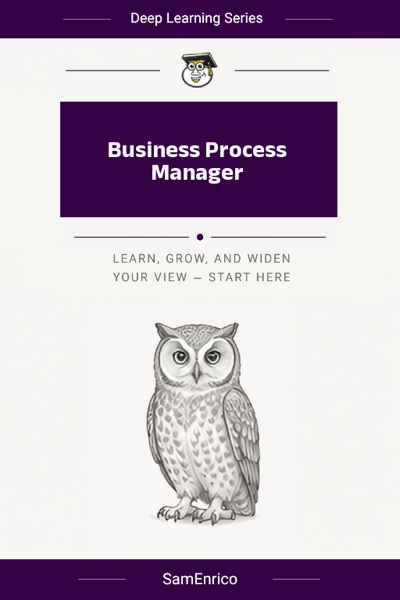
Non-FictionInformativeEducational
Business Process Manager eBook
A Coursebook on Business Process Manager
by Palmer Kelly
A Coursebook on Business Process Manager
Formats
Free sample
Chapter 1: The 48-Hour Lie--– In a gleaming regional bank headquarters, three department heads sat in a weekly operations meeting. The call center manager reported average wait times of 34 seconds. The loan processing manager showed a 99.2% accuracy rate. The compliance officer confirmed zero regulatory violations. Each slide was green.
Each leader was proud. Each department was, by its own metrics, a model of efficiency.And yet, new customers waited 48 hours to get their accounts active.Not because any single department was slow. Because the handoffs between them were a nightmare. Call center took the application, then emailed it to loan processing. Loan processing printed it, walked it physically to compliance.
Compliance stamped it, placed it in a tray. Operations picked it up the next morning. The customer sat in silence, wondering if they had chosen the wrong bank.Every department was locally efficient. The process was globally broken.This is not a story about a bad bank. This is a story about almost every organization on the planet.
Hospitals where patients wait three hours for a bed while every unit says they are “at capacity.” Software companies where features get built on time but never reach customers because release coordination fails. Universities where students get shuffled between eight offices to solve one problem. The pattern is universal, invisible, and expensive.This book exists because of one uncomfortable truth: most organizations are not designed to see their own broken processes. They are designed to see functions. Accounting sees accounting.
Marketing sees marketing. IT sees IT. No one sees the horizontal flow of work that cuts across all of them. No one is accountable for the handoffs. No one measures the wait times between departments.
And no one—until now—has given you a systematic way to fix it.Welcome to Business Process Management. It is not about software. It is not about flowcharts. It is not a one-time project you can outsource to consultants. Business Process Management—BPM—is the discipline of seeing, improving, and managing the end-to-end work that creates value for your customers.
It is the single most underleveraged capability in modern organizations. And by the time you finish this chapter, you will understand why your company feels chaotic even when everyone is working hard, and you will have the foundation for a completely different way of leading work.The Anatomy of a Process Let us start with a definition. A business process is a chain of linked activities that transforms inputs into outputs of customer value. That sounds academic. Here is what it means in practice: a process is how work actually gets done from someone’s request to someone’s satisfaction.Ordering a product online triggers a process.
A patient checking into an emergency room triggers a process. An employee submitting an expense report triggers a process. Each of these starts with a trigger, flows through a series of steps performed by people and systems, and ends with an outcome. The customer—internal or external—does not care about your departmental boundaries. The customer cares about the outcome.
Did the product arrive on time? Was the diagnosis accurate? Was the reimbursement deposited?Here is the problem. Most organizations are structured vertically. They have a Chief Financial Officer over Finance, a Vice President of Marketing, a Director of Human Resources.
This is called functional management, and it is excellent for specialized skill development. An accountant gets better at accounting by working alongside other accountants. A marketer gets better at marketing by being surrounded by marketers. The functional structure has real virtues.But the functional structure has a catastrophic blind spot. Work does not flow vertically.
Work flows horizontally, across functions. A customer order starts in sales, moves to fulfillment, touches warehousing, triggers billing, requires customer service follow-up. Each function does its piece well. No one owns the whole.When no one owns the whole, no one measures the whole. When no one measures the whole, no one improves the whole.
And when no one improves the whole, customers suffer, employees burn out, and competitors eat your lunch.The Cost of Silos Consider a study published in the Harvard Business Review. Researchers analyzed more than 1,000 companies and found that cross-functional handoffs accounted for 40% to 60% of total cycle time in complex processes. That is not waste from slow employees or bad technology. That is waste from structural friction—work sitting in queues between departments, work being re-entered into different systems, work being misinterpreted because each function uses different terminology.We have all felt this. You have sent an email to three people and received three different answers.
You have been told “that is not my job” by someone who could have solved your problem in ninety seconds. You have watched a project stall because approvals needed to bounce between four committees with no shared calendar. These are not failures of individual effort. They are failures of process design.The bank in our opening story was not staffed by lazy people. The call center agents were heroic, answering calls faster than the industry average.
The loan processors were meticulous, catching errors that would have caused regulatory problems. The compliance officers were diligent, protecting the bank from fines. Every individual succeeded. The customer failed. This is the signature pathology of the functional organization: locally efficient, globally inefficient.BPM exists to break this pathology.
It gives you a language to see the whole. It gives you tools to measure handoffs. It gives you methods to redesign work so that departments stop fighting each other and start serving the customer.The Three Myths That Keep Companies Stuck Before we go further, we need to clear the ground. Over twenty years of consulting and teaching, I have heard three myths about BPM so many times that they have become a kind of corporate folklore. Each myth is wrong.
Each myth costs organizations millions. Let me destroy them one by one.Myth Number One: BPM Is Just Automation.This is the most damaging myth. I have watched companies spend millions on Business Process Management Suites (we will cover those in Chapter 7) only to automate chaos. They take a broken process, map it into software, and hit “go.” The software executes the broken process perfectly, at ten times the speed. Now they have ten times the brokenness.Automation is a tool.
BPM is the discipline that tells you what to automate and how. You improve first, then automate. You never pave the cow path. A manufacturing firm I advised once automated its procurement process without redesigning it first. The process required seven approvals for a fifty-dollar purchase.
The software executed all seven approvals flawlessly, in under a minute, every single time. The firm celebrated for a week before realizing they had simply made their absurd approval process faster. They did not save money. They did not improve service. They created a high-speed machine for producing the wrong outcome.BPM is not automation.
BPM is strategy, people, and process working together. Automation is one possible implementation mechanism.Myth Number Two: BPM Is Only for Large Companies.I hear this from small business owners and mid-market executives. They believe that process discipline is something you add when you have hundreds or thousands…
This is the end of the free sample. Get the eBook to keep going. Buy now
About this book
Details
- Author
- Palmer Kelly
- Publisher
- SamEnrico
- Language
- English
- Genre
- Non-Fiction, Informative, Educational
- Released
- 2026-05-18
- Pages (approx.)
- 158
- Available as
- eBook, Audiobook

Read better in the ZLOADR app
Your eBooks on your phone or tablet. Sign in with your SamEnrico account and start reading.
More by Palmer Kelly
 Sleep More Weigh Less GuidePalmer Kelly$11.99
 Czech Green Tax Credits GuidePalmer Kelly$11.99
 The Eight Month Sleep RegressionPalmer Kelly$11.99
 Gulf Region Talent AttractionPalmer Kelly$11.99
 Micro Breaks for Work Stress ReliefPalmer Kelly$11.99
 Starlight Pilgrims: The Lost Voyage of the Kon-Tiki 2.0Palmer Kelly$11.99
 Writing Skills Development PlanPalmer Kelly$12.99
 EE Draw Cutoff AnalysisPalmer Kelly$12.99
 Understanding Chromosome 18, Trisomy 18pPalmer Kelly$17.99
 How to Start a Auditing Service BusinessPalmer Kelly$11.99
You may also like
 Hong Kong Handover 1997Dunn Johnnie$11.99
 Zumba For Postnatal Recovery CourseNeal Christian$11.99
 Zumba for BeginnersLadner Nikia$11.99
 YouTube Comment Mining GuideHumes Pandora$12.99
 Worry Box MeditationCarlin Rudy$11.99
 Workplace Stress MeditationNguyen Lynn$11.99
 Workplace Stress and Sleep RepairHawley Ivory$11.99
 Workplace Perfectionism CureDelaney Jeffry$11.99
 Workplace Injustice Anger GuideWallen Isabelle$11.99
 Work Addiction and Burnout LinkGreenwood Ester$11.99
 Women in Yoga and WellnessBeattie Galina$11.99
 Women in Stand Up ComedyChun Evangeline$11.99