
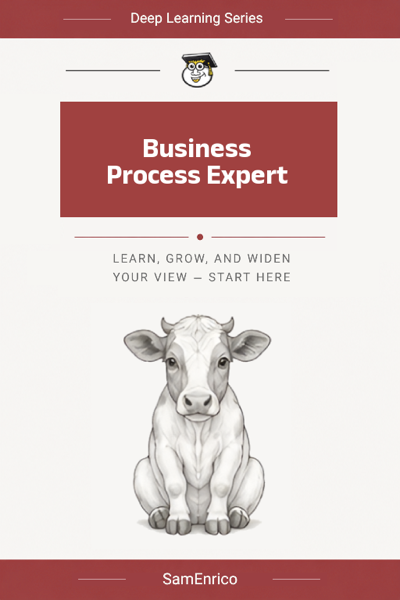
Non-FictionInformativeEducational
Business Process Expert eBook
A Coursebook on Business Process Expert
A Coursebook on Business Process Expert
Formats
Free sample
Chapter 1: The Three Hats--– The first time someone told me they didn’t need my help, I was twenty-six years old, freshly certified in Six Sigma, and absolutely certain that I could save the company millions of dollars if they would just listen. I had spent three weeks mapping a procurement process in perfect BPMN 2.0 notation—swimlanes, gateways, events, everything color-coded. I had identified seventeen distinct steps between “requisition submitted” and “purchase order approved.” Seventeen. My analysis showed that twelve of those steps added no value. I had the data.
I had the charts. I had the solution.The procurement manager, a woman named Diane who had been with the company for twenty-two years, looked at my presentation for about ninety seconds. Then she said something I have never forgotten: “That’s not how it works. And even if it did, I wouldn’t trust you to change it.”I was crushed. I had done everything right.
I had followed the methodology. I had the evidence. And I had absolutely zero impact.That was the day I learned that technical modeling is about twenty percent of this job. The other eighty percent is something else entirely—something that no certification exam tests for, something that no textbook teaches well, and something that most process experts figure out only after they have failed enough times to be humbled by it.This chapter is about that eighty percent. It is about the three mindsets that separate process experts who actually change things from those who produce beautiful documents that no one ever uses.
I call them the Three Hats: the Detective, the Negotiator, and the Doctor. You will wear all three, sometimes in the same meeting, and learning to switch between them fluidly is the single most important skill you will develop in your entire career.Let me be explicit about what this chapter is not. It is not a chapter about BPMN, LEAN, Six Sigma, or any other technical framework. Those tools are essential—I use them every day—but they are not the differentiator. The market is full of people who can draw a flawless process map.
The market is not full of people who can change how an organization actually works. That distinction begins here.The Great Misconception: Why Flowcharts Fail Every new process expert believes their value lies in drawing perfect flowcharts. I certainly did. There is a seductive logic to it: if you can see the process clearly, you can fix the process. The more detailed the map, the more precise the diagnosis.
The more precise the diagnosis, the more likely the solution will work.This logic is wrong in a way that is both subtle and devastating.The problem is not that process mapping is useless. It is not. The problem is that process mapping is incomplete. A flowchart shows you the steps. It does not show you the politics.
It does not show you the fear. It does not show you the workarounds that people have developed because the official process is unusable. It does not show you why Diane, the procurement manager with twenty-two years of experience, looked at my perfect diagram and saw a threat rather than a solution.Here is what my flowchart did not capture: Diane was not being irrational. She was being rational within a system that I did not understand. The twelve steps I wanted to remove?
Each one existed because of a previous disaster. Step four existed because someone had once ordered a million dollars of the wrong inventory. Step seven existed because a supplier had fraudulently invoiced the company. Step eleven existed because a new VP had demanded “visibility” into every purchase over ten thousand dollars.I had mapped the process as it was written in the policy manual. Diane lived in the process as it actually existed—messy, defensive, and full of scars from battles I knew nothing about.
She did not trust me because I had not earned the right to be trusted. I had walked in with solutions before I had understood her problems.The flowchart was not the problem. The flowchart was a symptom of a deeper error: I was wearing the wrong hat.The Three Hats: Detective, Negotiator, Doctor Over the next decade, I developed a simple framework for thinking about the different modes a process expert needs to operate in. I call them hats because you put them on and take them off depending on the situation. A good process expert knows which hat to wear at which time.
A great process expert can switch hats in the middle of a conversation without missing a beat.Let me introduce each hat, then we will spend the rest of the chapter learning how to wear them.The Detective wears the hat of pure inquiry. The Detective’s job is to find data and evidence, not anecdotes. When someone says “the system is slow,” the Detective asks “what does the timestamp say?” When someone says “approvals take forever,” the Detective asks “where does work actually sit?” The Detective is dispassionate, curious, and slightly annoying—the kind of person who keeps asking “how do you know that?” long after everyone else has moved on. The Detective’s tools are logs, counts, timelines, and the phrase “I don’t know yet, but I will measure.”The Negotiator wears the hat of strategic influence. The Negotiator’s job is to navigate territory disputes between departments, build coalitions, and find the trade-offs that make change possible.
The Negotiator understands that every process change creates winners and losers, and that you cannot help the winners without understanding what the losers are afraid of losing. The Negotiator’s tools are leverage, reciprocity, and the question “what do you need to say yes?”The Doctor wears the hat of diagnosis before prescription. The Doctor’s job is to resist the urge to fix symptoms immediately. When someone says “we need to automate this,” the Doctor asks “what problem are we trying to solve?” When someone says “just remove that step,” the Doctor asks “what risk does that step mitigate?” The Doctor is patient, systematic, and comfortable with ambiguity. The Doctor’s tools are hypotheses, tests, and the phrase “let me gather more information before I recommend anything.”Here is the secret that no certification tells you: you will wear all three hats in every single project.
You will start as a Detective, gathering data. You will shift into a Negotiator when you need buy-in from a skeptical stakeholder. You will become a Doctor when someone proposes a solution that addresses a symptom rather than a cause. And then you will switch back to Detective when the data surprises you.Most process experts fail because they get stuck in one hat. The analyst wears the Detective hat forever, gathering more and more data until analysis paralysis sets in.
The consultant wears the Doctor hat too quickly, prescribing solutions before understanding the patient. The politician wears the Negotiator hat exclusively, building consensus around changes that do not actually fix anything.The Rebel wears all three. Fluently. Without thinking about it.The Detective: How to Find What Is Actually Happening Let me tell you about…
This is the end of the free sample. Get the eBook to keep going. Buy now
About this book
Details
- Author
- Grossman Garland
- Publisher
- SamEnrico
- Language
- English
- Genre
- Non-Fiction, Informative, Educational
- Released
- 2026-05-18
- Pages (approx.)
- 148
- Available as
- eBook, Audiobook

Read better in the ZLOADR app
Your eBooks on your phone or tablet. Sign in with your SamEnrico account and start reading.
More by Grossman Garland
 Elizabeth I Speechwriting ManualGrossman Garland$11.99
 The Google EffectGrossman Garland$11.99
 Workplace Stress and Sabbatical PlanningGrossman Garland$11.99
 Vitamin D Emotional HealthGrossman Garland$11.99
 The Scipionic Gambit: Rome's Desperate Stand at ZamaGrossman Garland$11.99
 A Beginners Guide to Kinomichi (Volume 1)Grossman Garland$11.99
 Intercompany Transaction NettingGrossman Garland$12.99
 How to Produce ArtworkGrossman Garland$11.99
You may also like
 Hong Kong Handover 1997Dunn Johnnie$11.99
 Zumba For Postnatal Recovery CourseNeal Christian$11.99
 Zumba for BeginnersLadner Nikia$11.99
 YouTube Comment Mining GuideHumes Pandora$12.99
 Worry Box MeditationCarlin Rudy$11.99
 Workplace Stress MeditationNguyen Lynn$11.99
 Workplace Stress and Sleep RepairHawley Ivory$11.99
 Workplace Perfectionism CureDelaney Jeffry$11.99
 Workplace Injustice Anger GuideWallen Isabelle$11.99
 Work Addiction and Burnout LinkGreenwood Ester$11.99
 Women in Yoga and WellnessBeattie Galina$11.99
 Women in Stand Up ComedyChun Evangeline$11.99