
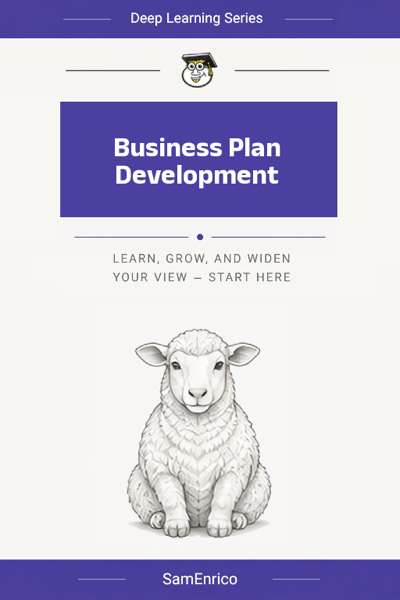
Non-FictionInformativeEducational
Business Plan Development eBook
A Coursebook on Business Plan Development
by Ware Santina
A Coursebook on Business Plan Development
Formats
Free sample
Chapter 1: The 47 Million Mistake--–- The email arrived at 11:47 PM on a Tuesday. I still remember the timestamp because I was sitting in a fluorescent-lit We Work phone booth, watching my bank account bleed $12,000 per week with nothing to show for it except a 78-page business plan that three investors had described as “very thorough” before politely declining to fund it.The email was from my former co-founder, Sarah. She had left six months earlier after we lost our third key hire. Her message was brief: “Saw you’re still fundraising. Remember when I told you that writing the plan before talking to customers was backwards?
You said I didn’t understand ‘strategic discipline.’ How’s that discipline working out?”It wasn’t. We had raised exactly zero dollars. We had built exactly zero features that customers actually wanted. We had a beautiful three-ring binder full of charts, market data, and financial projections that we updated religiously every quarter. And we were four weeks away from running out of money.That was ten years ago.
Since then, I’ve advised over 200 startups, reviewed more than 1,500 business plans, and watched founders repeat the exact same mistake I made: treating the business plan as a document to be finished rather than a muscle to be exercised.This chapter is about why that distinction matters more than anything else you’ll learn in this book.The $47 Million Lie Let me tell you about a company you’ve heard of. In 2008, a startup called The Point launched with a lofty mission: to solve collective action problems by letting people organize around social causes. They had a classic 35-page business plan, a seasoned founding team with Stanford MBAs, and a board packed with Silicon Valley royalty.The plan was flawless. It had market sizing. It had competitive moats.
It had five-year financial projections down to the penny. It had everything except one thing: customers who actually wanted what they were selling.For eighteen months, the team executed the plan perfectly. They built exactly what the plan said they should build. They hired exactly the team the plan said they should hire. They spent marketing dollars exactly where the plan said they should spend them.And absolutely nothing worked.By early 2010, the company was weeks from bankruptcy.
The board convened an emergency meeting. The founders presented a revised plan — new forecasts, new features, new everything. One board member, a grizzled veteran of three IPOs, listened quietly for twenty minutes. Then he said something that became Silicon Valley lore:“You’ve written a beautiful plan for a company that doesn’t need to exist. Burn it.
Start over. But this time, don’t write a plan. Find a problem.”The founders went back to the whiteboard. They stopped planning and started listening. They discovered that a small subset of their users — fewer than 3% — were using the platform not for social activism, but for something completely different: sharing daily deals with friends.
It was accidental. It was invisible to the plan. And it was the only thing anyone actually wanted.The company pivoted. They threw away 90% of their plan and 100% of their original vision. They renamed themselves Groupon.
Three years later, they turned down a $6 billion acquisition offer from Google.Here’s what most people get wrong about this story. They think it proves that planning is useless — that successful companies emerge from chaos and serendipity. That’s not true. Groupon’s success wasn’t the absence of planning. It was the discovery of what planning should actually be: a process of systematic learning, not a document of confident prediction.The founders didn’t succeed because they abandoned planning.
They succeeded because they stopped treating their plan as a destination and started treating it as a compass.The Two Types of Planning (And Why Most Founders Only Do One)Every entrepreneur plans. The question is not whether you plan, but how and when.After a decade of watching founders succeed and fail, I’ve identified two fundamentally different approaches to planning. I call them Monument Planning and GPS Planning.Monument Planning Monument Planning treats the business plan as a finished artifact — something to be carved in stone, polished, and presented. It asks: “What will my business look like in three years?” Then it works backward, filling in every detail with precise confidence.The Monument Planner believes that planning means predicting. They spend weeks or months writing before they spend hours talking to customers.
Their plan is a defense against uncertainty — a way to pretend that the future is knowable if you just work hard enough.Here’s what Monument Planning produces: beautiful documents that are obsolete the moment they’re printed. Long lists of assumptions disguised as facts. And, most dangerously, the illusion of progress — the feeling that because you wrote something down, you’ve actually accomplished something.I’ve seen this hundreds of times. A founder spends six weeks writing a 50-page plan. They feel exhausted, accomplished, ready to execute.
But they haven’t executed anything. They’ve just written down what they already believed. They haven’t learned a single new thing about their customers, their market, or their product.GPS Planning GPS Planning treats the business plan as a navigation system — something that gives you direction while adapting to new information. It asks: “What do I need to learn today?” Then it plans experiments, not outcomes.The GPS Planner believes that planning means learning. They start with a destination (the vision) but recognize that the route will change based on road conditions, traffic, and new information.
Their plan is a tool for reducing uncertainty, not eliminating it.Here’s what GPS Planning produces: shorter documents that are updated constantly. Explicit lists of assumptions to be tested. And, most importantly, a rhythm of learning — a systematic way to turn guesses into knowledge.The difference between Monument and GPS planning is not academic. It’s the difference between the 90% of startups that fail and the 10% that succeed.The Statistics That Should Terrify You (And Inspire You)Let me share three numbers that every founder should memorize.Number one: 90% of startups fail. That’s the oft-cited statistic from Harvard Business School researcher Shikhar Ghosh.
But here’s what most people miss: the failure rate drops by more than half — to under 40% — for founders who complete a formal planning process before raising capital or launching.Not a perfect plan. A formal planning process.Number two: 73% of business plans are never fully executed. According to a study of 1,500 companies by the Small Business Administration, nearly three-quarters of written plans end up in a drawer, never referenced again after the first quarter. Those plans weren’t failures of writing. They were failures of process — plans created for the wrong reasons, at the wrong time, in the wrong way.Number three: Companies that update their plans quarterly are 2.8 times more likely to survive their fifth year than companies that write a plan once and never revise it.
The act of revision — not the original document — is what predicts success.What do these numbers tell us? That planning works. But only when it’s done as an ongoing discipline, not a one-time event.…
This is the end of the free sample. Get the eBook to keep going. Buy now
About this book
Details
- Author
- Ware Santina
- Publisher
- SamEnrico
- Language
- English
- Genre
- Non-Fiction, Informative, Educational
- Released
- 2026-06-02
- Pages (approx.)
- 144
- Available as
- eBook, Audiobook

Read better in the ZLOADR app
Your eBooks on your phone or tablet. Sign in with your SamEnrico account and start reading.
More by Ware Santina
 The Anxiety Ladder MeditationWare Santina$11.99
 Mother Child Border Separation StoryWare Santina$11.99
 Cybersex Addiction Treatment PlanWare Santina$11.99
 Cryptocurrency Gambling AddictionWare Santina$11.99
 The Train Derailment HostageWare Santina$11.99
 Trading Floor Stress ManagementWare Santina$11.99
 Second Act Career ChangeWare Santina$11.99
 Learning Disability Academic StressWare Santina$11.99
 When Hospitals Became TargetsWare Santina$11.99
 The Star Keepers of the Nile: Egypt's Celestial GuardiansWare Santina$11.99
 The Siege of Azov: Cossack Defiance Against the TsarWare Santina$11.99
 How to Start a Advertising Contractor Business (Beginners Guide)Ware Santina$11.99
You may also like
 Hong Kong Handover 1997Dunn Johnnie$11.99
 Zumba For Postnatal Recovery CourseNeal Christian$11.99
 Zumba for BeginnersLadner Nikia$11.99
 YouTube Comment Mining GuideHumes Pandora$12.99
 Worry Box MeditationCarlin Rudy$11.99
 Workplace Stress MeditationNguyen Lynn$11.99
 Workplace Stress and Sleep RepairHawley Ivory$11.99
 Workplace Perfectionism CureDelaney Jeffry$11.99
 Workplace Injustice Anger GuideWallen Isabelle$11.99
 Work Addiction and Burnout LinkGreenwood Ester$11.99
 Women in Yoga and WellnessBeattie Galina$11.99
 Women in Stand Up ComedyChun Evangeline$11.99