
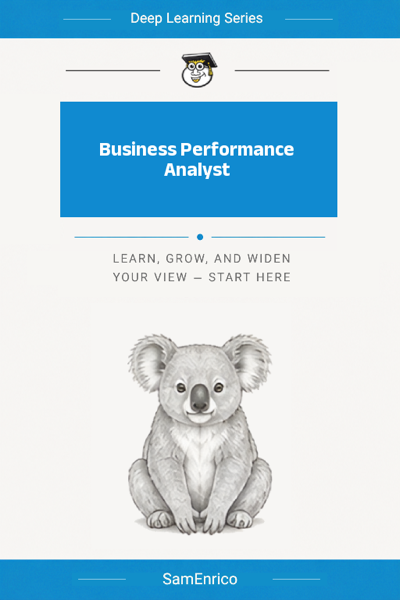
Non-FictionInformativeEducational
Business Performance Analyst eBook
A Coursebook on Business Performance Analyst
A Coursebook on Business Performance Analyst
Formats
Free sample
Chapter 1: The Spreadsheet Cemetery...--Every morning, Maya opened her laptop to the same sight: twelve spreadsheets, seven email requests for “updated numbers,” three dashboards nobody understood, and a calendar invite titled “Q3 Performance Review – Please Bring Your Analysis.” She had been an analyst at Urban Home Goods for four years. She knew the data models better than anyone. She could pivot a table in her sleep. And yet, when the VP of Sales asked her last week, “So, should we raise prices or cut costs?”, she had no answer. She had the numbers.
She did not have the insight.Maya’s story is not unique. Across thousands of companies, millions of analysts go to work every day, produce flawless reports, run perfect queries, and generate beautiful charts—only to discover that none of it moves the needle. The CFO still makes decisions based on gut feeling. The operations team still fights fires without data. The strategy that looked so good on paper last January has somehow gone off the rails, and nobody can explain why.This is the Intelligence Gap.
And closing it is the single most valuable skill a business professional can learn.The Great Paradox: More Data, Less Insight We live in the age of data abundance. A single medium-sized retail chain like Urban Home Goods generates millions of data points every day: point-of-sale transactions, website clicks, customer service calls, inventory movements, social media interactions, shipment tracking, returns processing, and employee clock-ins. The average company today stores more data in a week than an entire Fortune 500 company stored in a year in the 1990s.You would think, therefore, that business decisions have never been better. You would be wrong.Despite this explosion of data, the percentage of decisions made using data-driven analysis has barely moved. Studies consistently show that less than 40% of business decisions are made with quantitative analysis.
The rest rely on experience, intuition, politics, or simple inertia. The more data we collect, the more we seem to ignore it.Why? Because data is not insight. Reports are not decisions. And spreadsheets, for all their power, are where insights go to die unless someone knows how to bring them back to life.The Intelligence Gap is the chasm between raw information and strategic action.
On one side, you have operational reporting: what happened, when it happened, and sometimes who did it. On the other side, you have enterprise performance management: what we should do about it, how we should allocate resources, and whether we are moving toward our goals. Most organizations invest heavily in the first side and almost nothing in the second. They build data warehouses but never build decision-making muscles.This book exists to build those muscles.Defining the Modern Business Performance Analyst Before we go any further, let us be clear about who this book is for—and who it is not for.If you are a data scientist building complex machine learning models in Python, this book will feel too operational for you. If you are a controller focused exclusively on financial reporting and audit compliance, this book will feel too strategic for you.
If you are a junior analyst who has never built a forecast or presented to a VP, this book will be exactly what you need—but you may need to read it twice.The Target Reader: The Generalist Analyst This book is written for the generalist business performance analyst who works in a mid-market organization (100 to 5,000 employees) where roles blur and everyone wears multiple hats. You are probably:An FP&A analyst who also gets asked to fix operational dashboards A business intelligence analyst who also gets pulled into budget planning An operations analyst who also gets asked to explain why customer churn is rising A data analyst who also needs to present findings to skeptical executives A manager who inherited the “analytics” role without a formal title You are not a specialist. You cannot afford to be. In a mid-market company, the person who builds the forecast is often the same person who designs the dashboard and presents to the leadership team. This book assumes that reality.The Role Roadmap Because different analysts have different needs, here is a roadmap to help you navigate this book.
Identify your primary role below, then follow the recommended reading path. The full book is written sequentially, but if you are short on time, these paths will get you the most value fastest.If You Are A...Focus On These Chapters Skip or Skim Finance/FP&A Analyst Ch 4 (ABC), Ch 5 (Rolling Forecasts), Ch 6 (Supply Chain), Ch 11 (MCDA)Ch 7 (if you don't do predictive), Ch 8 (if you have a dedicated BI team)Operations Analyst Ch 6 (Supply Chain), Ch 8 (Dashboards), Ch 10 (Root Cause), Ch 11 (MCDA)Ch 4 (if cost accounting is handled by finance), Ch 5 (if budgeting is separate)Data/BI Analyst Ch 7 (Predictive), Ch 8 (Dashboards), Ch 9 (Storytelling), Ch 10 (Root Cause)Ch 4, Ch 5 (unless you support finance directly)Change Agent / Manager Ch 2 (Strategy), Ch 3 (KPIs), Ch 9 (Storytelling), Ch 10 (Root Cause), Ch 11 (Change Management)Ch 4-7 (read summaries only, focus on outcomes not mechanics)Complete Beginner All chapters in order. Do not skip. You need everything.Nothing. Read the whole book.From Data Cop to Strategic Business Partner The single biggest career shift any analyst can make is moving from being a Data Cop to a Strategic Business Partner.What is a Data Cop?
Someone who fetches numbers on request, validates that other people’s numbers are correct, and produces reports because “that’s what we’ve always done.” Data Cops are valuable. They prevent errors and keep the lights on. But they are not influential. They are not promoted. They are not invited to strategy meetings.
They are the person in the corner who says “actually, the number is 14.2, not 14.1.”What is a Strategic Business Partner? Someone who anticipates what decisions need to be made, designs the analysis to inform those decisions, and presents findings in a way that drives action. Strategic Business Partners are trusted. They are in the room when budgets are set. They are asked “what do you think?” by the VP.
They do not just report the number—they explain what the number means and what to do about it.The difference is not technical skill. The difference is mindset, framing, and communication. Everything in this book is designed to move you from the left column to the right column.The Three Layers of Business Analytics To understand where the Intelligence Gap lives, we need to distinguish between three fundamentally different types of analytical work. Most organizations conflate them. High-performing organizations separate them clearly.Layer 1: Operational Reporting (What Happened?)Operational reporting answers basic factual questions.
How many units did we sell yesterday? What was our cash balance at month end? How many customer service tickets were opened? This layer is automated, rules-based, and largely non-judgmental. It does not require interpretation.
It requires accuracy and timeliness.Examples of operational reporting:Daily sales flash report Weekly inventory status Monthly financial close package Real-time website traffic dashboard Operational reporting is necessary but not sufficient. It tells you what happened. It does not tell you why it happened, whether it was good or bad, or what…
This is the end of the free sample. Get the eBook to keep going. Buy now
About this book
Details
- Author
- Romo Claudette
- Publisher
- SamEnrico
- Language
- English
- Genre
- Non-Fiction, Informative, Educational
- Released
- 2026-05-11
- Pages (approx.)
- 151
- Available as
- eBook, Audiobook

Read better in the ZLOADR app
Your eBooks on your phone or tablet. Sign in with your SamEnrico account and start reading.
More by Romo Claudette
 SEAL Bin Laden Raid AccountRomo Claudette$11.99
 Noise Sensitivity AngerRomo Claudette$11.99
 Franklin Nature Of DNA Hydrogen Bonds GuideRomo Claudette$11.99
 The Workaholic's Evening Wind DownRomo Claudette$11.99
 Agile Team Creative PracticesRomo Claudette$11.99
 The Great Mail Strike of 1970: When the Post Office Stood StillRomo Claudette$11.99
 Moana’s Lost Star: The Navigator’s OmenRomo Claudette$11.99
 Understanding Fumarase DeficiencyRomo Claudette$17.99
 Financial Audit Preparation ManualRomo Claudette$12.99
 Chinese Pronunciation GuideRomo Claudette$12.99
 How to Become a Director Of Pupil Personnel ProgramRomo Claudette$11.99
You may also like
 Hong Kong Handover 1997Dunn Johnnie$11.99
 Zumba For Postnatal Recovery CourseNeal Christian$11.99
 Zumba for BeginnersLadner Nikia$11.99
 YouTube Comment Mining GuideHumes Pandora$12.99
 Worry Box MeditationCarlin Rudy$11.99
 Workplace Stress MeditationNguyen Lynn$11.99
 Workplace Stress and Sleep RepairHawley Ivory$11.99
 Workplace Perfectionism CureDelaney Jeffry$11.99
 Workplace Injustice Anger GuideWallen Isabelle$11.99
 Work Addiction and Burnout LinkGreenwood Ester$11.99
 Women in Yoga and WellnessBeattie Galina$11.99
 Women in Stand Up ComedyChun Evangeline$11.99