
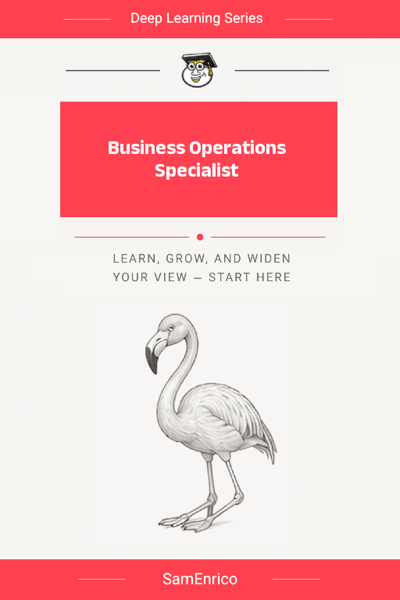
Non-FictionInformativeEducational
Business Operations Specialist eBook
A Coursebook on Business Operations Specialist
by Colon Pamela
A Coursebook on Business Operations Specialist
Formats
Free sample
Chapter 1: The Bottleneck Hunter–- It was 10:47 on a Tuesday morning when Priya realized she had become exactly what she swore she would never be: a professional firefighter.Her Slack notifications had hit 247 unread messages. Three different managers had claimed her time for conflicting “urgent” projects. A customer ticket had been escalated to the CEO because nobody could figure out why orders were shipping five days late. And somewhere in the chaos, Priya was supposed to be the operations specialist who made things run smoothly.Instead, she was drowning.She had been hired six months ago with a glowing title and a mandate to “optimize processes.” But nobody had defined what that meant. Her desk sat between Sales (who wanted everything faster) and Finance (who wanted everything cheaper) and Customer Support (who wanted everything to just work for once).
Every day, she walked into an invisible war zone where the weapons were spreadsheets and the casualties were her weekends.Priya’s story is not unique. It is the story of thousands of operations specialists who enter the field with high hopes and exit with burnout. They are given responsibility without authority, expected to fix problems they did not create, and measured against outcomes they cannot fully control. The job description promises strategy; the reality delivers chaos.This book exists because Priya—and you—deserve better.The Operations Identity Crisis Let us start with an uncomfortable truth: most organizations do not know what to do with their operations specialists.Some companies treat the role as junior project management—assigning task coordination and meeting minutes. Others treat it as data analytics—building dashboards that nobody reads.
Still others treat it as administrative catch-all—the person who gets the work nobody else wants.None of these definitions are correct. And none of them lead to career satisfaction or organizational impact.The root of the problem is a fundamental confusion about what operations actually is. In business school, operations management is taught alongside marketing, finance, and strategy—but unlike those disciplines, operations lacks a clear identity in most corporate structures. Marketing has brand managers. Finance has controllers.
Operations has… whoever is available.This book argues for a different definition. One that is precise, actionable, and worthy of your career.An operations specialist is a system architect. You do not manage people (that is the manager’s job). You do not set strategy (that is the executive’s job). You design, diagnose, and improve the workflows that connect decisions to outcomes.
You are the person who can look at a messy process—whether it is onboarding new customers, fulfilling orders, or handling returns—and see not chaos but a system with leverage points.The metaphor that will guide this entire book is simple: you are a bottleneck hunter.Your job is to find the single constraint limiting your organization’s ability to deliver value, attack it relentlessly, and then find the next one. Everything else—the meetings, the dashboards, the email chains—is either supporting that mission or getting in the way.This chapter introduces the core frameworks you will need to begin that hunt. We will cover the First 90 Day Diagnostic (a phased approach to assessing operational maturity), the distinction between managers and specialists (so you stop doing someone else’s job), and the single most important question you can ask in any situation.The First 90 Days: From Firefighter to Architect When Priya started her role, she made a classic mistake. She said yes to everything.Yes, I will join that meeting. Yes, I will build that report.
Yes, I will investigate that customer complaint. Yes, I will fix the broken printer because nobody else will.Within weeks, she had become the office utility player—valued for her willingness but invisible for her expertise. She was putting out fires, but she never asked why the fires kept starting.The alternative is not laziness or refusal. The alternative is a deliberate, phased approach to your first three months. Let us call it the First 90 Day Diagnostic.Phase One: Observation (Days 1-5)Your first week is for watching, not doing.
This is harder than it sounds because everyone will ask for your opinion. Resist.What to observe:Workflow handoffs. Watch how work moves from one person to another. Where do people wait? Where do things get stuck?
Where does information have to be re-explained?Meeting patterns. Attend every meeting you are invited to, but sit in the back. Notice who talks, who listens, and who checks their phone. Notice which meetings start and end on time versus which ones drift.Metrics visibility. Can anyone tell you, without checking three systems, how the team is performing today?
Or are metrics locked in spreadsheets that update monthly?Bottleneck awareness. Ask people a simple question: “If you could change one thing about how we work, what would it be?” The answers will cluster. That cluster is your first clue.What to avoid:Do not make recommendations in your first week. You do not yet understand the politics, the history, or the hidden constraints. Recommendations made too early will be ignored or—worse—implemented badly and blamed on you.The output of Phase One: A one-page observation log.
Not analysis. Just facts. “On Tuesday, the approval process took 47 minutes between step 2 and step 3.” “Three different people asked me for the same customer data because nobody has a single source of truth.”Phase Two: Data Gathering (Days 6-30)Now you begin measuring. The goal is not perfection; the goal is baseline visibility.What to measure:Cycle times. How long does each step of a process actually take?
Not the documented time. The real time.Defect rates. How often does something go wrong? How often does work have to be redone? How often does a customer complain?Handoff frequency.
How many times does a single piece of work change hands before completion? Each handoff adds delay and risk.Wait time. This is the hidden killer. How much time does work spend sitting in someone’s inbox or queue versus being actively worked on?How to gather:Shadow one process from end to end. If you process customer orders, follow a single order from the moment it enters the system to the moment it ships.
Write down timestamps at every step. You will be shocked at the gaps.Interview five people in different roles. Ask the same three questions: (1) What is working well? (2) What is frustrating? (3) If you had a magic wand, what would you change?Review existing data.
Most companies have data they are not using—ticket logs, shipping records, timesheets. Ask for access. Look for patterns.The output of Phase Two: A data packet. Cycle times for each process step. Defect rates by type.
A list of recurring frustrations. This is not yet a solution. It is evidence.Phase Three: Analysis (Days 31-60)Now you look for the bottleneck. Remember: every system has exactly one primary constraint limiting its output. Your job is to find it.How to analyze:Start with the data from Phase Two.
Where are the longest wait times? Where do defects cluster? Where do people report the most frustration?Then map the process. Use a simple flowchart. Draw…
This is the end of the free sample. Get the eBook to keep going. Buy now
About this book
Details
- Author
- Colon Pamela
- Publisher
- SamEnrico
- Language
- English
- Genre
- Non-Fiction, Informative, Educational
- Released
- 2026-05-04
- Pages (approx.)
- 145
- Available as
- eBook, Audiobook

Read better in the ZLOADR app
Your eBooks on your phone or tablet. Sign in with your SamEnrico account and start reading.
More by Colon Pamela
 The Remote Layoff GuideColon Pamela$11.99
 Twelve Step Sponsorship GuideColon Pamela$11.99
 Stress and Friendship StrainColon Pamela$11.99
 Hair Loss after Weight LossColon Pamela$11.99
 Tall as the Sky: The Ladder to the StarsColon Pamela$11.99
 Translation Cost ForecastingColon Pamela$12.99
 How to Start a Books Printing BusinessColon Pamela$11.99
 How to Produce Bobblehead FiguresColon Pamela$11.99
You may also like
 Hong Kong Handover 1997Dunn Johnnie$11.99
 Zumba For Postnatal Recovery CourseNeal Christian$11.99
 Zumba for BeginnersLadner Nikia$11.99
 YouTube Comment Mining GuideHumes Pandora$12.99
 Worry Box MeditationCarlin Rudy$11.99
 Workplace Stress MeditationNguyen Lynn$11.99
 Workplace Stress and Sleep RepairHawley Ivory$11.99
 Workplace Perfectionism CureDelaney Jeffry$11.99
 Workplace Injustice Anger GuideWallen Isabelle$11.99
 Work Addiction and Burnout LinkGreenwood Ester$11.99
 Women in Yoga and WellnessBeattie Galina$11.99
 Women in Stand Up ComedyChun Evangeline$11.99