
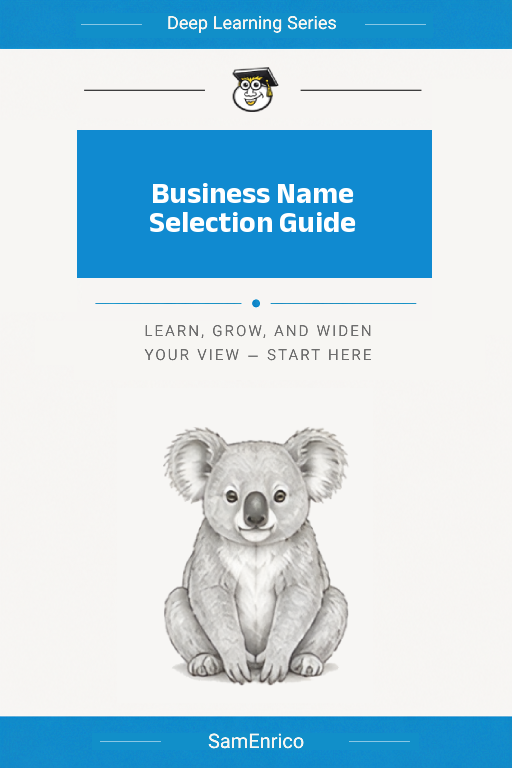
Non-FictionFirst 30 DaysBrand Setup
Business Name Selection Guide eBook
Check trademark availability, secure domain names,
Check trademark availability, secure domain names, and register your LLC name across all states correctly.
Formats
Free sample
Chapter 1: The DBA Delusion--–- Sarah had done everything right. She registered “Sugar Bee Bakery” as a DBA with her county clerk, paid the 35filingfee,andevenrananoticeinthelocalnewspaperasrequired.Shespent35 filing fee, and even ran a notice in the local newspaper as required. She spent 35filingfee,andevenrananoticeinthelocalnewspaperasrequired.Shespent10,000 on custom signage, packaging, and a website domain. Six months later, she received a cease-and-desist letter from a national bakery chain that owned the federal trademark for “Sugar Bee.” Her attorney’s words still echoed: “That DBA you filed? It’s just a piece of paper.
It gave you zero protection.”This opening story haunts thousands of entrepreneurs every year. They believe that filing a Doing Business As (DBA) or Fictitious Business Name statement gives them legal ownership of their brand name. It does not. This chapter dismantles that dangerous myth and replaces it with a clear framework for understanding how business names are actually protected in the United States.The Cost of Confusion Before we dive into the legal framework, let me be direct: confusing a DBA with brand ownership is one of the most expensive mistakes new business owners make. I have seen founders lose years of goodwill, thousands of dollars in marketing materials, and their entire brand identity because they relied on a DBA as their primary protection.Consider another case.
Marcus opened “Precision Auto Repair” in Austin, Texas. He filed a DBA, bought the domain, and built a thriving business over three years. When he tried to expand to Dallas, he discovered that another mechanic had registered “Precision Automotive Repair” as an LLC in Dallas two years earlier. Marcus had no legal right to stop him. The DBA that Marcus thought protected his name was worthless outside his home county.
He faced an impossible choice: rebrand his successful Austin business or operate under a different name in Dallas, destroying customer recognition.These stories are not anomalies. They are the predictable result of misunderstanding the fundamental legal reality of business names. This chapter will ensure you are never the protagonist of such a cautionary tale.Your Legal Entity Name vs. Your Brand Name The first and most critical distinction you must internalize is the difference between your Legal Entity Name and your Brand Name. Most entrepreneurs treat these as the same thing.
That is a mistake that limits both legal protection and marketing flexibility.Your Legal Entity Name is the name that appears on your Articles of Organization or Incorporation filed with your state’s Secretary of State. It is the formal, government-recognized identity of your business. For an LLC, this name must include a designator such as “LLC,” “L.L.C.,” or “Limited Liability Company.” For a corporation, it must include “Inc.,” “Corp.,” or “Incorporated.” This is the name the IRS uses. This is the name on your bank account. This is the name that gets sued.Your Brand Name is what customers see on your sign, your website, your packaging, and your advertisements.
It is the name that builds emotional connection, drives word-of-mouth, and becomes synonymous with your products or services. Sometimes the brand name matches the legal entity name. Often it does not. And that is perfectly fine—provided you understand the relationship between them.Here is the key insight that changes everything: Your legal entity name and your brand name serve different purposes and are protected by different legal mechanisms. Your legal entity name is protected by state law against confusingly similar names used by other businesses registered in that same state.
Your brand name is protected by trademark law, which can give you nationwide rights regardless of where you have registered an LLC.Most successful companies have different legal and brand names. Google’s legal name is Alphabet Inc. The Gap’s legal name is Gap Inc., but it operates Banana Republic, Old Navy, and Athleta as brand names. These companies understand that the legal entity is a corporate shell, while the brand is an asset worth protecting.The Hierarchy of Power: Four Layers of Name Protection Now that you understand the distinction between legal entity and brand, let me introduce the framework that will guide this entire book. I call it the Hierarchy of Power.
It ranks the four ways to protect a business name from weakest to strongest. Your goal is to move as far up this hierarchy as your business stage and budget allow.Layer 1: State LLC Registration (Weakest)When you register an LLC or corporation with a state, the Secretary of State checks that your proposed name is not “confusingly similar” to any existing registered business in that state. If it passes, the state approves your name and prevents any future business from registering a confusingly similar name in that same state.Here is what this protection actually means and, just as importantly, what it does not mean. State registration protects your name only within the borders of that single state. If you register “Apex Consulting LLC” in Texas, no other business can register “Apex Consulting LLC” or “Apex Consultancy LLC” in Texas.
But a business in Oklahoma can register the exact same name tomorrow with no legal consequences. Your protection stops at the state line.Furthermore, state registration only protects against other businesses that register with the Secretary of State. It does not give you the right to stop someone from using your name as an unregistered trade name, a domain name, or a social media handle. The state database is a registry of entities, not a trademark register.Despite these limitations, state registration is your foundation. You cannot get to the higher layers without it.
But you must never mistake this foundation for a fortress.Layer 2: Domain Name Owning a domain name gives you digital real estate. It allows customers to find you online. It can be a valuable asset. But a domain name alone gives you no legal right to stop anyone else from using your business name in commerce.I have interviewed dozens of entrepreneurs who believed that buying the .com domain was equivalent to owning the name. They were wrong.
Domain registration is simply a contract with a registrar. It grants you a license to use that web address, not a property right in the underlying name. If someone else opens a business with your domain name as their brand, your domain registration will not stop them.That said, domain names are not irrelevant to name protection. As we will see in Chapter 8, owning a domain that matches your trademark gives you leverage in cybersquatting disputes. And from a practical business perspective, securing the .com of your brand name is essential for customer trust.
But legally speaking, a domain name is not protection—it is a precondition for online commerce.Layer 3: Common Law Trademark This is where real protection begins. The moment you use a name in commerce—meaning you actually sell products or offer services under that name to customers—you automatically acquire common law trademark rights. These rights arise from use, not registration. You do not need to file any paperwork. You do not need to pay any fees.
The law recognizes that the first business to use a name in a particular geographic area has the right to…
This is the end of the free sample. Get the eBook to keep going. Buy now
About this book
Details
- Author
- Parham Celestine
- Publisher
- SamEnrico
- Language
- English
- Genre
- Non-Fiction, First 30 Days, Brand Setup
- Released
- 2026-05-30
- Pages (approx.)
- 149
- Available as
- eBook, Audiobook

Read better in the ZLOADR app
Your eBooks on your phone or tablet. Sign in with your SamEnrico account and start reading.
More by Parham Celestine
 The Adopted Child Sleep GuideParham Celestine$11.99
 South Korea Carbon Reduction CreditParham Celestine$11.99
 Bangladeshi Green Incentives ManualParham Celestine$11.99
 Innocence Project Arkansas CasesParham Celestine$11.99
 Meal Prep Weight Loss SystemParham Celestine$11.99
 The Last of the Ice Kings: How a Forgotten Explorer Changed the ArcticParham Celestine$11.99
 The Bone Hunters of the Pacific: How 16th-Century Navigators Uncovered Ancient GiantsParham Celestine$11.99
 How to Become a Transformer Assembler IiParham Celestine$11.99
 Financial Grants ManagerParham Celestine$11.99
 PDP Software Tools GuideParham Celestine$12.99
 Understanding Chromosome 20, Duplication 20pParham Celestine$17.99
You may also like
 Hong Kong Handover 1997Dunn Johnnie$11.99
 Zumba For Postnatal Recovery CourseNeal Christian$11.99
 Zumba for BeginnersLadner Nikia$11.99
 YouTube Comment Mining GuideHumes Pandora$12.99
 Worry Box MeditationCarlin Rudy$11.99
 Workplace Stress MeditationNguyen Lynn$11.99
 Workplace Stress and Sleep RepairHawley Ivory$11.99
 Workplace Perfectionism CureDelaney Jeffry$11.99
 Workplace Injustice Anger GuideWallen Isabelle$11.99
 Work Addiction and Burnout LinkGreenwood Ester$11.99
 Women in Yoga and WellnessBeattie Galina$11.99
 Women in Stand Up ComedyChun Evangeline$11.99