
Non-FictionInformativeEducational
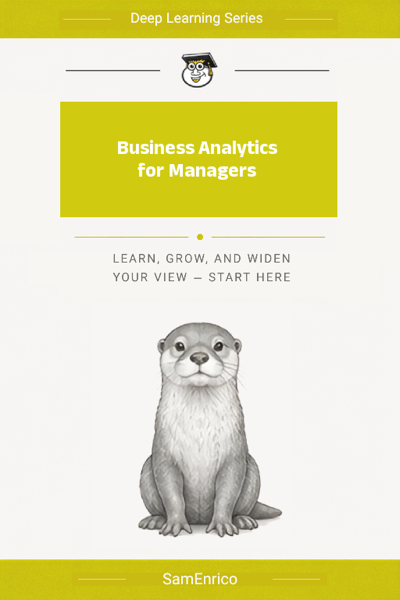
Business Analytics for Managers eBook
A Coursebook on Business Analytics for Managers
by Lai Velva
A Coursebook on Business Analytics for Managers
Formats
Free sample
Chapter 1: The Numbers Trap...--–- The conference room smelled of stale coffee and desperation. Sarah, the regional sales director for a mid-sized consumer goods company, had just received what her team considered a masterpiece of reporting: a seventeen-page dashboard printed in color, bound neatly, with every number perfectly aligned. Revenue was down 5% in the Northeast region. The dashboard showed her exactly that. It showed her the percentage drop by week, by product category, by sales representative, and by customer segment.
It was accurate. It was comprehensive. It was completely useless.Sarah stared at the report and asked the question that would become the thesis of this book: “I know sales are down. But why? And what do I do about it?”No one in the room could answer.
The data team had done their job perfectly—they had extracted, transformed, and loaded every available transaction. They had built beautiful bar charts and line graphs. They had delivered exactly what was asked for: a report. But a report is not a decision. A report is not insight.
A report is, at best, the raw material for thinking, and at worst, a sophisticated excuse for avoiding action.This chapter dismantles the single most expensive mistake managers make in analytics: confusing data with intelligence. You will learn why most analytics spending fails to improve decisions, how to distinguish genuine Business Analytics from Business Intelligence, and why the holistic model of analytics—integrating IT, strategy, processes, and people—is the only path out of the Numbers Trap.The Great Confusion: BI vs. BAEvery manager has heard the terms Business Intelligence and Business Analytics. Most use them interchangeably. This is a mistake that costs millions.Business Intelligence is the practice of collecting, storing, and reporting historical data.
When your dashboard shows last quarter’s sales by region, that is BI. When your finance team produces a monthly profit and loss statement, that is BI. When a report answers the question “What happened?”—that is BI. It is valuable. It is necessary.
It is not enough.Business Analytics, as defined throughout this book, goes further. BA answers the questions: “Why did it happen? What will happen? And how can we make it happen?” Where BI looks backward, BA looks forward. Where BI describes, BA prescribes.
Where BI tells you that you have a problem, BA tells you how to solve it.The Radio Station That Learned to Listen Consider the case of a commercial radio station that appeared in the research of Laursen and Thorlund, two of the leading thinkers in applied business analytics. The station had, for years, produced a standard BI report for its advertisers: total listeners, average listening time, peak hours, demographic breakdowns by age and gender. The report was accurate. It was comprehensive. And advertisers were fleeing.Why?
Because the report answered no strategic question. An advertiser did not care about “average listening time” in the abstract. They cared about whether their specific commercial reached the right people at the right time. They cared about whether listeners actually remembered the commercial. They cared about whether the commercial drove store visits or website clicks.The station transformed its approach.
Instead of simply reporting historical listenership, it began analyzing patterns: Which segments of a commercial drove drop-off? Which times of day produced the highest conversion for different products? Which listener behaviors predicted a purchase? The station moved from BI (reporting what happened) to BA (analyzing why and what would happen next). Advertisers returned.
Revenue increased. The data became a strategic asset rather than a compliance document.This is the difference between being data-rich and insight-poor. Most organizations are drowning in the former and starving for the latter.The Four Components of the Holistic BA Model Here is the central framework of this chapter, and indeed a pillar of this entire book: Business Analytics does not live in your software. It does not live in your data warehouse. It does not live in your team of data scientists.
Analytics succeeds only when four domains work together seamlessly.Component 1: IT (Data Infrastructure)You cannot do analytics without data, and you cannot trust data without infrastructure. This means databases, data warehouses, ETL processes (covered in detail in Chapter 5), and the systems that capture transactions in the first place—your CRM, your ERP, your point-of-sale terminals. The IT component answers the question: “Do we have the raw material?” Without reliable infrastructure, everything else collapses. But infrastructure alone is a very expensive way to produce nothing.Component 2: Strategy (Business Goals)The most common failure in analytics is building something that answers no real business question. IT teams, left to their own devices, will build technically perfect systems that executives ignore.
Data scientists, without strategic direction, will build statistically elegant models that no one uses. Strategy provides the guardrails. It answers the question: “What are we trying to achieve?” Before any analytics project, you must be able to state the business goal in plain language: increase retention, reduce cost per acquisition, optimize inventory turns. If you cannot state the goal without using the word “data,” you are not ready to start.Component 3: Processes (Workflow Integration)An insight that does not change a process is worthless. Consider a predictive model that identifies which customers are likely to churn with 90% accuracy.
If your sales team has no workflow for reaching out to those customers—no automated alert, no standardized script, no way to track intervention success—then the model produces nothing but academic satisfaction. Processes are the bridge between insight and action. They answer the question: “When we learn something, what changes?”Component 4: People (Decision-Makers and Analysts)Analytics does not happen in a vacuum. It requires analysts who understand both statistics and business (a rare combination, as we will explore in Chapter 10). It requires managers who know how to ask questions, not just request reports.
And it requires a culture that values curiosity over compliance. The people component answers the question: “Who is responsible for turning data into decisions?” If that responsibility is diffuse or absent, no amount of technology will save you.The Diagnostic Tool: Rate Your Organization Before you read another chapter, pause. Using the four components above, rate your organization on a scale of 1 (critical weakness) to 5 (world-class strength) for each:Component Your Rating (1-5)IT / Data Infrastructure Strategy / Business Goals Processes / Workflow Integration People / Decision-Makers & Analysts Be honest. Most managers rate their IT component highly (they have data) and their process component poorly (they do nothing with it). The goal of this book is not to achieve all fives.
The goal is to identify your weakest link and strengthen it first.Actionable Intelligence: A Three-Level Framework Earlier, I promised to resolve a confusion that plagues the analytics industry: what does “actionable” actually mean?Throughout this book, actionable intelligence means insight that directly informs a decision. But not all actionable intelligence is created equal. There are three levels, each more valuable and more difficult than the last.Level 1: Diagnostic Actionability (The Minimum)Diagnostic analytics answers the question: “Why did this happen?” When Sarah, our sales director from the opening vignette, learns that the Northeast region’s sales dropped because a competitor launched a price promotion on a comparable product, she has achieved…
This is the end of the free sample. Get the eBook to keep going. Buy now
About this book
Details
- Author
- Lai Velva
- Publisher
- SamEnrico
- Language
- English
- Genre
- Non-Fiction, Informative, Educational
- Released
- 2026-05-07
- Pages (approx.)
- 148
- Available as
- eBook, Audiobook

Read better in the ZLOADR app
Your eBooks on your phone or tablet. Sign in with your SamEnrico account and start reading.
More by Lai Velva
 The Nap Journaling MethodLai Velva$11.99
 Study Schedule PlannerLai Velva$11.99
 Zumba for Stress ReliefLai Velva$11.99
 Parent Death and AdoptionLai Velva$11.99
 The Cruise Ship EnslavementLai Velva$11.99
 Google Calendar MemoryLai Velva$11.99
 Cessation For Mental Health PatientsLai Velva$11.99
 Child Loss And AdoptionLai Velva$11.99Child Loss And AdoptionLai Velva$11.99
 Assertiveness For The BedriddenLai Velva$11.99
 Seams of Time: The Unseen Threads of Dior’s New LookLai Velva$11.99
 The Silent Rebellion: The Forgotten Uprising of the Women of HollowayLai Velva$11.99
You may also like
 Hong Kong Handover 1997Dunn Johnnie$11.99
 Zumba For Postnatal Recovery CourseNeal Christian$11.99
 Zumba for BeginnersLadner Nikia$11.99
 YouTube Comment Mining GuideHumes Pandora$12.99
 Worry Box MeditationCarlin Rudy$11.99
 Workplace Stress MeditationNguyen Lynn$11.99
 Workplace Stress and Sleep RepairHawley Ivory$11.99
 Workplace Perfectionism CureDelaney Jeffry$11.99
 Workplace Injustice Anger GuideWallen Isabelle$11.99
 Work Addiction and Burnout LinkGreenwood Ester$11.99
 Women in Yoga and WellnessBeattie Galina$11.99
 Women in Stand Up ComedyChun Evangeline$11.99