
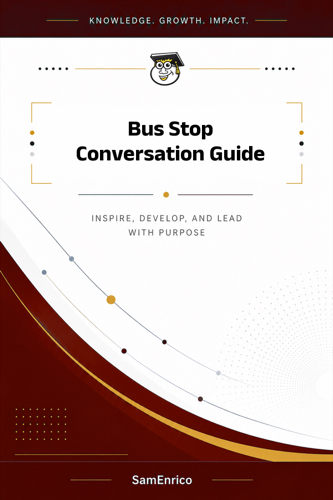
Bus Stop Conversation Guide eBook
Chats while waiting for public transit.
Chats while waiting for public transit.
Formats
Free sample
Chapter 1: The Frozen Mouth...–- You are standing at a bus stop. The sky is that particular shade of gray that suggests the weather can’t decide whether to commit to rain or just threaten it forever. Your phone is in your hand. You have already checked Instagram, refreshed your email, scrolled past three ads for things you don’t need, and opened your weather app to confirm that yes, it is still the same temperature it was thirty seconds ago. There is a person standing six feet to your left.
They have also checked their phone. You have both been standing here for four minutes. You will both be standing here for at least six more. And in all that time, neither of you will say a single word to each other.This is not a failure of manners. This is not because you are shy or awkward or fundamentally broken as a human being.
This is a learned behavior—a habit so deeply ingrained that it feels like instinct. You have been trained, by years of city living and smartphone conditioning, to treat the people around you as furniture. Not hostile furniture. Just… furniture. Background noise.
Obstacles to navigate around on your way to somewhere else.And yet.And yet, if you are honest with yourself, there is a small part of you that has wondered. What if you spoke? What if you looked up from your screen and said something—anything—to the person next to you? What would happen? Would they look at you like you had grown a second head?
Would they ignore you? Or—and this is the possibility that keeps the thought alive—would they smile?This chapter is about that small, persistent, terrifying thought. It is about why we don’t speak, why we should, and how to reframe the bus stop from a place of anxious waiting to a place of genuine possibility. We are going to talk about liminal spaces, the finite duration safety net, and the difference between trapped time and free time. We are going to talk about why your phone is not the enemy but also not your friend.
And we are going to begin the work of unfreezing your mouth—not by forcing you to become an extrovert, but by showing you that the bus stop is actually the safest place in the world to try.The Unspoken Commuter Code Every bus stop operates under an invisible set of rules. No one wrote them down. No one voted on them. And yet, everyone follows them. Sociologists call this a “folk norm”—a behavior so widely accepted that violating it feels like a violation of reality itself.Here are the rules you already know:Do not make eye contact for more than one second.
A glance is acknowledgment. A stare is aggression. Anything between one and three seconds is ambiguous and therefore dangerous.Do not speak unless absolutely necessary. Necessary means: asking if the bus has come yet, warning someone they dropped something, or responding to a direct question. Everything else is optional and therefore suspicious.Your phone is your shield.
If you are looking at your phone, you are officially “busy.” No one can fault you for not talking because you are clearly engaged in something important. It does not matter that you are looking at a picture of a cat.Stand at least one body length away from other humans. Exceptions are made only when the shelter is crowded. In those cases, you may stand closer, but you must increase your phone-shielding proportionally.When the bus arrives, board in order of arrival. Speaking during boarding is allowed only to say “after you” or to confirm the route number.
Any other words are a violation of the boarding covenant.These rules are not malicious. They evolved for good reasons. In crowded cities, privacy is scarce. The bus stop—like the subway car, the elevator, and the grocery store line—became a place where strangers agreed to pretend each other didn’t exist as a gift of mutual respect. I won’t bother you if you won’t bother me.
It is a social contract written in silence.But here is the problem. That contract was written before smartphones. It was written when “not bothering someone” meant simply standing quietly, not actively disappearing into a screen. And over the past fifteen years, something has shifted. The silence that was once a shared, almost companionable quiet has become a void.
We are not respecting each other’s privacy anymore. We are hiding from each other.Consider this. Before smartphones, if you stood at a bus stop with another person, you were at least aware of them. You might not speak, but you were present. You noticed if they were carrying something heavy.
You glanced over when a loud car passed. You existed in the same physical space. Now, you exist in parallel digital universes. You are at the bus stop, but you are also on Twitter. You are next to a human being, but you are also reading an article about cephalopod intelligence.
You are, in a very real sense, not there.And neither are they.The Liminal Space Revelation Let me introduce you to a term that will change how you see every waiting situation for the rest of your life: liminal space.In anthropology, liminal spaces are thresholds—places between one state and another. A doorway is a liminal space. A hallway is a liminal space. An airport is a liminal space. You are not yet at your destination, but you have left your origin.
You are in the in-between.The bus stop is a quintessential liminal space. You are no longer at home or work or wherever you were. You are not yet on the bus, let alone at your destination. You are in a brief, floating pocket of time where your usual identities are paused. The version of you that exists at your office desk—the competent professional, the stressed employee, the person who knows exactly what they are doing—is not fully activated.
The version of you that exists at home—the parent, the partner, the person who can finally exhale—is not yet online. You are, for these few minutes, nobody in particular. And that is strangely freeing.Here is why liminal spaces matter for conversation. In most social situations, the stakes feel high. If you speak to a coworker in the break room, you are still a coworker.
There are hierarchies, histories, expectations. If you speak to someone at a party, you are at a party—an event designed for social evaluation. If you speak to someone on a date, God help you, everything matters.But at a bus stop, you are neither here nor there. You are a ghost. A temporary human.
A person who will disappear in seven minutes. And the person next to you is equally ghostly. Neither of you has any power over the other. Neither of you will remember a slightly awkward sentence by tomorrow morning. The usual social consequences do not apply.That is the first great secret of the bus stop: it is the lowest-stakes…
This is the end of the free sample. Get the eBook to keep going. Buy now
About this book
Details
- Author
- Guillory Rhett
- Publisher
- SamEnrico
- Language
- English
- Genre
- Non-Fiction, Self-Help, Commuting
- Released
- 2026-06-07
- Pages (approx.)
- 131
- Available as
- eBook, Audiobook

Read better in the ZLOADR app
Your eBooks on your phone or tablet. Sign in with your SamEnrico account and start reading.
More by Guillory Rhett
 Zookeeper Emergency Stress GuideGuillory Rhett$11.99
 Restroom Social AnxietyGuillory Rhett$11.99
 Selling Your Home in RetirementGuillory Rhett$11.99
 The First Car GenerationGuillory Rhett$11.99
 Listening Skills for LibrariansGuillory Rhett$11.99
 Remote Work Focus Music GuideGuillory Rhett$11.99
 Personal Branding for Real EstateGuillory Rhett$11.99
 The Phantom of the Met: The Great Imposter Who Stole a LifeGuillory Rhett$11.99
 Quetzalcoatl's Celestial Spire: The Feathered Serpent's SkybridgeGuillory Rhett$11.99
 How to Produce Lighter FluidGuillory Rhett$11.99
 How to Produce Waste Container WheelsGuillory Rhett$11.99
 A Collector's Handbook to the Mercedes-benz 300sel 3.5Guillory Rhett$11.99
You may also like
 Hong Kong Handover 1997Dunn Johnnie$11.99
 Zumba For Postnatal Recovery CourseNeal Christian$11.99
 Zumba for BeginnersLadner Nikia$11.99
 YouTube Comment Mining GuideHumes Pandora$12.99
 Worry Box MeditationCarlin Rudy$11.99
 Workplace Stress MeditationNguyen Lynn$11.99
 Workplace Stress and Sleep RepairHawley Ivory$11.99
 Workplace Perfectionism CureDelaney Jeffry$11.99
 Workplace Injustice Anger GuideWallen Isabelle$11.99
 Work Addiction and Burnout LinkGreenwood Ester$11.99
 Women in Yoga and WellnessBeattie Galina$11.99
 Women in Stand Up ComedyChun Evangeline$11.99