
Non-FictionSelf-HelpPeer Support
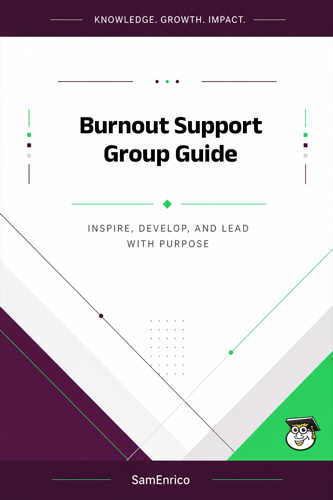
Burnout Support Group Guide eBook
Find or start a peer group for mutual support, val
Find or start a peer group for mutual support, validation, and shared coping strategies.
Formats
Free sample
Chapter 1: The Loneliness Trap--–- You bought the weighted blanket. You downloaded the meditation app. You took the weekend off, turned off notifications, and even tried that expensive adaptogen powder your coworker swore by. And yet, here you are: still exhausted, still numb, still wondering why everyone else seems to be coping while you are barely holding on.If this feels familiar, you are not broken. You are not weak.
And you are not alone in the way you think you are. But you are trapped in something far more insidious than a lack of sleep or an overloaded calendar. You are trapped in the Loneliness Trap—the cultural lie that burnout is an individual problem requiring an individual solution.This chapter will dismantle that lie. It will show you why traditional self-care fails when you are isolated, why venting to loved ones often makes things worse, and how a structured peer group offers something no bubble bath ever could: social efficacy, the rewiring of your brain's belief in your own ability to recover. By the time you finish this chapter, you will understand that isolation is not merely a symptom of burnout.
It is the primary engine that keeps it running.The Myth of the Bubble Bath Solution Let us name the elephant in the room immediately. Everywhere you look—social media, wellness blogs, workplace memos, even well-meaning friends—the message is the same. Burnout is portrayed as a self-care deficit. The solution, therefore, is more self-care. Take a bath.
Light a candle. Go for a walk. Say no to one meeting. Get a massage. Try yoga.
Drink more water.None of these things are bad. But they are catastrophically incomplete.The problem is not that self-care lacks value. The problem is that self-care assumes the burned-out person has sufficient internal resources to regulate their own nervous system back to baseline. And here is the brutal truth that the wellness industry will never tell you: human beings did not evolve to regulate alone. We evolved in tribes, villages, and extended family units where emotional regulation was a shared activity.
When you were frightened, someone held you. When you were exhausted, someone fed you. When you doubted yourself, someone reminded you of your worth.That is not dependency. That is biology.Research in social neuroscience has demonstrated repeatedly that the human brain is wired for co-regulation. Your vagus nerve—the primary pathway of the parasympathetic nervous system—responds more robustly to the sound of a calm voice than to any solitary breathing exercise.
Your oxytocin system, which buffers against stress hormones, activates most strongly during mutual eye contact and shared laughter. In other words, your body is literally designed to heal in the presence of others.So when you isolate yourself to "recharge," you are not solving the problem. You are starving your nervous system of the very input it needs to reset. The weighted blanket cannot look you in the eye and say, "I see you, and you are not crazy." The meditation app cannot reflect back your own humanity in a way that makes you feel less alone. Only another person can do that.This is why so many burned-out people report feeling worse after a weekend of "rest." They slept in, they stayed home, they avoided people—and they emerged on Monday morning feeling not restored, but hollow.
They mistook solitude for recovery. And the culture of individualistic self-care applauded them for it.The Toxic Venting Trap: Why Your Friends Are Making It Worse Perhaps you have tried the other common solution: reaching out. You call a friend, a partner, or a family member. You spill the truth about how exhausted and hopeless you feel. And then something unexpected happens.
Instead of relief, you feel worse.This is not because your loved ones are bad people. It is because untrained supporters almost always fall into one of three toxic venting traps, none of which actually heal burnout.Trap One: Unsolicited Advice. You say, "I am so tired I cannot think straight." They say, "Have you tried going to bed earlier?" You say, "My boss keeps dumping extra work on me." They say, "You should set firmer boundaries." The advice might even be correct. But it lands as criticism because it implies that you simply have not tried hard enough. The implicit message is: your suffering is your fault.Trap Two: Toxic Positivity.
You say, "I feel completely hopeless about my job." They say, "Just think positive! It could be worse! At least you have a job!" This response invalidates your pain by rushing past it. It tells you that your negative emotions are unwelcome, unhelpful, or even ungrateful. Over time, toxic positivity teaches you to hide your real feelings, which deepens isolation.Trap Three: Competitive Suffering.
You say, "I am so burned out I can barely get out of bed." They say, "You think you are tired? I worked sixty hours this week and I am still standing." This response turns pain into a competition. It leaves you feeling guilty for struggling, as if your suffering is not legitimate enough to warrant support.Each of these traps shares a common flaw: they center the responder, not you. The advice-giver gets to feel smart. The positivity-bringer gets to feel helpful.
The competitive sufferer gets to feel resilient. Meanwhile, you walk away feeling more alone than before—because you just shared your deepest exhaustion and received nothing that made you feel truly seen.This is not a failure of friendship. It is a limitation of untrained support. Your friends love you. But they do not know how to sit with your pain without trying to fix it, minimize it, or compare it to their own.
And that is not their fault. No one taught them. Just as no one taught you.Validated Support: The Third Option There is a third way, distinct from both solitary self-care and informal venting. It is called validated support, and it is the core mechanism of every effective peer support group.Validated support has three components, which will be explored in depth in Chapter 2. For now, understand it as the active, verbal practice of reflecting another person's emotional experience back to them without judgment, advice, or comparison.
When someone offers you validated support, they do not say, "Here is what you should do." They say, "What I hear you saying is that you feel exhausted and unseen. Is that right?" They do not say, "Look on the bright side." They say, "That sounds incredibly hard. Tell me more about what that is like for you."The difference is not subtle. Advice distances. Validation connects.
Advice implies inadequacy. Validation implies acceptance. Advice asks you to change. Validation asks you to be known.Decades of research on peer support groups—from Alcoholics Anonymous to postpartum support circles to cancer survivor groups—have demonstrated that validation is not merely nice to have. It is the active ingredient of healing.
When a person feels truly heard and validated, their cortisol levels drop, their heart rate variability improves, and their brain's default mode network (the region associated with rumination and self-criticism) quiets. You do not just feel better. Your…
This is the end of the free sample. Get the eBook to keep going. Buy now
About this book
Details
- Author
- Harding Mickey
- Publisher
- SamEnrico
- Language
- English
- Genre
- Non-Fiction, Self-Help, Peer Support
- Released
- 2026-06-07
- Pages (approx.)
- 133
- Available as
- eBook, Audiobook

Read better in the ZLOADR app
Your eBooks on your phone or tablet. Sign in with your SamEnrico account and start reading.
More by Harding Mickey
 Sleep Meditation for AutismHarding Mickey$11.99
 Francis of Assisi Order FoundationHarding Mickey$11.99
 Keto Coffee Bulletproof GuideHarding Mickey$11.99
 The Beethoven Deaf ComposerHarding Mickey$11.99
 The Phantom of the Royal Road: Europe's Last Stagecoach BanditsHarding Mickey$11.99
 Agile vs Waterfall StartupsHarding Mickey$12.99
 Faceless YouTube Script WritingHarding Mickey$12.99
 Tax SpecialistHarding Mickey$11.99
 Learn to Play the Toba, TowlaHarding Mickey$11.99
 How to Become a Line InspectorHarding Mickey$11.99
You may also like
 Hong Kong Handover 1997Dunn Johnnie$11.99
 Zumba For Postnatal Recovery CourseNeal Christian$11.99
 Zumba for BeginnersLadner Nikia$11.99
 YouTube Comment Mining GuideHumes Pandora$12.99
 Worry Box MeditationCarlin Rudy$11.99
 Workplace Stress MeditationNguyen Lynn$11.99
 Workplace Stress and Sleep RepairHawley Ivory$11.99
 Workplace Perfectionism CureDelaney Jeffry$11.99
 Workplace Injustice Anger GuideWallen Isabelle$11.99
 Work Addiction and Burnout LinkGreenwood Ester$11.99
 Women in Yoga and WellnessBeattie Galina$11.99
 Women in Stand Up ComedyChun Evangeline$11.99