
Non-FictionBusiness BriefTax Optimization
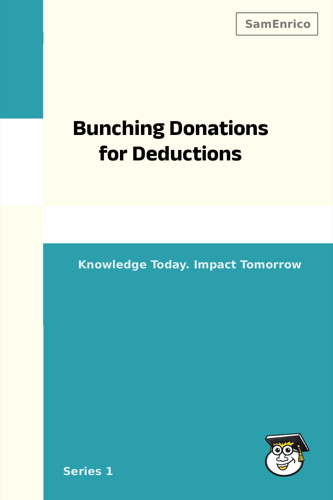
Bunching Donations for Deductions eBook
Combine multiple years of giving into one tax year
Combine multiple years of giving into one tax year to exceed standard deduction thresholds.
Formats
Free sample
Chapter 1: The $10,000 Habit--–- Margaret and David sat across from their CPA, coffee growing cold, as they watched their carefully organized tax folder get pushed aside. “You’re taking the standard deduction again this year,” the CPA said without looking up. “Your charitable gifts? They’re giving you zero tax benefit.” Margaret’s hand paused mid-reach for her water glass. They had given $8,200 to their church, their local food bank, and an animal rescue that year.
Every check had been written with intention, with generosity, with the quiet assumption that they were doing the right thing for both their community and their tax bill. They were wrong.That moment—the moment a well-meaning donor realizes their annual giving has been providing zero tax benefit for years—is the single most expensive and least-discussed failure in personal finance. Margaret and David are not outliers. They are the majority. According to IRS data from 2022, over 85% of taxpayers take the standard deduction.
For those taxpayers, every dollar given to charity provides exactly $0 of tax benefit. Not a partial benefit. Not a reduced benefit. Zero.If you have been writing annual checks to your church, alma mater, or favorite nonprofit under the assumption that you are “writing it off,” this chapter will be an uncomfortable but necessary reckoning. The good news is that the problem is fixable.
The bad news is that most donors will never know it exists until they have already lost thousands of dollars in potential savings.This chapter introduces the concept of Negative Giving Power—the silent wealth destroyer hiding inside your charitable habits. You will learn why the 2017 Tax Cuts and Jobs Act fundamentally broke the old model of annual giving, how the coming 2026 tax changes will make the problem worse, and why a simple shift in timing can turn your generosity from a tax waste into a wealth-building machine. By the end of this chapter, you will never write another annual check without first asking: “Is this the year I bunch?”The Myth of the Charitable Deduction The average American believes that if they give money to charity, they get a tax deduction. This belief is not entirely false, but it is dangerously incomplete. The charitable deduction is not a universal benefit.
It is a conditional benefit available only to taxpayers who itemize their deductions—and most taxpayers do not itemize.Let us be precise. When you give $1,000 to a qualified charity, you are eligible to deduct that $1,000 from your taxable income. But eligibility is not the same as realization. You only realize the benefit if your total itemized deductions exceed the standard deduction. The standard deduction is the government’s default offer: a flat amount you can subtract from your income without providing any receipts or documentation.
For 2024, the standard deduction is $14,600 for single filers and $29,200 for married couples filing jointly. For 2026, it is estimated to rise to approximately $16,100 and $32,200 respectively, subject to final inflation adjustments.Think of the standard deduction as a high wall. On one side, itemized deductions. On the other side, the standard deduction. You cannot take both.
You must choose whichever is higher. For the vast majority of taxpayers, the standard deduction is higher than the sum of all their itemizable expenses—mortgage interest, state and local taxes (capped at $10,000), medical expenses above 7.5% of AGI, and charitable gifts.Here is the brutal arithmetic: If your standard deduction is $32,200 and your other itemized deductions (mortgage interest, SALT, medical) total $12,000, you need at least $20,200 in charitable gifts before the first dollar of giving provides any tax benefit. Give $19,999? Zero benefit. Give $20,200?
You finally clear the wall, and now every dollar above that threshold reduces your taxable income.Most donors never clear that wall. They give $2,000, $5,000, even $10,000 annually—and receive nothing in return from the IRS. Their generosity is real. Their tax savings are imaginary.Negative Giving Power: The Definition Negative Giving Power is the gap between what you give to charity and what the charity actually receives after accounting for the lost tax benefit you could have captured but did not. More bluntly: It is the money you leave on the table by giving inefficiently.Consider Margaret and David again.
They earn $180,000 jointly, putting them in the 22% tax bracket. They give $8,200 annually to charity. Because they take the standard deduction, they receive zero tax benefit. Their after-tax cost of giving is the full $8,200. The charity receives $8,200.
The government takes nothing from the transaction—but also gives nothing back. In economic terms, Margaret and David have spent $1.00 to deliver $1.00 to charity. That sounds fine until you realize they could have spent $0.78 to deliver $1.00.Now imagine they had bunched three years of giving into one. Instead of giving $8,200 each year, they give $24,600 in Year 1 and nothing in Years 2 and 3. In Year 1, their itemized deductions exceed the standard deduction.
The $24,600 donation reduces their taxable income by the full amount. At a 22% marginal rate, their tax savings are approximately $5,412. Their after-tax cost of giving $24,600 is $19,188. Over three years, they have delivered $24,600 to charity at an after-tax cost of $19,188. Their effective cost per dollar given: $0.78.That $0.22 difference per dollar is the Negative Giving Power they were previously losing.
Over a decade of giving, a couple like Margaret and David loses over $18,000 in potential tax savings. Over a lifetime of giving, the losses can easily exceed $100,000.Let us put this in starker terms. If you are a 22% bracket taxpayer giving $10,000 annually for 30 years without bunching, your total after-tax cost is $300,000. The charities receive $300,000. If you bunch properly, your after-tax cost drops to approximately $234,000.
You save $66,000. That is a fully funded retirement account. That is a child’s college tuition. That is a year of long-term care. And it requires no additional giving—only smarter timing.The 2017 Tax Cuts and Jobs Act: Before and After To understand why bunching has become essential rather than optional, you need to understand the single most disruptive tax change of the past generation: the Tax Cuts and Jobs Act of 2017 (TCJA).Before the TCJA, the standard deduction was roughly half of what it is today.
In 2017, the last year before the law took effect, the standard deduction for married couples was $12,700. That same year, approximately 31% of taxpayers itemized. Charitable giving was a routine part of itemized returns because the threshold was low enough that many middle-class families could clear it with a modest mortgage and a few thousand dollars in charitable gifts.The TCJA nearly doubled the standard deduction. By 2018, the standard deduction for married couples jumped to $24,000. Overnight, millions of taxpayers who had itemized for decades found themselves on the standard deduction side of the wall.
Itemization rates collapsed from 31% to approximately 11%. For the first time in modern tax history, the vast majority of charitable gifts provided zero tax benefit.The architects of the TCJA understood this consequence. They calculated that the increased standard deduction would simplify tax filing for most Americans—and it did. But simplification came at a cost. The cost was the near-erasure of the charitable deduction as a middle-class tax benefit.
Today, the charitable deduction is effectively a subsidy for the wealthy who itemize and for strategic donors who bunch. Everyone else is giving at a 100% after-tax cost.Some tax policy…
This is the end of the free sample. Get the eBook to keep going. Buy now
About this book
Details
- Author
- Oconner Mariana
- Publisher
- SamEnrico
- Language
- English
- Genre
- Non-Fiction, Business Brief, Tax Optimization
- Released
- 2026-06-11
- Pages (approx.)
- 143
- Available as
- eBook, Audiobook

Read better in the ZLOADR app
Your eBooks on your phone or tablet. Sign in with your SamEnrico account and start reading.
More by Oconner Mariana
 Referral Request PsychologyOconner Mariana$11.99
 Gacy Detective Joseph KozenczakOconner Mariana$11.99
 Ramirez Drug Use EscalationOconner Mariana$11.99
 Word of Mouth Buying InfluenceOconner Mariana$11.99
 Quit Smoking Apps GuideOconner Mariana$11.99
 Gambling Cravings Emergency KitOconner Mariana$11.99
 Vitamin B12 Deficiency GuideOconner Mariana$11.99
 The Harp of Dagda: How a God's Music Shaped the Celtic CosmosOconner Mariana$11.99
 The Calculators of Timbuktu: The Mathematicians Who Charted the CosmosOconner Mariana$11.99
 Ransomware RaaS Groups GuideOconner Mariana$12.99
 Factoring Contract Renewal HandbookOconner Mariana$12.99
 How to Produce Ghillie SuitsOconner Mariana$11.99
You may also like
 Hong Kong Handover 1997Dunn Johnnie$11.99
 Zumba For Postnatal Recovery CourseNeal Christian$11.99
 Zumba for BeginnersLadner Nikia$11.99
 YouTube Comment Mining GuideHumes Pandora$12.99
 Worry Box MeditationCarlin Rudy$11.99
 Workplace Stress MeditationNguyen Lynn$11.99
 Workplace Stress and Sleep RepairHawley Ivory$11.99
 Workplace Perfectionism CureDelaney Jeffry$11.99
 Workplace Injustice Anger GuideWallen Isabelle$11.99
 Work Addiction and Burnout LinkGreenwood Ester$11.99
 Women in Yoga and WellnessBeattie Galina$11.99
 Women in Stand Up ComedyChun Evangeline$11.99