
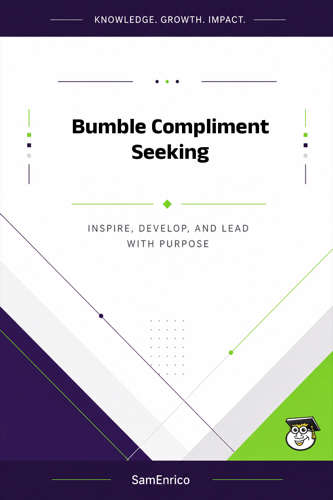
Non-FictionSelf-HelpDating Validation
Bumble Compliment Seeking eBook
Reduces validation seeking through matches.
Reduces validation seeking through matches.
Formats
Free sample
Chapter 1: Empty Calories of Ego--Every time you send a Bumble Compliment, you are not just typing 150 characters into a box. You are placing a small bet on your own self-worth. And if you are like most users, you have been losing that bet for months without even realizing there was a wager.Let me describe a scene that will feel uncomfortably familiar. It is Tuesday evening. You have just finished work, eaten dinner, and settled onto the couch.
You open Bumble. You scroll through a few profiles, barely registering faces, because your thumb has done this motion ten thousand times before. Then you see someone. They are attractive. Their profile has a prompt that makes you exhale through your nose—not quite a laugh, but something.
You decide to send a Compliment. You spend twelve minutes drafting it. Delete. Rewrite. Delete again.
Finally, you send it. A tiny animation plays. The Compliment is gone, launched into the algorithmic void.Then you wait.You check the app three minutes later. Nothing. You check again at the next commercial break.
Nothing. You check before brushing your teeth. Nothing. You check one last time before sleep, phone screen glowing in the dark, and still nothing. You feel a small, specific ache.
Not heartbreak. Not loneliness. Something more mundane and more insidious: the feeling of being unseen by someone who does not owe you their attention.You fall asleep wondering if you used the wrong word. If you should have complimented their dog instead of their hiking photo. If you are simply not the kind of person who gets replies.This is not about romance.
This is not about connection. This is about dopamine, and you have been addicted to it since the first time a stranger validated your existence with a right swipe.Welcome to the first chapter of your recovery.The Question Nobody Asks Let us start with a brutal question that most dating advice books avoid because the answer is too uncomfortable: why do you actually want a match?Not the polite, socially acceptable answer. Not “I want to find a partner” or “I am looking for my person.” Those may be true in the abstract, but they are not what drives your behavior at 11:47 on a Tuesday night when you refresh Bumble for the fifteenth time. What drives that behavior is something else entirely.You want proof that you are desirable.You want evidence that you exist in the eyes of others. You want the small, sharp thrill of a notification that says someone chose you.
Not because of your personality, which they have not yet experienced. Not because of your conversation, which has not yet happened. But because of a photograph and a hundred and fifty characters—because of a fragment of you that you carefully curated to be as broadly appealing as possible.This is what psychologists call contingent self-worth. It is the dangerous habit of basing your sense of value on external outcomes that you cannot control. And dating apps have turned contingent self-worth into a business model.The truth that no dating app wants you to realize is this: the match is not the beginning of a relationship.
The match is the end of a transaction. You traded a small piece of your emotional stability for a notification, and you lost.The Neuroscience of the Refresh To understand why a simple match notification can feel so powerful—and so devastating when it does not arrive—we need to look inside your brain. Specifically, we need to look at a neurotransmitter called dopamine.Dopamine has been widely misunderstood in popular culture. Most people think dopamine is the chemical of pleasure. You eat chocolate, dopamine spikes.
You have sex, dopamine spikes. You win a prize, dopamine spikes. This is not incorrect, but it is incomplete. The more accurate understanding, based on decades of neuroscientific research, is that dopamine is the chemical of anticipation.Dopamine is released not when you receive a reward, but when you expect a reward that might arrive at any moment. This distinction is crucial.
The slot machine does not make your heart race when you win. Your heart races when the wheels are spinning and you do not yet know the outcome. That uncertainty, combined with the possibility of reward, is the most powerful dopamine trigger known to behavioral science.Bumble is a slot machine.Every time you send a Compliment, you pull the lever. The wheels start spinning. You do not know if you will win (a match, a reply, a conversation) or lose (silence, indifference, the slow erosion of hope).
That period of not-knowing is where dopamine floods your system. And because the rewards are unpredictable—sometimes you get a match instantly, sometimes after days, sometimes never—the app creates what behaviorists call variable-ratio reinforcement.This is the same mechanism that makes gambling addictive. A predictable reward (you get a match every single time you send a Compliment) would actually be less compelling because your brain would adapt. But an unpredictable reward? Your brain cannot adapt to uncertainty.
It keeps chasing. It keeps checking. It keeps hoping that the next spin, the next swipe, the next Compliment will be the one that pays off.The problem is not that you lack willpower. The problem is that you are fighting against millions of years of neural evolution inside an environment designed by engineers who know exactly how to exploit it.Empty Calories of Ego Let me introduce a concept that will appear throughout this book: Empty Calories of Ego.Think about the last time you ate a meal that was nutritionally worthless. Perhaps a bag of cheap chips or a sugary soda.
For a moment, you felt full. Your hunger quieted. But within an hour, you were hungry again—hungrier, even, because your body had received energy without any of the vitamins, protein, or fiber it actually needed. You consumed calories, but you did not consume nourishment.A match is exactly the same.When you receive a match notification, you feel a spike of validation. For a moment, you feel chosen, attractive, interesting, worthy.
This is the calorie—the brief energy. But a match contains no relational nourishment. It tells you nothing about whether you and this person would enjoy a conversation, let alone a relationship. It gives you no information about their values, their humor, their kindness, or their capacity for intimacy. It is pure, empty ego-calories.And like junk food, the empty calories of ego leave you hungrier than before.This is why you can accumulate fifty matches and still feel profoundly lonely.
This is why you can have a full Beeline and still feel anxious about your desirability. You have been consuming empty calories, mistaking them for a meal, and wondering why you remain emotionally malnourished.The research backs this up. A 2020 study published in the journal Computers in Human Behavior found that higher levels of dating app use were correlated with lower self-esteem and higher rates of social comparison, particularly among users who reported high levels of “validation seeking” as a motivation for using the apps. In other words, the people who most needed external approval were the ones…
This is the end of the free sample. Get the eBook to keep going. Buy now
About this book
Details
- Author
- Higgins Shelley
- Publisher
- SamEnrico
- Language
- English
- Genre
- Non-Fiction, Self-Help, Dating Validation
- Released
- 2026-06-06
- Pages (approx.)
- 144
- Available as
- eBook, Audiobook

Read better in the ZLOADR app
Your eBooks on your phone or tablet. Sign in with your SamEnrico account and start reading.
More by Higgins Shelley
 Visual Distraction Decluttering GuideHiggins Shelley$11.99
 Senior Video Chat Self EsteemHiggins Shelley$11.99
 Self Hypnosis for EnduranceHiggins Shelley$11.99
 The Fractal Fire: How Black Mathematicians Decoded Nature's ChaosHiggins Shelley$11.99
 Sales RepresentativeHiggins Shelley$11.99
 How to Produce Advertising and Marketing ServicesHiggins Shelley$11.99
 Remote Employee Engagement Survey HandbookHiggins Shelley$12.99
 How to Start a Hobby in Art collectingHiggins Shelley$11.99
You may also like
 Hong Kong Handover 1997Dunn Johnnie$11.99
 Zumba For Postnatal Recovery CourseNeal Christian$11.99
 Zumba for BeginnersLadner Nikia$11.99
 YouTube Comment Mining GuideHumes Pandora$12.99
 Worry Box MeditationCarlin Rudy$11.99
 Workplace Stress MeditationNguyen Lynn$11.99
 Workplace Stress and Sleep RepairHawley Ivory$11.99
 Workplace Perfectionism CureDelaney Jeffry$11.99
 Workplace Injustice Anger GuideWallen Isabelle$11.99
 Work Addiction and Burnout LinkGreenwood Ester$11.99
 Women in Yoga and WellnessBeattie Galina$11.99
 Women in Stand Up ComedyChun Evangeline$11.99