
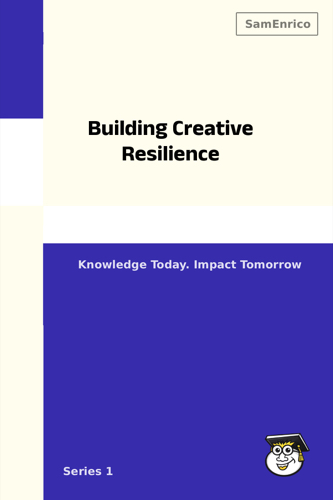
Non-FictionSelf-HelpResilience
Building Creative Resilience eBook
Bounces back from creative rejection.
Bounces back from creative rejection.
Formats
Free sample
Chapter 1: The Ten Thousand No’s--–- Let me tell you something most creative success books won’t: the average artist, writer, musician, or entrepreneur who eventually achieves a sustainable career does not receive one hundred rejections before their first breakthrough. They do not receive five hundred. According to a meta-analysis of creative career trajectories published in the Journal of Creative Behavior and adapted through Angela Duckworth’s grit research, the number hovers closer to ten thousand. Ten thousand “no’s.” Ten thousand closed doors. Ten thousand moments when someone in a position of authority looked at your work and said, “Not this time,” or “Not quite right,” or—most devastating of all—said nothing at all.Ten thousand.Let that number sit on your chest for a moment.
If you have ever received a single rejection that made you want to quit—one brutal email, one silence after a submission, one friend who said “maybe this isn’t your thing”—then ten thousand sounds less like a statistic and more like a death sentence. And yet, here is the paradox that this entire book is built upon: the people who do make it through those ten thousand no’s are not necessarily the most talented, the most connected, or even the hardest working. They are the ones who understood, consciously or unconsciously, that rejection is not the opposite of success. Rejection is the engine of it.This chapter dismantles the most dangerous myth in creative culture: the myth of the overnight success, the myth that rejection equals failure, and the myth that somewhere out there is an artist who never got told “no.” We will look at the actual data on persistence, walk through case studies of creators who collected rejections like badges of honor, and introduce the first of twelve tools you will use to build your creative resilience: the Rejection Résumé. But before we do any of that, we need to talk about why this myth has such a grip on you in the first place.The Lie They Sold You You have been told, probably since childhood, that talent rises to the top.
That good work gets recognized. That if you just keep improving, the right door will open. These statements are not entirely false, but they are dangerously incomplete. What they omit is the sheer volume of rejection that exists between “I have talent” and “someone said yes.” They omit the fact that for every J.K. Rowling who was rejected by twelve publishers, there are thousands of equally talented writers who were rejected by twelve publishers and then quit.
The difference was not talent. The difference was that Rowling had a number thirteen.Consider the data. Duckworth’s research on grit—defined as passion and perseverance for long-term goals—found that grit is a better predictor of success than IQ, talent, or socioeconomic status in domains ranging from the National Spelling Bee to West Point military academy to the Chicago Public Schools. In creative fields specifically, a longitudinal study of art school graduates found that the single strongest predictor of who would still be making art ten years after graduation was not their technical skill at graduation, not their grades, not their connections. It was their score on a grit assessment.
In other words, the artists who kept going when the rejections piled up were the ones who kept going.But here is where the myth gets cruel. We are shown highlight reels of successful creators—the Oscar speech, the book launch party, the gallery opening—and we are never shown the ten thousand no’s. We see Beyoncé on stage but not the record executives who told her Destiny’s Child was “too urban” for mainstream radio. We see Stephen King’s seventy million books sold but not the thirty rejections for Carrie, which he threw in the trash and his wife had to fish out. We see Emily Dickinson now revered as one of America’s greatest poets, but we do not see that she published only a handful of poems in her lifetime and died believing she had failed.
The myth of the overnight success is not just a lie. It is a weapon. It makes your rejections feel like evidence of your inadequacy when in fact they are evidence that you are playing the same game everyone else played.The case studies that follow are not meant to inspire you in the way a motivational poster might. They are meant to recalibrate your expectations. If you believe that rejection is a sign you are on the wrong path, you will quit at rejection number one hundred.
If you believe that rejection is a near-universal precursor to breakthrough, you will treat it as a data point. The difference between those two beliefs is the difference between a closed door and a locked one. A closed door you can open. A locked one you walk away from.Case Study One: The Director Who Couldn’t Get Funded Martin Scorsese is now considered one of the greatest living film directors. Taxi Driver, Raging Bull, Goodfellas, The Departed—the list of masterpieces is staggering.
But before Scorsese became Scorsese, he was a film school graduate trying to get his first feature funded. His script for Mean Streets was rejected by every major studio in Hollywood. Not some. Every. One.
He was told the script was “too ethnic,” “too violent,” “too Catholic,” and “not commercial.” One executive reportedly said, “No one wants to watch a movie about small-time gangsters from Little Italy. Make a western.”Scorsese did not make a western. He scraped together money from friends, family, and a small independent producer. Mean Streets was made for five hundred thousand dollars—a shoestring budget even in 1973. When it was released, it received standing ovations at film festivals, launched the careers of Robert De Niro and Harvey Keitel, and established Scorsese as a major voice in American cinema.
The same studios that had rejected him now wanted to meet. The same executives who had called his script “not commercial” were now calling it “visionary.”The point is not that Scorsese was right and the studios were wrong—though he was. The point is that rejection number one through rejection number twenty did not mean the script was bad. They meant that the script did not fit the existing template of what a successful movie looked like. Scorsese was not trying to fit an existing template.
He was trying to create a new one. And new templates, by definition, get rejected until they don’t.This is a crucial distinction that will echo throughout this book: there is a difference between a rejection that says “this needs work” and a rejection that says “this does not fit our current category.” The first is feedback. The second is a mismatch. Most of the rejections you will receive—especially early in your career—are the second kind. You are not being told you are bad.
You are being told you are different. And different is scary to institutions that thrive on predictability.Case Study Two: The Writer Who Almost Quit Twelve Times J.K. Rowling’s story is so famous…
This is the end of the free sample. Get the eBook to keep going. Buy now
About this book
Details
- Author
- Buckingham Shayne
- Publisher
- SamEnrico
- Language
- English
- Genre
- Non-Fiction, Self-Help, Resilience
- Released
- 2026-06-06
- Pages (approx.)
- 139
- Available as
- eBook, Audiobook

Read better in the ZLOADR app
Your eBooks on your phone or tablet. Sign in with your SamEnrico account and start reading.
More by Buckingham Shayne
 Prototype Rapid CreationBuckingham Shayne$11.99
 Law Firm Layoff GuideBuckingham Shayne$11.99
 The Crucial Conversation WorkbookBuckingham Shayne$11.99
 Customer Need Mapping PlanBuckingham Shayne$11.99
 Joy for ExtrovertsBuckingham Shayne$11.99
 Handling Q and A SessionsBuckingham Shayne$11.99
 Adoptive Parent Anger GuideBuckingham Shayne$11.99
 Blood and Shield: The Zulu Sun Rises at IsandlwanaBuckingham Shayne$11.99
 The Legend of 'El Chino' Hernández: How a Mexican Comedian Conquered Latin America's StagesBuckingham Shayne$11.99
 Armadillos: Unique Placental MammalsBuckingham Shayne$11.99
 Post Pop Up Strategy GuideBuckingham Shayne$12.99
 Free Business Phone Number WorkbookBuckingham Shayne$12.99
You may also like
 Hong Kong Handover 1997Dunn Johnnie$11.99
 Zumba For Postnatal Recovery CourseNeal Christian$11.99
 Zumba for BeginnersLadner Nikia$11.99
 YouTube Comment Mining GuideHumes Pandora$12.99
 Worry Box MeditationCarlin Rudy$11.99
 Workplace Stress MeditationNguyen Lynn$11.99
 Workplace Stress and Sleep RepairHawley Ivory$11.99
 Workplace Perfectionism CureDelaney Jeffry$11.99
 Workplace Injustice Anger GuideWallen Isabelle$11.99
 Work Addiction and Burnout LinkGreenwood Ester$11.99
 Women in Yoga and WellnessBeattie Galina$11.99
 Women in Stand Up ComedyChun Evangeline$11.99