
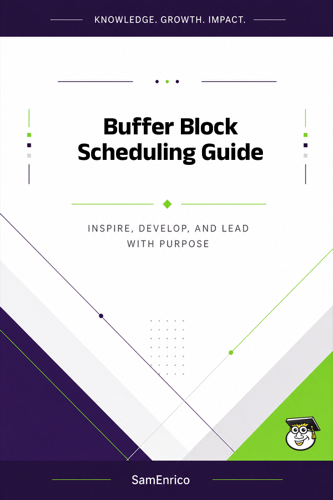
Buffer Block Scheduling Guide eBook
Leaves white space between blocks for overflow and
Leaves white space between blocks for overflow and breaks.
Formats
Free sample
Chapter 1: The Insatiable Culture--–- The first time Mia realized her schedule was broken, she was sitting in her car in the office parking garage, crying. It was 7:15 PM. She had arrived at work at 8:00 AM. In those eleven hours and fifteen minutes, she had attended seven meetings, answered eighty-three emails, completed zero of her priority projects, and eaten a granola bar over her keyboard for lunch. She had not used the bathroom between 11:00 AM and 3:00 PM.
She had not looked out a window. She had not had a single thought that was not a reaction to someone else’s demand. Her calendar had been full. Every slot occupied. Every minute accounted for.
And she had never felt more empty.Mia is not lazy. Mia is not disorganized. Mia is not bad at her job. Mia is a high-achieving professional trapped in what productivity expert Juliet Funt calls "the culture of insatiability" —the pervasive, invisible, culturally reinforced belief that busyness equals importance, that a full calendar signals value, and that any empty space on your schedule is a personal failure.This chapter explains why we have become addicted to busyness, why back-to-back scheduling fails, and what it costs us in creativity, health, and effectiveness. You will learn the hidden psychology of over-scheduling, the difference between activity and productivity, the five hidden costs of zero white space, and the first step toward reclaiming your time.
By the end of this chapter, you will understand that your schedule is not broken because you are bad at time management. It is broken because you have been playing a rigged game. And you are about to learn the rules of a better one.The False God of Busyness In her seminal book A Minute to Think, Juliet Funt describes a phenomenon that has become the background noise of modern professional life. We have learned, consciously or not, that a full calendar signals value. An empty calendar signals failure.
So we fill every slot, not because the tasks are essential, but because the fullness makes us feel needed. This is the False God of Busyness.The problem is not that busyness is always bad. The problem is that we have confused activity with productivity. Activity is doing things. Productivity is doing the right things.
A hamster on a wheel is highly active. It is running, sweating, exhausting itself. It is not productive. It is not going anywhere. It is just running.Back-to-back scheduling turns knowledge workers into hamsters.
We react. We respond. We attend meetings that could have been emails. We answer emails that could have been ignored. We say yes to requests that should have been declined.
We fill every minute with something, anything, because the alternative—empty space—feels like failure. And at the end of the day, we have nothing to show for our exhaustion except the hollow satisfaction of having been "so busy."The research is clear. Back-to-back scheduling does not increase output. It increases errors, decreases creativity, and accelerates burnout. A study cited by Funt found that the average knowledge worker loses over two hours per day to task-switching and context-shifting—the direct result of schedules with no buffer room.
That is ten hours per week. Five hundred hours per year. Twelve and a half full weeks of lost productivity.Twelve and a half weeks. That is not a rounding error. That is a stolen season.The Hidden Costs of Zero White Space When we eliminate white space from our schedules, we pay costs that are not immediately visible.
These costs compound over time, creating a debt of stress and inefficiency that eventually becomes unsustainable. They are like interest on a credit card you did not know you had. The minimum payment is exhaustion. The balance just keeps growing.Cost 1: The Transition Tax Every time you switch from one task to another, your brain pays a transition cost. It takes time to disengage from the previous activity, to reorient to the new one, and to regain focus.
Research suggests this transition takes an average of twenty-three minutes for complex tasks. Twenty-three minutes. That means when you switch from a meeting to email to a report to a phone call, you are not simply spending the time of the tasks themselves. You are paying a tax of nearly half an hour for every shift.When your schedule has no buffers, you are paying this tax constantly. You bleed minutes you never account for.
You finish the day exhausted not because you did so much, but because you switched so often. The tax is invisible, which makes it insidious. You cannot fix what you cannot see.Cost 2: The Overflow Crisis Tasks rarely take exactly as long as we predict. They take longer. Meetings run over.
Problems arise. Questions emerge. New information arrives. When your schedule has no overflow room—no white space to absorb the unexpected—every delay becomes a crisis. You are forced to choose: abandon the current task incomplete, or sacrifice the next task entirely.
Neither is a good option.Abandoning means leaving work half-done, which creates a cognitive load that follows you into the next task. Sacrificing means disappointing someone else or pushing deadlines. Either way, you lose. The problem is not that tasks run long. The problem is that you designed a schedule that cannot accommodate reality.Cost 3: The Creativity Void Creativity does not happen in the space between tasks.
It happens in the space within tasks—the moments of pause, the unexpected connections, the quiet insights that arise when the mind is not constantly reacting. Back-to-back scheduling kills creativity because it leaves no room for the mind to wander. And a mind that never wanders never discovers anything new.Every major creative breakthrough in history—every scientific discovery, every artistic innovation, every business insight—emerged from a moment of pause. Archimedes in his bath. Newton under an apple tree.
Einstein on a hill overlooking a lighthouse. These were not back-to-back moments. They were white space. By eliminating white space, you are not becoming more productive. You are starving your brain of the very conditions that produce breakthrough thinking.Cost 4: The Stress Cascade When every minute is accounted for, any deviation—no matter how small—triggers a stress response.
Your amygdala activates. Your hypothalamus releases corticotropin-releasing hormone. Your pituitary gland releases ACTH. Your adrenal glands release cortisol. Your heart rate increases.
Your blood pressure rises. Your digestion slows. Your immune system suppresses. Your decision quality plummets.This is the stress cascade. It is designed for genuine emergencies—for running from a predator or fighting an attacker.
It is not designed for a meeting that ran ten minutes over. But your brain does not know the difference. It just knows that your plan has deviated, and deviation feels like threat.Over time, this chronic stress damages your health, your relationships, and your ability to think clearly. It is not the big crises that break you. It is the thousand small deviations, each triggering a stress cascade, each leaving a residue of cortisol in your system, each making you a little more brittle and a little less resilient.Cost 5: The Illusion of Control The most insidious cost is the last one.…
This is the end of the free sample. Get the eBook to keep going. Buy now
About this book
Details
- Author
- Overton Joaquina
- Publisher
- SamEnrico
- Language
- English
- Genre
- Non-Fiction, Self-Help, Margin Planning
- Released
- 2026-06-05
- Pages (approx.)
- 128
- Available as
- eBook, Audiobook

Read better in the ZLOADR app
Your eBooks on your phone or tablet. Sign in with your SamEnrico account and start reading.
More by Overton Joaquina
 Benzodiazepine Protracted WithdrawalOverton Joaquina$11.99
 Anchor Dream SymbolOverton Joaquina$11.99
 Road Rage Legal ConsequencesOverton Joaquina$11.99
 Immigrant Founder Work Ethic CourseOverton Joaquina$11.99
 Cross Border Franchise Tax GuideOverton Joaquina$12.99
 Morning Reading RitualsOverton Joaquina$11.99
 Self Empathy FirstOverton Joaquina$11.99
 Heartburn Acid RefluxOverton Joaquina$11.99
 Professional Working MemoryOverton Joaquina$11.99
 The Silent Ropes: How a Legendary Gymnastics Coach Manipulated an EmpireOverton Joaquina$11.99
 The Silk Road Code: The Alchemist’s Heist for the Secrets of LifeOverton Joaquina$11.99
 The Last Broadcast: The Mysterious Final Transmission of Flight MH370Overton Joaquina$11.99