
Non-FictionInformativeEducational
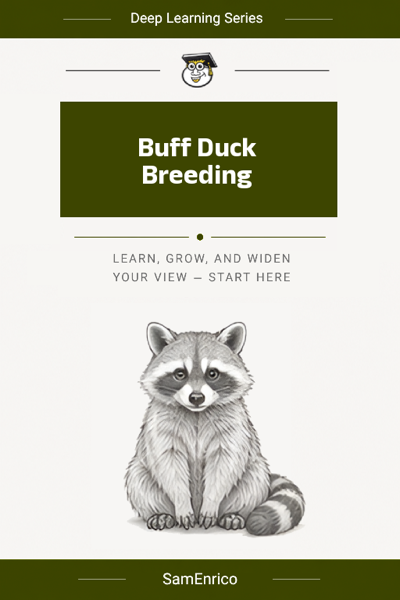
Buff Duck Breeding eBook
A Coursebook on Buff Duck Breeding
by Mallory Oda
A Coursebook on Buff Duck Breeding
Formats
Free sample
Chapter 1: The Duck That Found Me--–- It was a Tuesday when I stopped believing that good things came from careful planning. I had driven two hours to a rural swap meet in the Missouri Ozarks, my truck bed empty, my wallet full, and my head filled with confidence. I was going to buy Pekins. That was the plan. Every book I had read said Pekins were the starting point for duck keeping—fast-growing, docile, and abundant.
I had a coop half-built, a budget of two hundred dollars, and the smug certainty of a man who had done his research. What I did not have, as I would soon discover, was any idea what I was doing.The swap meet was held in a fairground that had seen better decades. The livestock auction barn still smelled of last week’s cattle, and the poultry pens were arranged in uneven rows on a concrete floor stained with generations of muddy boots. I walked past cages of squawking chickens, silent rabbits, and a single turkey that regarded me with prehistoric suspicion. Then I saw the ducks.A farmer in bib overalls had three of them in a wire cage no bigger than a dog crate.
They were not Pekins. They were not white at all. They were the color of dry hay in August, a warm, even tan that seemed to glow against the grey concrete. Their bills were a deep, almost absurd shade of orange, and their eyes were dark and calm. While the Pekins in the next cage were shoving and quacking and generally carrying on like feathered teenagers, these three sat still, watching me with what I can only describe as patience.“What are those?” I asked.The farmer looked up from his coffee.
“Buff Orpingtons. Heritage breed. Don’t make ’em like they used to.”I had never heard of a Buff Orpington duck. I knew the chickens—the big, fluffy, brown egg layers that every homesteader loved—but ducks? I crouched down and put my finger through the wire.
One of the ducks, the smallest of the three, waddled over and gently nibbled my knuckle. Not a bite. Not a peck. A nibble, soft and curious, like she was testing whether I was food or friend.“That one’s a hen,” the farmer said. “Good layer.
Good mother. Tastes better than a Pekin, too.”I asked how much. He said twenty dollars for the trio. I said I only wanted one. He laughed and said, “She’s not a goldfish, son.
Ducks need company.” So I bought all three, loaded them into a cardboard box with air holes poked by a pocketknife, and drove home with my plan in shambles and my truck cab smelling faintly of wet feathers and small mercies.That was ten years ago. Those three ducks—I named them Goldie, Penny, and Nugget before I knew any better—out-lived, out-laid, and out-charmed every other bird I have ever owned. Goldie, the nibbler, lived to be seven years old, which is ancient for a domestic duck. She laid eggs well into her fourth year, long after the Pekins I eventually bought had slowed to a trickle. Penny survived a raccoon attack that should have killed her, healing from a torn wing with nothing but rest and good food.
Nugget, the drake, was so gentle that my then-three-year-old daughter used him as a pillow during afternoon naps in the grass.I did not choose the Buff. The Buff chose me. And after a decade of breeding, showing, selling, and occasionally eating these remarkable birds, I am going to show you why this forgotten breed is the single best-kept secret in small-scale agriculture.The Duck You Have Never Heard Of (But Should)If you walk into a typical farm supply store in the spring, you will see bins of chirping ducklings. Most of them will be Pekins—white, fluffy, and destined for freezers or backyard ponds. A few might be Khaki Campbells, sold as “egg machines.” If you are lucky, you might find Runners, the upright, bowling-pin-shaped ducks that look like they are perpetually late for something important.
What you will almost never find is a Buff Orpington.This is not because Buffs are inferior. It is because they are inconvenient for industrial agriculture.The Pekin was bred for one thing: speed. A Pekin duckling can go from hatch to slaughter weight in seven weeks, which is astonishingly fast. The Khaki Campbell was bred for one thing: volume. A good Campbell hen can lay three hundred eggs in a year, rivaling the production of a commercial chicken.
But the Buff Orpington was bred for a different era—an era when a family farm needed one bird that could do everything. Eggs for breakfast, meat for Sunday dinner, feathers for pillows, and a temperament calm enough that the children could collect eggs without getting savaged. The Buff was the Swiss Army knife of the poultry world, and then industrial agriculture decided that Swiss Army knives were less profitable than specialized tools.The result is that the Buff Orpington duck is now classified as “Critical” by the Livestock Conservancy. Fewer than five hundred breeding birds remain in North America. To put that in perspective, there are more giant pandas in the wild than there are purebred Buff ducks.
Every time you hatch a Buff, you are not just adding a duck to your backyard. You are increasing the genetic diversity of a breed teetering on the edge of extinction.I do not say this to guilt you into buying this book. I say it because understanding the stakes changes how you breed. When you raise Pekins, you are participating in a commodity system that has millions of birds. When you raise Buffs, you are a steward of something rare.
The decisions you make—which birds to mate, which eggs to hatch, which ducklings to keep—have consequences that ripple beyond your fence line.What This Breed Actually Gives You Let me be specific about what you are getting into, because the conservation argument only goes so far. You are not a charity. You are a duck breeder, or you want to be, and you deserve to know exactly what these birds will deliver.Egg Production. A good Buff hen will lay two hundred to two hundred twenty eggs per year. This is fewer than a Khaki Campbell (which can hit three hundred) but significantly more than a Muscovy (sixty to one hundred twenty) or a Mallard-derived breed like the Rouen (eighty to one hundred fifty).
The eggs are large—comparable to a jumbo chicken egg—and they range in color from pure white to a pale, lovely tint of blue-green. The tint is cosmetic; it does not affect flavor or nutrition, but it does make the eggs look beautiful in a basket. My Buff eggs sell for a premium at the farmers’ market simply because they are unusual, and I will teach you how to price and market them in Chapter 12.Meat Quality. The Buff carcass weighs five to six pounds at processing age, which is smaller than a Pekin (six to seven pounds) but larger than a Campbell (four…
This is the end of the free sample. Get the eBook to keep going. Buy now
About this book
Details
- Author
- Mallory Oda
- Publisher
- SamEnrico
- Language
- English
- Genre
- Non-Fiction, Informative, Educational
- Released
- 2026-06-03
- Pages (approx.)
- 145
- Available as
- eBook, Audiobook

Read better in the ZLOADR app
Your eBooks on your phone or tablet. Sign in with your SamEnrico account and start reading.
More by Mallory Oda
 Giving and Receiving FeedbackMallory Oda$11.99
 Weapon Violence Dream Symbols GuideMallory Oda$11.99
 Water Phobia GuideMallory Oda$11.99
 The Virtual AA Meeting GuideMallory Oda$11.99
 Meth Relapse Digital Tracking AppMallory Oda$11.99
 Nefertem: The Lotus-Born Healer of the SunMallory Oda$11.99
 Streaming Media Spending GuideMallory Oda$12.99
 Freelance Grant Writer Side HustleMallory Oda$12.99
 Understanding Infantile Spinal Muscular AtrophyMallory Oda$17.99
 How to Become a Jewel-bearing FacerMallory Oda$11.99
You may also like
 Hong Kong Handover 1997Dunn Johnnie$11.99
 Zumba For Postnatal Recovery CourseNeal Christian$11.99
 Zumba for BeginnersLadner Nikia$11.99
 YouTube Comment Mining GuideHumes Pandora$12.99
 Worry Box MeditationCarlin Rudy$11.99
 Workplace Stress MeditationNguyen Lynn$11.99
 Workplace Stress and Sleep RepairHawley Ivory$11.99
 Workplace Perfectionism CureDelaney Jeffry$11.99
 Workplace Injustice Anger GuideWallen Isabelle$11.99
 Work Addiction and Burnout LinkGreenwood Ester$11.99
 Women in Yoga and WellnessBeattie Galina$11.99
 Women in Stand Up ComedyChun Evangeline$11.99