
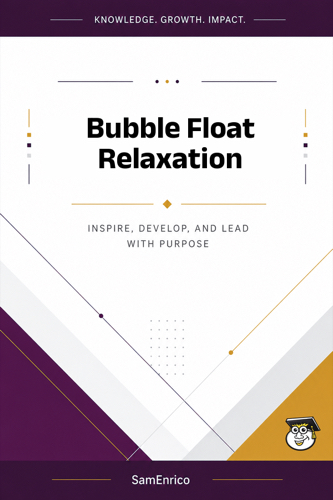
Bubble Float Relaxation eBook
Rises in giant soap bubble, seeing iridescent worl
by Maes Barb
Rises in giant soap bubble, seeing iridescent world.
Formats
Free sample
Chapter 1: The Weightless Permission...–- The first time you watch a soap bubble drift across a sunlit sky and feel your shoulders drop without knowing why, you have stumbled upon a neurological doorway that most stress-management books spend three hundred pages trying to build. This chapter is not about building anything. It is about noticing what your brain already knows how to do—and why the modern world has trained you to unlearn it.You are about to encounter a paradox that will appear throughout this book, and it is worth naming at the outset. The paradox is this: the most profound relaxation often arrives when you stop trying to relax. Effort, as you will discover, is not the path to rest.
Effort is often the obstacle. The bubble does not try to float. It simply does. And in that doing-without-trying lies a lesson that your nervous system is desperate to relearn.This chapter establishes the neurological and physiological foundation for everything that follows. You will learn why chronic stress is not merely an emotional problem but a physical wiring issue.
You will discover the specific brainwave state that bubble gazing induces—a state researchers call the Alpha-Theta borderland. And you will perform your first exercise: a simple, three-bubble practice that requires no special equipment, no prior meditation experience, and no willpower. In fact, willpower would ruin it.By the end of this chapter, you will understand why staring at a drifting, iridescent object is not childish escapism but a potent form of neural training. You will also be introduced to the book's two fundamental modes of practice: Bubble Gazing (watching bubbles from the outside) and Bubble Riding (imagining yourself inside them). This chapter focuses entirely on the first mode.
The second will come in Chapter 2 and beyond.Let us begin with the problem that made you pick up this book in the first place.The Epidemic of Effortful Living You live in a culture that worships effort. From the moment your alarm clock disrupts your sleep cycle to the hour you finally collapse into bed, you are bombarded with messages that more effort equals more value. Work harder. Optimize your morning routine. Crush your goals.
Hustle. Grind. The language of self-improvement has become the language of self-punishment dressed in motivational clothing.There is nothing wrong with effort in its proper place. Effort builds careers, repairs relationships, and moves furniture. But effort has become the default setting for your inner life.
You try to sleep. You try to relax. You try to stop thinking about the email you should have sent. And the trying itself—the muscular clench of attention, the furrowed brow of concentration—activates the very stress response you are attempting to quiet.This is the first and most important discovery of modern stress neuroscience: the relaxation response cannot be forced. It can only be invited.
The parasympathetic nervous system—your body's "rest, digest, and repair" network—does not respond to commands. It responds to safety cues. And safety cues are almost never produced by effort. They are produced by surrender.Consider what happens when you try to fall asleep. The moment you command yourself to sleep, you become alert.
Your brain interprets the command as a threat because commands come from the part of you that expects resistance. Sleep arrives only when you stop chasing it. The same is true of relaxation. You cannot muscle your way into calm. You can only create the conditions for calm to find you.This is where the soap bubble enters the story.The Soap Film State: A Neurological Discovery Hiding in Plain Sight Neuroscientists who study meditation have identified a distinctive brainwave pattern associated with deep, effortless focus.
It is called the Alpha-Theta state. Alpha waves (8–12 Hz) correspond to relaxed alertness—the feeling of a quiet mind in a wakeful body. Theta waves (4–8 Hz) correspond to light trance, creativity, and the kind of dreamy awareness that occurs just before sleep or just after waking.Most people experience these states only briefly and accidentally. You might slip into Alpha-Theta while staring out a train window, watching flames in a fireplace, or listening to music that moves you without demanding your attention. But these moments are fleeting.
The modern world actively suppresses them with notifications, obligations, and the endless scroll of social media.Yet there is one activity that reliably and rapidly induces the Alpha-Theta state in almost every person who attempts it. That activity is watching a soap bubble float.I call this The Soap Film State.Why does a bubble work where meditation cushions and breathing apps often fail? The answer lies in three specific properties of the floating bubble, each of which targets a different vulnerability in the stressed brain.Property One: Unpredictable Slowness A bubble does not move in a straight line. It drifts, wobbles, rises, dips, and swirls according to air currents you cannot predict or control. Your brain, which is wired to track predictable threats (a tiger running toward you) and ignore predictable non-threats (a ceiling fan spinning in circles), finds itself in unfamiliar territory.
The bubble is moving slowly, so it is not a threat. But it is moving unpredictably, so your brain cannot fully ignore it.This places your attention in a perfect middle zone: engaged enough to stay present, but not so engaged that it triggers the fight-or-flight response. Your brain enters a state of soft fascination—a term coined by environmental psychologists to describe the kind of attention that restores rather than depletes.Property Two: Iridescent Complexity The colors in a soap bubble are not painted on. They are created by interference patterns as light waves bounce off the inner and outer surfaces of the soap film. These colors shift continuously as the film thins, thickens, and flows.
No two bubbles display exactly the same pattern, and no single bubble displays the same pattern for more than a few seconds.Your brain finds this kind of complex, non-repeating visual information deeply interesting but not demanding. Unlike a screen, which presents discrete symbols that require interpretation (words, icons, faces), a bubble presents pure sensory data. You do not need to read a bubble. You only need to see it. And seeing, when unburdened by interpretation, is one of the most restful activities your brain can perform.Property Three: Inevitable Disappearance Every bubble pops.
This is not a design flaw; it is the definition of a bubble. And your brain knows this on a pre-conscious level. When you watch a bubble, you are watching something that you know will not last. This knowledge frees you from the expectation of permanence. You are not trying to capture the bubble, preserve it, or analyze it.
You are simply witnessing it while it exists.This is remarkably similar to the mental posture that meditation teachers call "non-attachment" and that psychologists call "acceptance." But unlike those concepts, which require years of practice to internalize, the bubble teaches non-attachment in real time. You watch. It pops. You do not mourn. You simply watch the next one.The Two Modes of Bubble Practice Before we go further, it is important to clarify something that will become essential in later chapters.
This book distinguishes between two fundamentally different ways of engaging with bubbles. Both are valuable. Both induce relaxation. But they…
This is the end of the free sample. Get the eBook to keep going. Buy now
About this book
Details
- Author
- Maes Barb
- Publisher
- SamEnrico
- Language
- English
- Genre
- Non-Fiction, Self-Help, Bubbles
- Released
- 2026-06-07
- Pages (approx.)
- 149
- Available as
- eBook, Audiobook

Read better in the ZLOADR app
Your eBooks on your phone or tablet. Sign in with your SamEnrico account and start reading.
More by Maes Barb
 Self Talk for Job LossMaes Barb$11.99
 Hayloft Rest GuideMaes Barb$11.99
 Stress Inflammation ConnectionMaes Barb$11.99
 Flow Environment AuditMaes Barb$11.99
 The Mindfulness Focus LinkMaes Barb$11.99
 Ultimate Frisbee Self HypnosisMaes Barb$11.99
 ABCDE for CaregiversMaes Barb$11.99
 The Siege of Jeddah Prison: A 19th-Century Bloodbath in the Heart of the Ottoman EmpireMaes Barb$11.99
 Shadows Over Istanbul: The Vanished DiplomatMaes Barb$11.99
 How to Become a Counter-supply WorkerMaes Barb$11.99
 Woolly Mammoths: Ancient ElephantMaes Barb$11.99
 How to Produce a Digital Television AdapterMaes Barb$11.99