
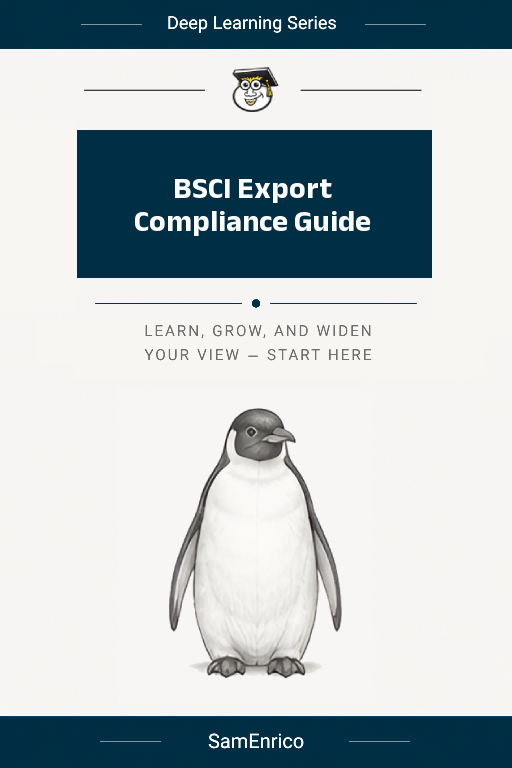
BSCI Export Compliance Guide eBook
Meet Business Social Compliance Initiative standar
Meet Business Social Compliance Initiative standards for European retailers.
Formats
Free sample
Chapter 1: The Unseen Gatekeeper--–- The factory had passed every internal audit. The fire extinguishers were mounted on freshly painted walls, their inspection tags gleaming with the signatures of the newly hired safety officer. The attendance records, meticulously handwritten in matching blue ink, covered twelve consecutive months without a single gap. The workers, when asked by the plant manager what they would say if an auditor questioned them, had recited their answers in unison: "The bathrooms are clean. The overtime is voluntary.
We have never seen anyone under eighteen."When the BSCI auditor arrived from Paris on a Tuesday morning, the factory manager greeted him with confidence. Six hours later, the manager sat in stunned silence as the auditor read the preliminary findings: four major non-conformances, two zero tolerance flags, and a provisional rating of D. The fire extinguisher tags were dated for the previous week—all twelve of them, suggesting that no inspections had occurred for eleven months and someone had backdated them the night before. The attendance records showed identical handwriting across twelve different employees, suggesting that one person had filled out every log. And the worker interviews?
Three separate workers, when asked the same question, had repeated the same phrase: "The bathrooms are clean." Word for word. As if memorized.The manager had made a catastrophic error. He had treated BSCI as a checklist to be gamed rather than a system to be lived. He had prepared for the audit like a student cramming for an exam—and like that student, he had failed not because he lacked resources, but because he misunderstood what was being tested.This book exists to ensure you never make that manager's mistake. And this chapter exists to answer the foundational question upon which every subsequent chapter depends: What is BSCI, why does it control access to the European market, and what does the 2026 update mean for your business?The Nature of the Beast: More Than a Certificate If you ask most factory owners what BSCI is, they will give you a one-sentence answer: "It's a social compliance audit for European buyers." That answer is not wrong, but it is dangerously incomplete.
BSCI is not a certificate you hang on the wall. It is not a one-time hurdle you clear. It is a continuous, multi-dimensional performance standard that sits at the intersection of human rights law, corporate supply chain management, and international trade.The Business Social Compliance Initiative began in 2003 as a project of the Foreign Trade Association, a Brussels-based group of European retailers. Today, it is managed by amfori, an organization representing more than 2,400 member companies. Those members include virtually every major European retailer you can name: Lidl, Aldi (both Nord and Süd), Carrefour, H&M, C&A, Decathlon, Metro, Puma, Tchibo, and many others.
When these companies source products from outside Europe—from Bangladesh, China, Vietnam, Turkey, India, Pakistan, Indonesia, Cambodia, Morocco, and dozens of other countries—they require their suppliers to adhere to the BSCI Code of Conduct.But here is what most factory owners fail to understand. BSCI is not a legal requirement imposed by any government. There is no BSCI police force. No European law says you must have a BSCI certificate to ship a container into Rotterdam or Hamburg. So why does every major European buyer demand it?The answer lies in a piece of European legislation that will fundamentally reshape global supply chains: the EU Corporate Sustainability Due Diligence Directive (CSDDD) .
Passed in 2024 and beginning phased enforcement in 2026, the CSDDD holds European companies legally responsible for human rights and environmental violations that occur in their supply chains—even if those violations happen in factories on the other side of the world. If a German brand sources from a Turkish factory that uses child labor, the German brand can be sued in a German court. If a French retailer buys from a Bangladeshi factory with unsafe housing, the French retailer can be fined up to 5% of its global revenue and banned from public contracts.Faced with this legal exposure, European buyers have a powerful incentive to ensure their suppliers comply with international labor and environmental standards. And the most efficient way to manage compliance across thousands of suppliers is to outsource the monitoring to a common, unified standard—BSCI.Think of BSCI as an electronic passport system for the European market. When your factory holds an active BSCI rating of A, B, or C on the amfori platform, you are effectively pre-approved for any of the 2,400 member companies.
When your rating expires or drops to D or E, your passport is revoked, and every member company can see the failure.This is why BSCI is the unseen gatekeeper. It does not announce itself at customs. It does not appear on any shipping manifest. But without a valid rating, your containers will sit on the dock while your buyers cancel orders and find other suppliers.The Anatomy of a BSCI Audit: What Is Actually Being Measured To understand how to pass a BSCI audit, you must first understand what the audit measures. The BSCI Code of Conduct is organized into thirteen principles, grouped under five Performance Areas (PAs).
Each principle is a specific, measurable requirement. Each PA is scored independently, and the scores combine to produce your final rating.Performance Area 1: Social Management System (Principle 1)This is the foundation. It measures whether your factory has a documented management system for social compliance. Do you have a written policy committing to BSCI standards? Have you assigned a specific person (the BSCI Manager) with authority to implement compliance?
Do you have a corrective action plan (CAP) process for addressing problems? Do you retain documents for at least twelve months? Factories that fail here almost always fail elsewhere, because without a management system, no one is responsible for fixing problems when they arise.Performance Area 2: Labour (Principles 2-9)This is the largest PA, covering eight principles:Principle 2 (Freedom of Association) : Workers may form or join organizations of their choosing.Principle 3 (Working Hours) : Maximum 48 regular hours per week, 60 including overtime.Principle 4 (Remuneration) : Wages meet legal minimums, overtime premiums paid, no unlawful deductions.Principle 5 (Child Labor) : No workers under 15 (or compulsory schooling age, whichever is higher); amfori strongly recommends 16 as the effective minimum.Principle 6 (Forced Labor) : No withholding passports, no financial deposits, no restrictions on movement.Principle 7 (Health and Safety) : Covered in PA 3 (not PA 2—this is a common point of confusion).Principle 8 (Non-Discrimination) : Equal treatment in hiring, promotion, termination, and training.Principle 9 (Disciplinary Practices) : No physical, mental, or verbal abuse.Performance Area 3: Health and Safety (Principles 7, 10, 11)This PA covers the physical conditions of your factory:Principle 7 (Occupational Health and Safety) : Machine guarding, chemical storage, personal protective equipment, first aid.Principle 10 (Fire Safety) : Exits, extinguishers, alarms, emergency lighting, evacuation drills.Principle 11 (Welfare Facilities) : Toilets, drinking water, canteen, dormitory (if provided).Performance Area 4: Environment (Principle 12)Formerly a supporting area, now an independently scored PA as of 2026. It covers waste management (segregation, disposal contracts, permits), chemical management (MSDS sheets, spill response), and the new Carbon Module (emissions reporting and reduction planning).Performance Area 5: Business Ethics…
This is the end of the free sample. Get the eBook to keep going. Buy now
About this book
Details
- Author
- Vickers Sparkle
- Publisher
- SamEnrico
- Language
- English
- Genre
- Non-Fiction, Business Brief, BSCI
- Released
- 2026-05-28
- Pages (approx.)
- 151
- Available as
- eBook, Audiobook

Read better in the ZLOADR app
Your eBooks on your phone or tablet. Sign in with your SamEnrico account and start reading.
More by Vickers Sparkle
 Breast Health For Jewish WomenVickers Sparkle$11.99
 Telling Friends About LayoffVickers Sparkle$11.99
 Stress and Diabetes Risk GuideVickers Sparkle$11.99
 Divorce Recovery TimelineVickers Sparkle$11.99
 Sleep Music Delta WavesVickers Sparkle$11.99
 The Growth Mindset for TeensVickers Sparkle$11.99
 Team Creativity for WritersVickers Sparkle$11.99
 Persuasion for ArchitectsVickers Sparkle$11.99
 The Great British Brainwash: How a Nation’s Mind Was MoldedVickers Sparkle$11.99
 The Fires of Enterprise: Black Entrepreneurs Who Built EmpiresVickers Sparkle$11.99
 How to Produce Cordless TelephonesVickers Sparkle$11.99
 Edible Frogs: The Frog Leg Industry & Species GuideVickers Sparkle$11.99
You may also like
 Hong Kong Handover 1997Dunn Johnnie$11.99
 Zumba For Postnatal Recovery CourseNeal Christian$11.99
 Zumba for BeginnersLadner Nikia$11.99
 YouTube Comment Mining GuideHumes Pandora$12.99
 Worry Box MeditationCarlin Rudy$11.99
 Workplace Stress MeditationNguyen Lynn$11.99
 Workplace Stress and Sleep RepairHawley Ivory$11.99
 Workplace Perfectionism CureDelaney Jeffry$11.99
 Workplace Injustice Anger GuideWallen Isabelle$11.99
 Work Addiction and Burnout LinkGreenwood Ester$11.99
 Women in Yoga and WellnessBeattie Galina$11.99
 Women in Stand Up ComedyChun Evangeline$11.99