
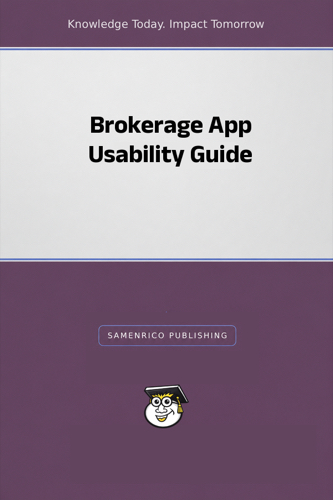
Non-FictionBusiness BriefMobile Trading
Brokerage App Usability Guide eBook
Compares mobile app interfaces, trading ease, and
Compares mobile app interfaces, trading ease, and features across Robinhood, Webull, and traditional brokers.
Formats
Free sample
Chapter 1: The Dopamine Loop--–- The first time I lost money in a brokerage app, I didn't feel regret. I felt confusion. The trade was simple—buy low, sell high—except the "low" kept getting lower. My finger hovered over the red "Sell" button for what felt like minutes. Then I tapped it.
The app rewarded me with a subtle animation, a green "Order Filled" confirmation, and a cheerful notification sound. I had just lost $400, and yet the app had made the experience feel... pleasant. That was the moment I realized I wasn't trading. I was being played.This chapter is not about trading strategies, stock selection, or market analysis.
Those topics are covered in thousands of other books. This chapter is about something far more insidious: the psychological architecture buried inside every brokerage app you use. It is about why you tap when you should wait, why you buy when you should sell, and why you check your portfolio seventeen times a day even though nothing has fundamentally changed.The answer begins with a molecule called dopamine.The Chemistry of a Tap Dopamine is often misunderstood. Popular culture calls it the "pleasure molecule," but that is not quite right. Dopamine is not released when you experience pleasure.
It is released when you anticipate pleasure. It is the chemical of craving, of "more," of the next hit. And brokerage apps have become extraordinarily sophisticated at triggering it.Consider what happens when you open Robinhood, Webull, or any modern trading app. The first thing you see is not your long-term portfolio performance. It is a price chart—often a green candlestick chart if the market is up, or a red one if it is down.
That color alone triggers a cascade of neurological responses. Green signals safety, growth, opportunity. Red signals danger, loss, the need to act immediately. Your brain, still operating with the same hardware that helped your ancestors avoid predators, cannot distinguish between a red stock chart and a red warning sign in the savanna. It reacts the same way: alert, aroused, ready to move.This is not accidental.
Every element of a brokerage app's interface has been tested, optimized, and re-optimized to keep you engaged. The placement of the buy button, the size of the price font, the refresh rate of the chart, even the spacing between menu items—all of it is designed to minimize the time between the impulse to trade and the execution of that trade.Variable Rewards: The Slot Machine in Your Pocket In his book Hooked, Nir Eyal describes the psychology of variable rewards. A predictable reward—like getting paid every Friday—produces a modest dopamine response. But an unpredictable reward—like a slot machine that pays out randomly—produces a much stronger response. The uncertainty is what keeps you pulling the lever.Brokerage apps have turned stock trading into a variable reward machine.
When you open the app, you do not know if your portfolio will be up or down. That uncertainty triggers dopamine. When you place a trade, you do not know if it will be profitable or not. More dopamine. When you refresh the chart, you do not know if the price has moved in your favor.
Even more dopamine.Robinhood, in particular, has been criticized for taking this too far. Its famous confetti animation—which showers the screen with colorful particles after a trade—is a textbook variable reward. The confetti does not appear every time. It appears randomly, or after certain types of trades, or when the app detects that you need encouragement. The unpredictability is the point.
You are not trading stocks. You are playing a game where the stocks are the interface and the confetti is the prize.Webull takes a different approach. Its dense, data-heavy interface appeals to a different psychological mechanism: the illusion of control. When you have fifty technical indicators on the screen, you feel like you have information. You feel like you understand something that others do not.
This feeling is seductive, but it is also dangerous. Research in behavioral finance consistently shows that more information does not lead to better trading outcomes. It leads to more trading. And more trading, for the vast majority of retail investors, leads to lower returns.The Minimalist Trap: Robinhood's False Promise Let me be clear about something that will save you thousands of dollars: Robinhood is not a minimalist app. It was, at one point.
When it launched in 2013, it offered exactly one thing: commission-free stock trading. No options, no crypto, no margin, no frills. The interface was clean, almost stark. White space dominated. The buy button was large and unambiguous.That Robinhood no longer exists.Over the past decade, Robinhood has added options trading, cryptocurrency trading, margin lending, IPO access, and a cash management account.
None of these products are simple. Options trading alone has dozens of variables: strike prices, expiration dates, implied volatility, Greeks, assignment risk, early exercise risk. And yet the interface has remained stubbornly minimal. The same clean screens that made stock trading accessible now obscure the complexity of the products behind them.This is the feature creep paradox, and it is one of the most dangerous usability patterns in modern finance. An app that looks simple but offers complex products lulls users into a false sense of safety.
You think you understand what you are doing because the interface is easy to navigate. But you do not. The complexity is still there, hidden beneath the surface, waiting to destroy your account.I have interviewed dozens of retail investors who lost significant money trading options on Robinhood. Almost all of them said the same thing: "I didn't realize how risky it was. The app made it look so easy." One user, a 24-year-old in Texas, sold a naked call option—a strategy with theoretically unlimited losses—without understanding what "unlimited" meant.
He lost $47,000. He had never traded options before. The app had not warned him. It had simply presented the trade as if it were any other.Cognitive Load: Why Your Brain Freezes Cognitive load theory, developed by educational psychologist John Sweller, explains why some interfaces are easier to use than others. The basic insight is simple: your working memory can only hold about four to seven pieces of information at once.
When an interface presents more than that, your brain becomes overloaded. You make mistakes. You miss important details. You default to the simplest possible action, which is often the wrong one.Apply this to brokerage apps. A novice trader opening Webull for the first time sees dozens of numbers: bid, ask, spread, volume, market cap, P/E ratio, dividend yield, beta, fifty-day moving average, two hundred-day moving average, RSI, MACD, Bollinger Bands, and on and on.
That is not information. That is noise. The cognitive load is so high that the user cannot process any of it meaningfully. So they ignore most of it and focus on the one number they understand: the price.Robinhood, by contrast, shows very little. Price, change percentage, and a chart.
That is it. The cognitive load is low, which feels good. But low cognitive load has a dark side: it encourages action without…
This is the end of the free sample. Get the eBook to keep going. Buy now
About this book
Details
- Author
- Nickerson Enoch
- Publisher
- SamEnrico
- Language
- English
- Genre
- Non-Fiction, Business Brief, Mobile Trading
- Released
- 2026-06-08
- Pages (approx.)
- 116
- Available as
- eBook, Audiobook

Read better in the ZLOADR app
Your eBooks on your phone or tablet. Sign in with your SamEnrico account and start reading.
More by Nickerson Enoch
 The Remote Manager ToolkitNickerson Enoch$11.99
 Full Body Awareness GuideNickerson Enoch$11.99
 Choking Conscious AdultNickerson Enoch$11.99
 The Silk Road Ransom: The Kidnapping of the Last Emperor's HeirNickerson Enoch$11.99
 SA Black Ownership Credit BoostNickerson Enoch$12.99
 Associate Trust OfficerNickerson Enoch$11.99
 How to Produce BlindsNickerson Enoch$11.99
 How to Start a Bent Timber Business (Beginners Guide)Nickerson Enoch$11.99
You may also like
 Hong Kong Handover 1997Dunn Johnnie$11.99
 Zumba For Postnatal Recovery CourseNeal Christian$11.99
 Zumba for BeginnersLadner Nikia$11.99
 YouTube Comment Mining GuideHumes Pandora$12.99
 Worry Box MeditationCarlin Rudy$11.99
 Workplace Stress MeditationNguyen Lynn$11.99
 Workplace Stress and Sleep RepairHawley Ivory$11.99
 Workplace Perfectionism CureDelaney Jeffry$11.99
 Workplace Injustice Anger GuideWallen Isabelle$11.99
 Work Addiction and Burnout LinkGreenwood Ester$11.99
 Women in Yoga and WellnessBeattie Galina$11.99
 Women in Stand Up ComedyChun Evangeline$11.99