
Non-FictionBusiness BriefPersonal Finance
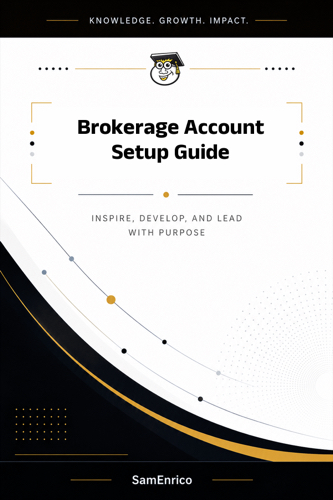
Brokerage Account Setup Guide eBook
Walks through selecting a brokerage, opening an ac
Walks through selecting a brokerage, opening an account, and funding it for first time investors.
Formats
Free sample
Chapter 1: The Silent Thief...--I want you to try a short exercise. Look at your bank account balance right now—the number in your checking or savings account that makes you feel safe. Got that number in your head? Good. Now subtract 3% from it.
On $10,000, that is $300. On $50,000, that is $1,500. On $100,000, that is $3,000.Now ask yourself: Did your bank just send you a notice that they removed that money? Of course not. The money is still there, displayed in crisp digital numbers on your screen.
But here is the ugly truth that no bank teller will ever tell you: That money is already gone. Not because of a hacker, not because of a fraudulent charge, and not because you spent it. It disappeared through a silent, invisible, perfectly legal mechanism called inflation. And unlike a thief who leaves evidence, inflation steals while making you feel responsible and safe.This chapter exists because you have been lied to. Not maliciously, but systematically.
Every adult in America has been trained since childhood to believe that saving money is virtuous and that putting cash in a bank account is the responsible thing to do. Your parents told you. Your school teachers told you. Every financial commercial on television shows a happy family depositing money into a savings account while uplifting music plays. And none of them are wrong, exactly—saving is better than spending recklessly.
But they are dangerously incomplete. They left out the part where your "responsible savings" loses value every single year, guaranteed, with no exceptions, while the people who understand the game use a different tool to grow wealth.That tool is a brokerage account. And if the word "brokerage" makes you think of Wolf of Wall Street, fancy suits, or complicated trading platforms that require a finance degree to understand, you have been lied to about that too.The Three Jars Lie When you were a child, someone probably taught you to divide your money into three jars: one for spending, one for saving, and one for giving. That is a fine lesson for a seven-year-old with a weekly allowance. But as an adult managing real money that will determine whether you retire comfortably or work until you die, that model is not just simplistic—it is destructive.Let me give you the corrected adult version of the three jars.Jar One: Checking Account (Spending Money).
This is for rent, groceries, utilities, coffee, movie tickets, and every other expense you will incur in the next thirty days. A checking account pays either 0% interest or something so close to zero that it might as well be zero. Money in checking is not supposed to grow; it is supposed to be spent. You should keep only one month of expenses here.Jar Two: Savings Account (Safety Money). This is your emergency fund.
If you lose your job, your car breaks down, or you have a medical bill, this money keeps you from going into debt. A high-yield savings account currently pays between 4% and 5% interest (as of this writing), but that number is historically abnormal. For most of the past fifteen years, savings accounts paid 0.5% or less. This jar is for safety, not growth. You should keep three to six months of expenses here.Jar Three: Brokerage Account (Growth Money).
This is where the magic happens. Unlike the first two jars, a brokerage account is designed specifically to make your money grow faster than inflation. Instead of letting a bank pay you pennies to lend out your money at high interest rates, a brokerage account lets you bypass the bank entirely and become a partial owner of real companies—Apple, Amazon, Microsoft, Nvidia, Coca-Cola, and thousands of others. When those companies grow, you grow with them.Here is what no one tells you: the wealthy do not keep significant money in jars one and two. They keep just enough for immediate expenses and emergencies.
Everything else lives in jar three. Not because they are reckless gamblers, but because they understand a simple mathematical truth that I am about to show you.The Mathematics of Silence Let us walk through a real example using realistic numbers.Imagine you have $10,000 that you do not need for at least five years. You have three choices for where to put it.Choice One: A Standard Savings Account. The national average interest rate for a standard savings account is 0.46% (FDIC data as of this writing). After one year, your $10,000 becomes $10,046.
You earned $46. Congratulations? Meanwhile, inflation runs at an average of 3% annually. That $10,000 needs to become $10,300 just to maintain the same purchasing power. You lost $254 of buying power in a single year while feeling responsible for saving.
Your money did not grow; it shrank. You just worked a year for free.Choice Two: A High-Yield Savings Account. These accounts currently pay 4-5% because of unusual economic conditions. Let us use 4.5%. After one year, your $10,000 becomes $10,450.
Against 3% inflation, you gained $150 in purchasing power. This is not bad. But high-yield savings rates are variable. The bank can lower them tomorrow. In 2019, these same accounts paid 1%.
In 2013, they paid 0.1%. When the economy changes, your return vanishes. You also miss out on the single most powerful force in finance.Choice Three: A Brokerage Account Invested in the Stock Market. The S&P 500 (an index of the five hundred largest US companies) has returned an average of approximately 10% per year before inflation over the past century. After adjusting for 3% inflation, that is roughly 7% real returns.
It is important to state clearly: this is a long-term average over decades. In any single year, the market can drop 30% or rise 30%. The 7% figure is what happens if you buy and hold for twenty or thirty years, never selling during downturns. But for money you will not need for at least five years, the odds overwhelmingly favor the market.Let us run the math conservatively using 7% after inflation. Your $10,000 becomes $10,700 in purchasing power after one year.
After five years, that same $10,000 becomes approximately $14,025 in purchasing power. After twenty years, it becomes approximately $38,700. Do you see what happened? Your money almost quadrupled in real terms while doing nothing. The savings account money stayed flat or shrank.This is not gambling.
This is arithmetic. And the people who tell you that the stock market is "too risky" are usually the same people who are perfectly happy watching inflation eat 3% of their savings every single year with zero chance of upside.But What About the Risk? (The Question Everyone Asks)At this point, a reasonable voice in your head is asking: "If the stock market is so great, why doesn't everyone do it? What about crashes? What about 2008?
What about 2020? What if I invest and lose everything?"These are fair questions. Let me answer them directly.First, you will not lose everything. Not unless you do something incredibly foolish like borrow money to invest (margin trading, which Chapter 2 will warn you against) or put all your money into a single sketchy company that goes bankrupt. A diversified investment in the S&P 500 has never gone to zero.
Even during the Great Depression, the market eventually recovered and went on to reach new highs. During the 2008 financial crisis, the market…
This is the end of the free sample. Get the eBook to keep going. Buy now
About this book
Details
- Author
- Mccord Anissa
- Publisher
- SamEnrico
- Language
- English
- Genre
- Non-Fiction, Business Brief, Personal Finance
- Released
- 2026-06-09
- Pages (approx.)
- 159
- Available as
- eBook, Audiobook

Read better in the ZLOADR app
Your eBooks on your phone or tablet. Sign in with your SamEnrico account and start reading.
More by Mccord Anissa
 Wedding Planner StressMccord Anissa$11.99
 NVC For School AdministrationMccord Anissa$11.99
 Neurosurgery Resident StressMccord Anissa$11.99
 The Opium Wars of the South: Tipu Sultan's Defiance Against British EmpireMccord Anissa$11.99
 Freemium Pay As You Go ModelMccord Anissa$12.99
 How to Produce Bird Gyms and PlaystandsMccord Anissa$11.99
 10 Ways to Use Ginger Beer (Recipe Book)Mccord Anissa$11.99
 ApheresisMccord Anissa$11.99
You may also like
 Hong Kong Handover 1997Dunn Johnnie$11.99
 Zumba For Postnatal Recovery CourseNeal Christian$11.99
 Zumba for BeginnersLadner Nikia$11.99
 YouTube Comment Mining GuideHumes Pandora$12.99
 Worry Box MeditationCarlin Rudy$11.99
 Workplace Stress MeditationNguyen Lynn$11.99
 Workplace Stress and Sleep RepairHawley Ivory$11.99
 Workplace Perfectionism CureDelaney Jeffry$11.99
 Workplace Injustice Anger GuideWallen Isabelle$11.99
 Work Addiction and Burnout LinkGreenwood Ester$11.99
 Women in Yoga and WellnessBeattie Galina$11.99
 Women in Stand Up ComedyChun Evangeline$11.99