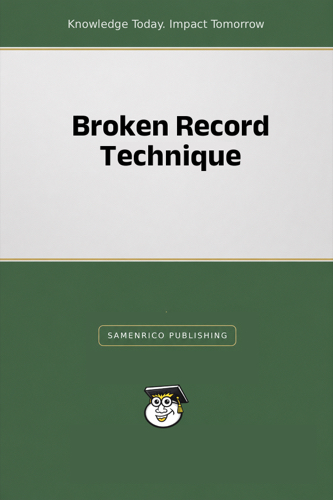
Broken Record Technique eBook
Repeats your boundary calmly without getting drawn
by Anglin Honey
Repeats your boundary calmly without getting drawn into debate.
Formats
Free sample
Chapter 1: The Yes Trap--–- The phone buzzes. You see the name. Your stomach tightens. You already know what they want. And you already know what you're going to say.
Not because you want to. Because you have to. Because saying no feels like a violation of something deeper than politeness. It feels like a violation of who you are supposed to be.This is the Yes Trap. And this chapter is about learning to see it for what it is: not kindness, not generosity, not the price of being a good person.
It is a conditioned reflex. And like any reflex, it can be unlearned.Before we teach you the Broken Record Technique, we have to understand why you need it in the first place. Because here is the uncomfortable truth that most assertiveness books gloss over: you already know how to say no. You say no all the time. You say no to the second slice of cake.
You say no to waking up at 4 AM. You say no to strangers who ask for your credit card information. The problem is not that you lack the ability to form the word "no." The problem is that certain people, in certain situations, activate a neural pathway that bypasses your will entirely. You become a puppet. And the puppet master is not the person asking.
The puppet master is your own conditioning.This chapter will identify the three root causes of the Yes Trap, help you distinguish between chosen generosity and forced compliance, and guide you through a self-assessment to locate your "emotional crack"—the specific trigger that difficult people habitually exploit. By the end of this chapter, you will understand why you say yes when you mean no. And that understanding is the first step toward becoming unstuck.The Universal Scene Let me describe a scene. I want you to see if it feels familiar.It is Tuesday afternoon. You are tired.
You have already completed your essential tasks for the day, and you are looking forward to an evening of nothing—reading, watching television, sitting in silence. Then your phone buzzes. It is a friend. Or a coworker. Or a family member.
They need something. A favor. A loan. An extra pair of hands at an event you did not agree to attend. Your mind immediately generates the word "no." You feel it.
The word is right there, on the tip of your tongue.And then something happens.Your mouth opens. And instead of "no," you hear yourself say, "Sure. What do you need?"Or worse: "I can probably do that. Let me check my schedule." Which means yes. It always means yes.You hang up the phone.
Or you close the email. Or you walk away from the conversation. And you feel it immediately: the sinking sensation in your chest. The quiet resentment. The voice in your head that says, "Why did I just agree to that?"This is the Yes Trap.
It is not a failure of vocabulary. It is a failure of what psychologists call "behavioral inhibition"—the ability to stop an automatic response and substitute a deliberate one. And it happens to nearly everyone, not because we are weak, but because we have been trained to be this way.The training started early. And it never stopped.The Three Root Causes of the Yes Trap After decades of research into assertiveness psychology, attachment theory, and behavioral conditioning, three primary causes emerge as the architects of the Yes Trap. They are not separate problems.
They are three strands of the same rope, twisted together over years of reinforcement. Pull one, and the others tighten.Cause One: Childhood Conditioning You were not born afraid of saying no. Watch a two-year-old. They say no with glorious, unfiltered abandon. "No" is their favorite word.
They say it to vegetables. They say it to bedtime. They say it to hugs they do not want. The word "no" is one of the first words children learn, and they deploy it without guilt, without explanation, without apology.Then the adults in their lives begin the conditioning."Don't say no to Grandma.""Be polite.""Stop being so difficult.""What's wrong with you? Just say yes.""If you can't be nice, go to your room."Each of these statements is a tiny electrical shock.
Each one teaches the child that "no" is followed by punishment—not physical punishment necessarily, but social punishment: withdrawal of affection, disapproval, shame. Meanwhile, "yes" is followed by reward: praise, smiles, the warm feeling of being a "good kid."By the time that child reaches adulthood, the conditioning is so deep that it operates below conscious awareness. You do not decide to say yes. You simply say yes. And then you invent a reason after the fact to make yourself feel better about it.This is not your fault.
But it is your responsibility to undo.Cause Two: People-Pleasing as Identity For many people, "being nice" is not a behavior. It is an identity. They do not say yes because they want to. They say yes because saying no would mean they are not the person they believe themselves to be.This is a dangerous fusion.When you attach your self-worth to your compliance, every request becomes a test. If you say yes, you pass.
If you say no, you fail. You are not evaluating the request on its merits—whether you have the time, the energy, the desire, the obligation. You are evaluating only one thing: what will this say about me?The people-pleaser says yes to the committee assignment they do not want because saying no would feel "selfish."The people-pleaser says yes to the family gathering they dread because saying no would feel "disloyal."The people-pleaser says yes to the extra work they cannot handle because saying no would feel "lazy."Notice the pattern: the people-pleaser is not actually thinking about the other person. They are thinking about themselves. Their own self-image.
Their own fear of being seen as anything other than "nice." The irony is profound: people-pleasing is not generosity. It is self-protection. You are not saying yes to help them. You are saying yes to avoid the discomfort of your own judgment.The distinction introduced in this chapter—between choosing to be nice and being forced to be compliant—lands hardest here. Choosing to be nice is an act of deliberate generosity.
You have the time. You have the energy. You want to help. There is no resentment afterward. Being forced to be compliant is a reflex.
You do not want to help. You feel resentment immediately. But you say yes anyway because the alternative—saying no—feels like a threat to your identity.If you cannot tell the difference between these two, you are trapped.Cause Three: Fear of Conflict The third root cause is the most primal. Fear of conflict is not learned in the same way as people-pleasing. It is hardwired.
Humans are social animals. For most of human history, being rejected by the tribe meant death. No shelter. No food sharing. No protection from predators.
Your brain is still running that ancient software, even though the stakes have changed dramatically.When someone asks you for something…
This is the end of the free sample. Get the eBook to keep going. Buy now
About this book
Details
- Author
- Anglin Honey
- Publisher
- SamEnrico
- Language
- English
- Genre
- Non-Fiction, Self-Help / Technique
- Released
- 2026-06-06
- Pages (approx.)
- 135
- Available as
- eBook, Audiobook

Read better in the ZLOADR app
Your eBooks on your phone or tablet. Sign in with your SamEnrico account and start reading.
More by Anglin Honey
 Financial Management MemoryAnglin Honey$11.99
 Only Child Self WorthAnglin Honey$11.99
 Helicopter Search LimitationsAnglin Honey$11.99
 Nightmare Rescripting Music TherapyAnglin Honey$11.99
 Conversation Starters for Any OccasionAnglin Honey$11.99
 Hypnosis Memory RisksAnglin Honey$11.99
 Critical Thinking HandbookAnglin Honey$11.99
 The DNA of Victory: Spartan Bloodlines at ThermopylaeAnglin Honey$11.99
 The Ghosts of Malacca: Portugal’s Bloody Clash with the Sultanate (1511)Anglin Honey$11.99
 A Collector's Handbook to the Daimler Light 20Anglin Honey$11.99
 How to Produce Sports and EntertainmentAnglin Honey$11.99
 Freemium Analytics for Low BandwidthAnglin Honey$12.99