
Non-FictionHistoryGenocide Studies
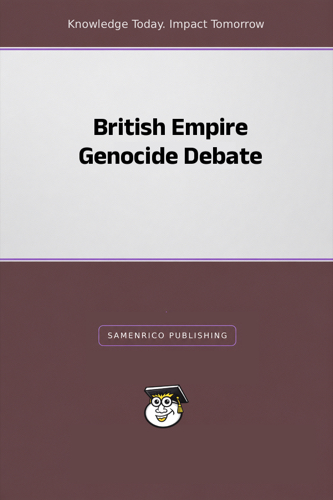
British Empire Genocide Debate
Investigates claims of genocide in Tasmania, Irela
Investigates claims of genocide in Tasmania, Ireland, and Namibia.
Formats
About this book
Free sample
Chapter 1: The Uncomfortable Question...--–- In the quiet reading rooms of Oxford’s Bodleian Library, surrounded by centuries of accumulated wisdom, a peculiar silence hangs over one particular shelf. It is not the reverent silence of scholarly contemplation, but the uneasy quiet of avoidance. Here, nestled between gilt-spined volumes on Nazi Germany’s extermination camps and Stalin’s purges, sit the imperial histories of the British Empire—massive, authoritative, and curiously unexamined in the one register that matters most. Open any of them, and you will find meticulous accounts of administrative reforms, economic transformations, and the spread of common law. What you will struggle to find is the word that haunts every page: genocide.The British Empire presents a paradox that has tormented historians, legal scholars, and activists for generations.
On one hand, it is celebrated—even today, in certain circles—as a force for global progress, a bringer of railways, judiciaries, and the English language to four continents. On the other hand, its record is stained by demographic collapses, famines, and massacres that bear uncomfortable resemblance to events we have elsewhere categorized as crimes against humanity. Yet the term “genocide” attaches to the British Empire only reluctantly, fleetingly, and always in the midst of fierce dispute. Why?This opening chapter establishes the book’s central puzzle: why does the British Empire provoke such uniquely heated debate over the term “genocide,” while atrocities under Nazi Germany or Stalinist Russia are more readily classified as such? The answer, we will discover, is not found in the facts of violence alone—for those facts are abundantly documented—but in the ways those facts have been narrated, defended, silenced, and contested across two centuries of imperial apologia and post-colonial reckoning.
The debate is not merely academic. It is a proxy for contemporary battles over national identity, multiculturalism, and post-colonial guilt. To ask whether the British Empire committed genocide is to ask who we are now, and whether the monuments we venerate and the histories we teach are built on ground that should have been consecrated long ago.The Peculiarity of British Denial Unlike…
This is the end of the free sample. Get the eBook to keep going. Buy now
Contents
- Chapter 1
- Chapter 2
- Chapter 3
- Chapter 4
- Chapter 5
- Chapter 6
- Chapter 7
- Chapter 8
- Chapter 9
- Chapter 10
- Chapter 11
- Chapter 12
Details
- Author
- Mccray Wilmer
- Publisher
- SamEnrico
- Language
- English
- Genre
- Non-Fiction, History, Genocide Studies
- Released
- 2026-06-08
- Pages (approx.)
- 141
- Available as
- eBook, Audiobook

Read better in the ZLOADR app
Your eBooks on your phone or tablet. Sign in with your SamEnrico account and start reading.
More by Mccray Wilmer
 Anger In Dementia Care GuideMccray Wilmer$11.99
 Hearing Loss Self EsteemMccray Wilmer$11.99
 Armenian Power Gang LAMccray Wilmer$11.99
 The Seasonality Adjustment GuideMccray Wilmer$11.99
 Cognitive Restructuring AngerMccray Wilmer$11.99
 Overcoming Procrastination for MarketersMccray Wilmer$11.99
 Jungian Dream Interpretation WorkbookMccray Wilmer$11.99
 The 1989 World Series Earthquake: Baseball’s Unshakable MomentMccray Wilmer$11.99
 The Photographer's Guide to Old-time PhotographyMccray Wilmer$11.99
 Horseradish: Root HarvestingMccray Wilmer$11.99
 First 48 Hours After BankruptcyMccray Wilmer$12.99
 Trial to Paid Conversion OptimizationMccray Wilmer$12.99
You may also like
 Hong Kong Handover 1997Dunn Johnnie$11.99
 Zumba For Postnatal Recovery CourseNeal Christian$11.99
 Zumba for BeginnersLadner Nikia$11.99
 YouTube Comment Mining GuideHumes Pandora$12.99
 Worry Box MeditationCarlin Rudy$11.99
 Workplace Stress MeditationNguyen Lynn$11.99
 Workplace Stress and Sleep RepairHawley Ivory$11.99
 Workplace Perfectionism CureDelaney Jeffry$11.99
 Workplace Injustice Anger GuideWallen Isabelle$11.99
 Work Addiction and Burnout LinkGreenwood Ester$11.99
 Women in Yoga and WellnessBeattie Galina$11.99
 Women in Stand Up ComedyChun Evangeline$11.99