
Non-FictionHealth & WellnessSpine Health
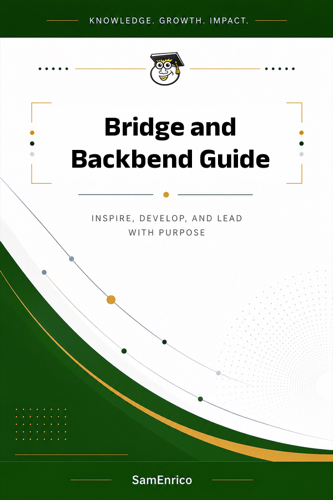
Bridge and Backbend Guide eBook
Open thoracic spine and chest with wheel and camel
Open thoracic spine and chest with wheel and camel progressions.
Formats
Free sample
Chapter 1: The Spinal Betrayal--–- Every time you bend backward and feel that familiar pinch in your lower back, your spine is sending you a warning. Most people ignore it. They assume the pinch means they are "tight" or "not flexible enough" or simply "not good at backbends." But the pinch is not a sign of weakness. It is a sign of misdirection. You are bending in the wrong place.
This chapter dismantles the most common and dangerous myth in all of backbending: that a deep arch comes from a flexible lower back. It does not. Sustainable, safe, pain-free backbends require thoracic extension—movement in your upper back—not lumbar hyperextension, which is simply your lower back doing work it was never designed to do. By the end of this chapter, you will understand why your lower back has been taking the blame for your upper back's stiffness, and you will have the tools to finally reverse that pattern.The Anatomy of a Mistake Let us begin with a simple experiment. Stand with your back against a wall.
Your heels, sacrum, shoulders, and the back of your head should all touch the wall. Now, without moving your feet or letting your hips leave the wall, try to arch your upper back and chest away from the wall. Do not move your lower back—keep your sacrum against the wall. Can you do it? For many people, the answer is no.
The upper back feels stuck, frozen, or simply absent. Now step away from the wall and try a traditional backbend from standing. Bend backward from your waist. Feel how easy it is to crank the lower back into an arch while the upper back remains relatively flat. That ease is a lie.
What you just felt is your lumbar spine—the lower five vertebrae—doing the work that your thoracic spine should be sharing.Your spine is not a single, unified rod of bone. It is a chain of thirty-three vertebrae divided into four natural curves. The cervical spine (neck) has seven vertebrae designed for nodding, turning, and tilting. The thoracic spine (upper and mid-back) has twelve vertebrae, each attached to a pair of ribs. This is the longest section of your spine, and it is designed for rotation, lateral flexion, and—crucially for this book—extension.
The lumbar spine (lower back) has only five vertebrae, and they are built for one thing above all others: stability. The lumbar vertebrae are thick, blocky, and have large facet joints that limit their range of motion. They are meant to bear weight, protect the spinal cord, and transfer load from your trunk to your legs. They are not designed to bend deeply backward.And yet, in yoga classes around the world, students crank their lumbar spines into deep extension day after day. They call it "opening the heart." They call it "deepening their backbend." But what they are actually doing is compressing the facet joints of the lumbar spine, grinding the spinous processes together, and slowly—sometimes silently—damaging the very structure that keeps them upright.The Thoracic vs.
Lumbar Showdown To understand why this matters, you need to see the difference on paper. Place your hand on your lower back, right where the curve feels deepest in a backbend. Now imagine the anatomy beneath your palm. The lumbar facet joints are oriented vertically, which allows for some forward and backward bending but very little rotation or side bending. When you over-extend the lumbar spine, the inferior articular facets of the upper lumbar vertebrae slide up and onto the superior articular facets of the lower lumbar vertebrae.
In small amounts, this is normal. In the amounts required to fake a backbend that should be coming from the thoracic spine, this becomes what orthopedic surgeons call "impingement."Now move your hand up to your mid-back, between your shoulder blades. The thoracic facet joints are oriented more horizontally, which allows for a greater range of extension, rotation, and lateral flexion. The thoracic spine also has the mechanical advantage of the rib cage. Your ribs attach to your thoracic vertebrae and to your sternum, creating a bony ring that can expand, contract, and—when mobilized—contribute to extension in ways the lumbar spine simply cannot.Here is the uncomfortable truth that most yoga anatomy books dance around: the average adult has between ten and twenty degrees of lumbar extension available before the facet joints begin to impinge.
The average adult has between thirty and fifty degrees of thoracic extension available, but most people never access more than ten to fifteen degrees because their upper backs are frozen from years of sitting, slouching, and screen use. The math is simple. If you need fifty degrees of extension to do a full Wheel pose, and your thoracic spine gives you fifteen, your lumbar spine must provide the remaining thirty-five. But your lumbar spine only has twenty to give before it starts to hurt. Something has to give.
Usually, it is your lower back.The Flat Upper Back Epidemic Why do so many of us have flat, immobile upper backs? The answer is modern life. Your thoracic spine is designed to move through all three planes of motion: sagittal (forward and back), frontal (side to side), and transverse (rotation). But from the age of about seven, most people in industrialized societies begin a forty-year process of locking their thoracic spines into slight flexion. Desks do this.
Car seats do this. Sofas do this. Smartphones do this with vicious efficiency. Every hour you spend looking down at a screen, your thoracic spine rounds forward, your head drops, and your body adapts. The muscles of your upper back—the rhomboids, the middle and lower trapezius, the deep spinal erectors—lengthen and weaken.
The muscles of your chest—the pectoralis major and minor, the anterior deltoid—shorten and tighten. Your ribs become less mobile. Your breath becomes shallower. And your thoracic spine slowly, quietly, forgets how to extend.This is not a moral failing. It is a physical adaptation.
Your body is brilliantly efficient. If you do not ask your thoracic spine to extend, it will not maintain the capacity to extend. Use it or lose it is not a slogan; it is a neurological and physiological fact. The ligaments of the thoracic spine become stiff from disuse. The intercostal muscles between your ribs become tight from shallow breathing.
The fascia around your shoulder blades becomes glued down from lack of movement. And then one day you roll out your yoga mat, try to do a backbend, and your lower back screams at you. You assume you are not flexible. You assume backbends are not for you. But the real problem is that your upper back has been on strike for years, and your lower back has been doing double shifts to cover for it.The Heart Opener Myth Let us talk about the phrase "heart opener." In yoga classes, backbends are often called heart openers, and the instruction is to "open your heart to the sky" or "lift your heart toward the ceiling." This is beautiful poetry.
As anatomy, it is dangerously incomplete. Your heart sits in your mediastinum, protected by your sternum and rib cage. You…
This is the end of the free sample. Get the eBook to keep going. Buy now
About this book
Details
- Author
- Mercado Hulda
- Publisher
- SamEnrico
- Language
- English
- Genre
- Non-Fiction, Health & Wellness, Spine Health
- Released
- 2026-06-06
- Pages (approx.)
- 141
- Available as
- eBook, Audiobook

Read better in the ZLOADR app
Your eBooks on your phone or tablet. Sign in with your SamEnrico account and start reading.
More by Mercado Hulda
 Foster Care Self Esteem PlanMercado Hulda$11.99
 Assertive Communication for CaregiversMercado Hulda$11.99
 Academic Burnout Prevention WorkbookMercado Hulda$11.99
 Financial Comparison on Social MediaMercado Hulda$11.99
 The Emperor’s Poison: The First Forensic Trial of Meiji JapanMercado Hulda$11.99
 How to Start a Calendering Machinery for Textiles Business (Beginners Guide)Mercado Hulda$11.99
 Criminal LawMercado Hulda$11.99
 Citation Rule Video Script CompanionMercado Hulda$12.99
 Promotion Presentation BlueprintMercado Hulda$12.99
 Understanding N SyndromeMercado Hulda$17.99
You may also like
 Hong Kong Handover 1997Dunn Johnnie$11.99
 Zumba For Postnatal Recovery CourseNeal Christian$11.99
 Zumba for BeginnersLadner Nikia$11.99
 YouTube Comment Mining GuideHumes Pandora$12.99
 Worry Box MeditationCarlin Rudy$11.99
 Workplace Stress MeditationNguyen Lynn$11.99
 Workplace Stress and Sleep RepairHawley Ivory$11.99
 Workplace Perfectionism CureDelaney Jeffry$11.99
 Workplace Injustice Anger GuideWallen Isabelle$11.99
 Work Addiction and Burnout LinkGreenwood Ester$11.99
 Women in Yoga and WellnessBeattie Galina$11.99
 Women in Stand Up ComedyChun Evangeline$11.99