
Non-FictionSelf-HelpSomatic Practices
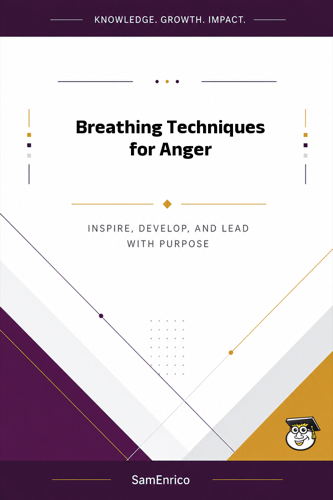
Breathing Techniques for Anger eBook
Teaches physiological sighing and box breathing to
Teaches physiological sighing and box breathing to downregulate nervous systems.
Formats
Free sample
Chapter 1: The $10,000 Rage--There is a moment, just before you explode, when you can feel everything going wrong. Your jaw tightens. Your breath catches in your chest. Heat floods your face. And somewhere in the back of your mind, a small, distant voice whispers—don't.
But the voice is quiet. The rage is loud. And before you can stop it, you have already said the thing you cannot take back. You have already sent the email. You have already slammed the door.
You have already watched someone you love flinch away from you.If you are reading this book, you know that moment. Perhaps you know it intimately. Perhaps you have lived there for years, cycling through guilt and shame and the solemn promise that next time will be different. But next time comes, and you are right back in the fire, watching yourself burn down everything you care about.This is not a book about anger management. That phrase has always bothered me—management.
It implies that anger is a resource to be optimized, like time or money. It suggests that you can schedule your outbursts, contain them, keep them in a neat little box labeled "acceptable release." But anyone who has ever truly lost their temper knows that anger does not manage. Anger consumes. Anger overrides. Anger turns you into someone you do not recognize, and by the time you come back to yourself, the damage is already done.Here is what this book actually is: a mechanical, physiological, no-nonsense guide to turning off the fire before it starts.
No meditation. No positive affirmations. No "just let it go." Just two breathing techniques, backed by neuroscience, that can lower your physiological arousal by nearly fifty percent in under thirty seconds.But before we get to the techniques, we need to talk about why everything you have tried so far has failed.The Lie You Have Been Told"Take a deep breath."You have heard this a thousand times. From your parents, your partners, your therapists, the well-meaning articles you skimmed at three in the morning after a bad fight. The implication is simple: breathing is easy.
Breathing is natural. If you are angry, just breathe, and the anger will pass.This is, quite frankly, terrible advice. Not because breathing does not help—it does, enormously—but because deep breathing without technique can actually make things worse.Let me explain.When you are angry, your body is not in a normal state. Your sympathetic nervous system—the gas pedal—has been pressed to the floor. Your heart rate is elevated.
Your blood vessels are constricted, which is why you feel hot. Your breathing has shifted from slow, diaphragmatic, nasal breaths to fast, shallow, thoracic, mouth-based gasps. This is the "anger signature," and it happens whether you want it to or not.Now, what happens when someone tells you to "take a deep breath"? Most people respond by doing exactly that: a single, enormous, chest-expanding gulp of air. But here is the problem.
That deep breath does not activate your parasympathetic nervous system—the brake pedal. In fact, for many people, it does the opposite. It fills your already over-oxygenated body with even more oxygen, which can increase feelings of dizziness, panic, and loss of control. You are essentially throwing gasoline on a fire and wondering why it is not going out.The other common piece of advice is "count to ten." This one is even worse. Counting to ten requires your prefrontal cortex—the logical, rational part of your brain—to be online and functioning.
But here is the thing about anger: it literally shuts down your prefrontal cortex. This is not a metaphor. This is neuroscience.The Neuroscience of Losing Your Mind Deep inside your brain, tucked just behind your ears, sits a small, almond-shaped cluster of neurons called the amygdala. Its job is simple: detect threats and initiate a response. Thousands of years ago, that threat might have been a saber-toothed tiger.
Today, it might be a rude email, a critical comment, or a child who will not stop screaming.The amygdala does not distinguish between physical threats and social threats. To your ancient, lizard brain, humiliation is as dangerous as a predator. Rejection is as lethal as a fall from a cliff. So when the amygdala detects a threat, it sends an emergency signal to the rest of your body: prepare for battle.Here is where it gets interesting. The amygdala's signal travels along a neural superhighway that bypasses your prefrontal cortex entirely.
That means by the time your logical brain even knows there is a problem, your body is already in full fight-or-flight mode. Your heart is pounding. Your muscles are tensed. Your breath is shallow. And your prefrontal cortex—the part of you that says "maybe I should not yell at my boss"—has been effectively cut out of the loop.This is called amygdala hijack, a term coined by psychologist Daniel Goleman.
When you are hijacked, your IQ effectively drops by ten to fifteen points. You cannot do math. You cannot think through consequences. You cannot remember the promise you made to yourself last week about staying calm. You are running on pure, ancient, biological autopilot.And this is why counting to ten does not work.
Counting to ten requires the very brain region that is currently offline. It is like trying to use your phone to call for help after the battery has died. The tool you need is not available when you need it most.The Bottom-Up Revolution Most anger management approaches are top-down. They assume that if you can just change your thoughts, your feelings will follow. Reframe the situation.
Challenge your cognitive distortions. Replace negative self-talk with positive affirmations.There is nothing wrong with these techniques, in theory. In practice, they are useless during an actual anger spike. You cannot reframe a thought when the part of your brain that does the reframing has been taken offline. You cannot challenge a cognitive distortion when your amygdala is screaming fight.What you need is a bottom-up approach.
Instead of trying to talk your brain into calming down, you work directly with your body. Specifically, you work with your breath.Here is why this works. Your breathing is the only automatic bodily function that you can also control voluntarily. You cannot consciously tell your heart to beat slower. You cannot will your blood vessels to dilate.
But you can change the rhythm, depth, and pattern of your breath. And when you change your breath, you send a powerful signal up the vagus nerve—the biological superhighway connecting your body to your brain—that the threat has passed.The vagus nerve is the brake pedal of your nervous system. When it is activated, it slows your heart rate, lowers your blood pressure, and tells your amygdala to stand down. The fastest way to activate the vagus nerve? A long, slow, extended exhale.This is the core physiological law that governs everything in this book: Longer exhales relative to inhales activate the vagus nerve and lower heart rate.
That is it. No philosophy. No spirituality. Just biology.Why This Book Is Different There are already dozens of books about…
This is the end of the free sample. Get the eBook to keep going. Buy now
About this book
Details
- Author
- Brantley Larraine
- Publisher
- SamEnrico
- Language
- English
- Genre
- Non-Fiction, Self-Help, Somatic Practices
- Released
- 2026-06-06
- Pages (approx.)
- 153
- Available as
- eBook, Audiobook

Read better in the ZLOADR app
Your eBooks on your phone or tablet. Sign in with your SamEnrico account and start reading.
More by Brantley Larraine
 Letting Go of Brand LoyaltyBrantley Larraine$11.99
 The Preschool TV Voice LifeBrantley Larraine$11.99
 Teen Social Anxiety GuideBrantley Larraine$11.99
 Pet Loss Support Groups OnlineBrantley Larraine$11.99
 Three Card Poker AddictionBrantley Larraine$11.99
 Rejection ResilienceBrantley Larraine$11.99
 Teacher Classroom StressBrantley Larraine$11.99Teacher Classroom StressBrantley Larraine$11.99
 The Lost City of the Moon God: Decoding the Enigma of Teotihuacan's PyramidsBrantley Larraine$11.99
 Burke and Wills: The Great Australian ExpeditionBrantley Larraine$11.99
 A Collector's Handbook to the Porsche C Carrera 2Brantley Larraine$11.99
 Pop Up Food and Beverage BlueprintBrantley Larraine$12.99
You may also like
 Hong Kong Handover 1997Dunn Johnnie$11.99
 Zumba For Postnatal Recovery CourseNeal Christian$11.99
 Zumba for BeginnersLadner Nikia$11.99
 YouTube Comment Mining GuideHumes Pandora$12.99
 Worry Box MeditationCarlin Rudy$11.99
 Workplace Stress MeditationNguyen Lynn$11.99
 Workplace Stress and Sleep RepairHawley Ivory$11.99
 Workplace Perfectionism CureDelaney Jeffry$11.99
 Workplace Injustice Anger GuideWallen Isabelle$11.99
 Work Addiction and Burnout LinkGreenwood Ester$11.99
 Women in Yoga and WellnessBeattie Galina$11.99
 Women in Stand Up ComedyChun Evangeline$11.99