

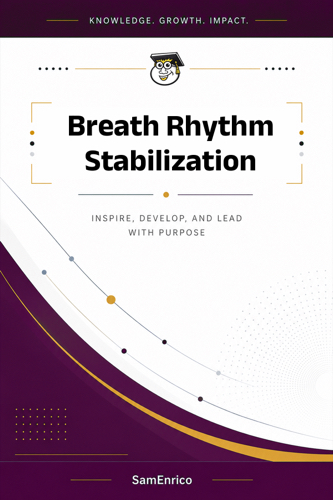
Non-FictionSelf-HelpRegulation
Breath Rhythm Stabilization eBook
Allow chaotic breathing to naturally settle into s
by Cintron Kory
Allow chaotic breathing to naturally settle into smooth rhythm without forcing.
Formats
Free sample
Chapter 1: The Invisible Scream--–- Your body is screaming at you right now. Not with pain. Not with hunger or thirst. With something far more subtle, far more constant, and far more damaging because you have learned to treat it as silence.Take a breath. Just one.
Don't change it—just notice it. Did your shoulders rise? Did your chest expand while your belly remained still? Did you hear the faint sound of air moving through your mouth or nose? Did you, perhaps, hold your breath entirely for a moment, unsure how to answer because you have never been asked to observe something so automatic?That uncertainty is the first clue.
You have been breathing every moment of your life since the second you were born, and yet you cannot describe your own breath with any accuracy. This is not a failure of intelligence. It is a failure of attention—and it is the single greatest obstacle to nervous system regulation, mental clarity, and physical health that you have never been taught to see.This chapter is about learning to see what has always been invisible. It is about recognizing the noise floor of your own respiration: the baseline level of chaos, inefficiency, and dysregulation that has become your normal. Before you can stabilize your breath, you must first hear what it has been saying.
And what it has been saying, quietly and constantly, is this: I am struggling. Help me.The Silence That Isn't Silent In audio engineering, the noise floor is the background level of unwanted sound present in any system before the intended signal appears. A professional recording studio has a noise floor so low that you hear nothing but the music—pure signal, pure intention. A crowded coffee shop has a noise floor so high that you struggle to hear the person across the table, even when they are shouting.Your breathing has a noise floor. It is the constant, low-grade chaos of upper-chest breathing, irregular timing, excessive volume, and unconscious mouth breathing that runs in the background of your waking life.
You do not hear it because you have never heard anything else. It is the hum of a refrigerator that has been running since childhood—present, pervasive, and utterly ignored.But ignoring a signal does not make it harmless. A high noise floor in an audio recording ruins the music. A high noise floor in your breathing ruins everything else: your sleep, your focus, your emotional resilience, your digestion, your immune function, and your capacity for joy.Consider this number: the average modern adult takes between fifteen and twenty breaths per minute at rest. The optimal, physiologically efficient rate—the rate at which the human respiratory system evolved to operate—is between five and seven breaths per minute.
You are breathing two to three times faster than your biology intends. That is not a minor variation. That is the difference between a gentle, rhythmic tide and a chaotic, crashing surf.But rate alone tells only part of the story. The quality of each breath matters equally. A fast breath can still be smooth, like a hummingbird's wings—rapid but rhythmic.
The problem is that modern breathing is not just fast; it is jagged, shallow at the top, collapsing at the bottom, with hitches and gasps and sighs that serve no physiological purpose other than to signal a nervous system in perpetual low-grade distress.Place your hand on your upper chest, just below your collarbone. Breathe normally for ten seconds. Does your chest rise visibly with each breath? If so, you are breathing with your accessory muscles—the scalenes, the sternocleidomastoid, the upper trapezius. These muscles are designed for emergency breathing during fight-or-flight responses, not for baseline respiration at rest.
Their chronic activation is the mechanical signature of a noise floor that has crept dangerously high.Now move your hand to your belly, just above your navel. Breathe normally for another ten seconds. Does your belly expand forward? Or does it remain still, even retracted, as your chest heaves? A still belly during breathing indicates a locked diaphragm—the primary breathing muscle has been disengaged, replaced by a frantic ensemble of secondary muscles that were never meant to carry the load for hours, days, and years on end.This is the invisible scream.
It is not a shout. It is a whisper that never stops.The Great Paradox: Why More Air Makes You Suffocate Here is where the problem becomes genuinely perverse. When your breathing becomes chaotic—fast, shallow, chest-dominant, irregular—your body does not send you a clear signal saying "Your breathing pattern is dysfunctional." Instead, it sends you a signal that says "I need more air."This is a lie. And your brain believes it every single time.The feeling of air hunger—that urgent, almost panicked sensation that you cannot get enough oxygen—is rarely caused by a lack of oxygen. Your blood oxygen saturation, even during intense exercise, typically remains above ninety-five percent.
The sensation of suffocation is driven almost entirely by one factor: carbon dioxide levels.Carbon dioxide is not a waste product. This is the single most important fact you will learn in this chapter, and it is the foundation upon which every subsequent practice in this book is built. CO2 is a critical signaling molecule. Among its many functions, it regulates the release of oxygen from your red blood cells through the Bohr Effect (a mechanism we will explore in depth in Chapter 8). It controls the diameter of your blood vessels, ensuring that oxygen-rich blood reaches your tissues.
It modulates the p H of your blood. And most relevant to our immediate concern, it directly stimulates the respiratory center in your brainstem to initiate the next breath.When you breathe too fast or too deeply, you exhale too much CO2. Your blood levels of CO2 drop below the optimal range. The brainstem, sensing low CO2, does not say "I have too little CO2." It says "I need to breathe more to get rid of this excess CO2"—except there is no excess. The signal is backwards.
The brain's algorithm, inherited from millions of years of evolution, is this:If CO2 is high → breathe more If CO2 is low → breathe less But the sensation of air hunger—the feeling of needing to breathe—is triggered by low CO2, not high CO2. This means your brain is telling you to take a deep breath precisely when taking a deep breath will make the problem worse. You feel like you are suffocating because you have been over-breathing. The cure is to breathe less. But everything in your body is screaming at you to breathe more.This is the trap.
And it is the engine of the noise floor.The Deep Breath Lie Before we proceed, we must dismantle a dangerous myth: the belief that "taking a deep breath" is always calming.This myth persists because it contains a kernel of truth. A single deep breath, taken intentionally, can activate the stretch receptors in the lungs and trigger a brief parasympathetic response—a momentary sense of relief. This is why the advice "just take a deep breath" is so ubiquitous in our culture. For someone…
This is the end of the free sample. Get the eBook to keep going. Buy now
About this book
Details
- Author
- Cintron Kory
- Publisher
- SamEnrico
- Language
- English
- Genre
- Non-Fiction, Self-Help, Regulation
- Released
- 2026-06-09
- Pages (approx.)
- 147
- Available as
- eBook, Audiobook

Read better in the ZLOADR app
Your eBooks on your phone or tablet. Sign in with your SamEnrico account and start reading.
More by Cintron Kory
 Child Star Co-Star RelationshipsCintron Kory$11.99
 Elon Musk Flamethrower MarketingCintron Kory$11.99
 The Betrayal Stress After Affair GuideCintron Kory$11.99
 PNE for Accident VictimsCintron Kory$11.99
 The Kegworth Air Disaster: A Trial That Redefined Aviation SafetyCintron Kory$11.99
 Event Tent SetupCintron Kory$11.99
 Wyoming LLC Foreign Owner WorkbookCintron Kory$12.99
 Digital Divide in ConsumptionCintron Kory$12.99
 How to Become a Sequins StringerCintron Kory$11.99
 Understanding Listeria InfectionCintron Kory$17.99
You may also like
 Hong Kong Handover 1997Dunn Johnnie$11.99
 Zumba For Postnatal Recovery CourseNeal Christian$11.99
 Zumba for BeginnersLadner Nikia$11.99
 YouTube Comment Mining GuideHumes Pandora$12.99
 Worry Box MeditationCarlin Rudy$11.99
 Workplace Stress MeditationNguyen Lynn$11.99
 Workplace Stress and Sleep RepairHawley Ivory$11.99
 Workplace Perfectionism CureDelaney Jeffry$11.99
 Workplace Injustice Anger GuideWallen Isabelle$11.99
 Work Addiction and Burnout LinkGreenwood Ester$11.99
 Women in Yoga and WellnessBeattie Galina$11.99
 Women in Stand Up ComedyChun Evangeline$11.99