
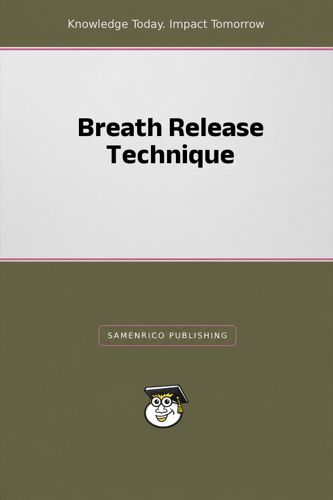
Non-FictionSelf-HelpBreathwork
Breath Release Technique eBook
Exhale resentment with extended out breath.
Exhale resentment with extended out breath.
Formats
Free sample
Chapter 1: The Frozen Fire...--–- The first time Carol wept on a yoga mat, she was not sad. She was furious. Not the slow-burn irritation of a bad day, but a volcanic, full-bodied rage that erupted from nowhere—or rather, from somewhere her conscious mind had cordoned off decades ago. She had come to the studio seeking peace, a quiet hour of stretching to relieve the tension in her neck and shoulders. Instead, as the instructor guided the class into a gentle supine position and asked them to “take a full, complete exhale,” Carol felt something crack open inside her rib cage.
It was not a spiritual awakening. It was a jailbreak.For twenty years, Carol had carried a low-grade war against her ex-husband. The divorce had been civil enough on paper—no screaming matches in court, no contested custody battles. But every morning, as she brushed her teeth, she rehearsed the conversation she would have with him if she ever had the courage. Every night, before sleep, she replayed the betrayal, polishing it like a cherished heirloom.
She told herself she had moved on. She had a new partner, a promotion, a house with a garden. But her body knew otherwise.The bodyworker she consulted for her chronic neck pain had noticed it first. “You never finish your exhale,” he said, placing a hand on her diaphragm. “You breathe in deeply, but halfway through the out-breath, you stop.
It’s like you’re holding something back.” Carol dismissed it as a breathing quirk. But when she finally attempted a full exhale on that yoga mat—emptying her lungs completely, letting the belly fall soft and the ribs collapse—the rage that poured out of her mouth was not a memory of anger. It was anger itself, still alive, still burning, still living in her tissues like a coal buried under ash.This book is for everyone who has ever felt that coal. For everyone who has tried to think their way out of a grudge, or meditate their way into forgiveness, or affirm their way into peace, only to find that the resentment returns the moment life goes slightly wrong. You cannot talk yourself out of a locked body.
You cannot think your way out of a nervous system that has learned, over years, that safety means holding on. But you can breathe your way out. Specifically, you can exhale your way out.This first chapter is an invitation to understand resentment not as a moral failing or a psychological flaw, but as a physical posture—a specific, learned pattern of holding that lives in your diaphragm, your ribs, your jaw, and your breath. Once you see resentment for what it actually is—a physiological lock, not a philosophical problem—the path to release becomes clear. And it begins with the one thing you do twenty-three thousand times a day without thinking: your exhale.The Posture of Holding On Resentment is not primarily a thought.
This is the single most important reframe this book will offer, and it must be stated at the outset because almost everything you have been taught about emotional healing has told you the opposite. You have been told that resentment is a story you tell yourself, a narrative loop that you can break by changing your thoughts. You have been told that forgiveness is a choice, an act of will, a decision to release the debtor. You have been told that if you just think positively enough, or repeat enough affirmations, or practice enough gratitude, the resentment will dissolve like morning fog.These approaches fail not because you are weak or undisciplined, but because they target the wrong layer of your being. Resentment lives in the body.
Specifically, it lives in the respiratory system. To understand why, we have to look at what happens to your breathing when you are threatened—and what continues to happen long after the threat has passed.Imagine a deer in the forest. A predator appears. The deer’s nervous system instantly shifts into sympathetic mode: fight, flight, or freeze. The heart races.
Blood flows to the muscles. The breath becomes rapid and shallow, preparing the body for explosive action. If the deer escapes, it will literally shake off the residual activation—trembling, panting, yawning—until the nervous system returns to baseline. The threat is over, and the body knows it.Humans are different. We have a prefrontal cortex, which means we can remember threats long after they have passed.
We can rehearse them. We can imagine future threats. And crucially, we can suppress the physical release of the activation because it is socially inappropriate to shake and tremble at the office. So we hold it. We tighten our diaphragm.
We lift our ribs. We shorten our exhale. And then we forget we are doing it, because the holding becomes automatic—a background hum of tension that we mistake for normal.This is the posture of holding on. It is not a metaphor. It is a literal, measurable pattern of breathing: shallow inhalation, truncated exhalation, elevated shoulders, clenched jaw, and a diaphragm that never fully relaxes.
The diaphragm is a dome-shaped muscle beneath your lungs. When you inhale, it contracts and flattens, drawing air in. When you exhale, it relaxes and rises, pushing air out. But when you are chronically resentful—when your nervous system is stuck in low-grade threat-detection mode—your diaphragm never fully relaxes. It stays partially contracted, like a fist that forgot how to open.Carol’s bodyworker had identified this exact pattern.
She would inhale deeply—a sharp, eager gasp, as if preparing for an argument—but her exhale was a controlled, hesitant release, as if letting go of the air might also mean letting go of her grip on the grievance. And she was right. That is exactly what it means.The Science of the Stuck Nervous System To understand why resentment creates this specific breathing pattern, we need a basic map of the nervous system. This is not academic trivia; it is the operating manual for your body’s safety system. You do not need to become a neuroscientist, but you do need to understand three key players: the sympathetic nervous system, the parasympathetic nervous system, and the vagus nerve.The sympathetic nervous system is your gas pedal.
It is responsible for the fight-or-flight response. When it is activated, your heart rate increases, your blood pressure rises, your pupils dilate, and your breathing becomes shallow and fast. This system is essential for survival. The problem is not activation; the problem is chronic, low-grade activation that never turns off. Resentment keeps your sympathetic nervous system idling in the red zone, like a car revving its engine in a parked garage.
You are not running from a predator, but your body does not know that. It only knows that the breath is short, the jaw is tight, and the threat has not passed.The parasympathetic nervous system is your brake pedal. It is responsible for rest, digestion, healing, and connection. When it is activated, your heart rate slows, your blood pressure drops, your digestion functions properly, and your breathing becomes deep and slow. The parasympathetic…
This is the end of the free sample. Get the eBook to keep going. Buy now
About this book
Details
- Author
- Carney Filomena
- Publisher
- SamEnrico
- Language
- English
- Genre
- Non-Fiction, Self-Help, Breathwork
- Released
- 2026-06-09
- Pages (approx.)
- 132
- Available as
- eBook, Audiobook

Read better in the ZLOADR app
Your eBooks on your phone or tablet. Sign in with your SamEnrico account and start reading.
More by Carney Filomena
 The OKR Execution HandbookCarney Filomena$11.99
 Creative Warm Up ActivitiesCarney Filomena$11.99
 Gambling Disorder SignsCarney Filomena$11.99
 Embracing Failure For GrowthCarney Filomena$11.99
 Foreclosure Stress SurvivalCarney Filomena$11.99
 Delegation for Healthcare LeadersCarney Filomena$11.99
 Flow for Artists GuideCarney Filomena$11.99
 The Celestial Architects of Meroë: How Kushite Astronomers Mastered the SkyCarney Filomena$11.99
 The Great Irish Auction: When Europe’s Banks Betrayed a NationCarney Filomena$11.99
 Redtop: BentgrassCarney Filomena$11.99
 How to Produce Electronic Musical InstrumentsCarney Filomena$11.99
 Digital Sabbath Implementation GuideCarney Filomena$12.99
You may also like
 Hong Kong Handover 1997Dunn Johnnie$11.99
 Zumba For Postnatal Recovery CourseNeal Christian$11.99
 Zumba for BeginnersLadner Nikia$11.99
 YouTube Comment Mining GuideHumes Pandora$12.99
 Worry Box MeditationCarlin Rudy$11.99
 Workplace Stress MeditationNguyen Lynn$11.99
 Workplace Stress and Sleep RepairHawley Ivory$11.99
 Workplace Perfectionism CureDelaney Jeffry$11.99
 Workplace Injustice Anger GuideWallen Isabelle$11.99
 Work Addiction and Burnout LinkGreenwood Ester$11.99
 Women in Yoga and WellnessBeattie Galina$11.99
 Women in Stand Up ComedyChun Evangeline$11.99