
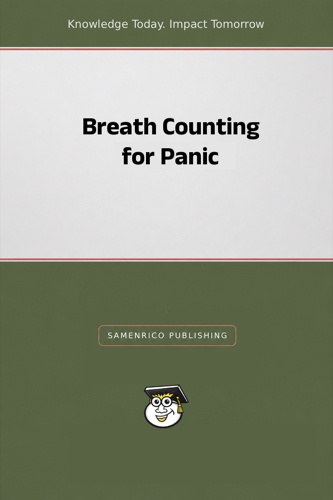
Non-FictionSelf-HelpAnxiety Management
Breath Counting for Panic eBook
Focuses on numbered breaths to interrupt panic att
Focuses on numbered breaths to interrupt panic attacks as they arise.
Formats
Free sample
Chapter 1: The False Alarm--You are driving on a highway. The traffic is dense but moving. You are not thinking about anything in particular—maybe what to make for dinner, maybe a conversation from earlier today. Then, without warning, your heart skips. Then it races.
Your chest feels tight. Your hands begin to tingle. The world suddenly seems distant, like you are watching it through the wrong end of a telescope. A voice in your head says, Something is very wrong.In that moment, you face a choice. You can interpret these sensations as danger—a heart attack, fainting, suffocation, madness.
Or you can interpret them as a false alarm. The difference between these two interpretations is the difference between a brief, uncomfortable surge of adrenaline and a full-blown panic attack that leaves you exhausted, embarrassed, and terrified of it happening again.This chapter is about why that first interpretation happens, why the standard advice of "just relax" makes it worse, and how understanding the structure of a panic attack is the first step toward stopping it. By the end of this chapter, you will know exactly what is happening inside your body during those terrifying moments—and why a simple numbered breath is the most effective tool you have to interrupt the process.The Paradox of Control Let us begin with a cruel irony. When you try to calm down during a panic attack, you almost always become more agitated. This is not a personal failing.
It is a neurological fact.Consider what happens when someone tells you, "Don't think about a pink elephant." You immediately think about a pink elephant. The instruction to suppress a thought requires you to first generate that thought so you know what to suppress. The same principle applies to panic. When you tell yourself, "Calm down, calm down, calm down," you are simultaneously monitoring your body for signs that you are not calm. And because panic creates real physical sensations—racing heart, rapid breathing, sweating—your monitoring system finds exactly what it is looking for.
See? Still not calm. Try harder.This is what Edmund Bourne, in his classic The Anxiety and Phobia Workbook, calls The Paradox of Control. The harder you grip, the more control slips away. The more urgently you demand relaxation, the more tension you create.Think of it this way.
Imagine you are holding a wet bar of soap. If you squeeze it gently, you can hold it easily. If you squeeze it with all your strength, it shoots out of your hand. Your nervous system is the same. Gentle attention allows regulation.
Desperate gripping creates chaos.During a panic attack, your brain's threat-detection system has already sounded an alarm. When you then add a second layer of alarm—I shouldn't be feeling this, something is wrong with me, I need to make this stop—you are not calming the system. You are pouring gasoline on a fire.The solution, as we will see throughout this book, is not to fight the sensations. It is to count them. But before we get to the tool, we must understand the problem.The Second Fear: Why One Sensation Becomes an Attack Here is something most people do not realize.
The initial physical sensations of panic are not the attack. They are the trigger for the attack. The attack itself is your reaction to those sensations.Let me explain.Every human being experiences sudden physical sensations throughout the day. Your heart rate fluctuates. Your breathing changes.
You feel hot or cold. These are normal biological events. Most of the time, you do not even notice them. But sometimes—especially if you are tired, stressed, or have had a panic attack before—you do notice one of these sensations. And you interpret it as threatening.This interpretation is what researchers call The Second Fear.The First Fear is the initial sensation itself.
Your heart rate increases from 70 to 110 beats per minute. That is it. That is the raw data.The Second Fear is what you tell yourself about that sensation. Why is my heart racing? Am I having a heart attack?
What if I faint right here? Everyone will see. I won't be able to get help. Oh God, here it comes again.The Second Fear is not a physical event. It is a cascade of catastrophic interpretations.
And it is the Second Fear—not the racing heart—that creates the full panic attack. The racing heart lasts sixty seconds. The catastrophic thinking can last for hours and create a phobia that lasts for years.Here is the liberating truth. You cannot always control the First Fear. Your body will sometimes produce unexpected sensations.
That is part of being alive. But you can learn to change your relationship to the Second Fear. You can learn to notice the sensation, label it as a false alarm, and return your attention to something neutral—like the count of your breath.This entire book is about that simple shift.The Sixty-Second Peak Now let us look at the actual timeline of a panic attack. Understanding this timeline is essential because it reveals exactly when you need to intervene.When your body's fight-or-flight system activates, it releases a surge of adrenaline. This surge takes approximately sixty to ninety seconds to peak.
During that time, you will feel the most intense physical sensations: racing heart, rapid breathing, sweating, trembling, dizziness, and a sense of impending doom.Here is what most people do not know. After that sixty-to-ninety-second peak, the adrenaline begins to clear from your system. Your body cannot sustain that level of arousal indefinitely. Even if you do nothing at all—even if you simply sit there and let the panic wash over you—the intensity will begin to subside within a few minutes.This is not theory. This is basic human physiology.However, and this is crucial, the complete return to your physiological baseline takes longer.
Your heart rate will not return to its resting rate in ninety seconds. Your breathing will not fully normalize in ninety seconds. The peak subsides quickly. The resolution takes five to ten minutes.Why does this distinction matter? Because many people abandon a technique if they do not feel completely calm within a minute or two.
They think, This isn't working, and they stop. Then they try something else. Then something else. By constantly switching strategies, they never give any single strategy enough time to work.The 10-Minute Rule, which we will return to throughout this book, is simple. Commit to using your breath count for ten full minutes.
Do not check your watch after two minutes and decide it is not working. Do not look for signs of improvement. Just count. When you reach ten minutes, you will still be alive. You will have collected evidence that the panic did not kill you.
And you will have built the neural pathway that makes the next attack easier to manage.What Panic Is Not Before we go further, let us clear up some common misconceptions. These misunderstandings keep people trapped in the panic cycle for years, and they are almost never corrected by well-meaning friends or doctors.Panic is not a heart attack.…
This is the end of the free sample. Get the eBook to keep going. Buy now
About this book
Details
- Author
- Sherrod Jackson
- Publisher
- SamEnrico
- Language
- English
- Genre
- Non-Fiction, Self-Help, Anxiety Management
- Released
- 2026-06-06
- Pages (approx.)
- 152
- Available as
- eBook, Audiobook

Read better in the ZLOADR app
Your eBooks on your phone or tablet. Sign in with your SamEnrico account and start reading.
More by Sherrod Jackson
 Benzo Protracted Withdrawal SupportSherrod Jackson$11.99
 Dental Chronic Pain GuideSherrod Jackson$11.99
 Relationship Building on LinkedinSherrod Jackson$11.99
 Peak Flow State Hypnosis GuideSherrod Jackson$11.99
 Press Release For AwardsSherrod Jackson$11.99
 Circadian Rhythm Research UpdateSherrod Jackson$11.99
 Cuban Family Reunification StorySherrod Jackson$11.99
 Calming Bodily FormationSherrod Jackson$11.99
 The Frozen Frontlines: Stalin’s Opium War on the Eastern FrontSherrod Jackson$11.99
 Ravana's Last Stand: The Asura King's DefianceSherrod Jackson$11.99
 How to Produce Bathroom SetsSherrod Jackson$11.99
 How to Become a Hydrate-control TenderSherrod Jackson$11.99
You may also like
 Hong Kong Handover 1997Dunn Johnnie$11.99
 Zumba For Postnatal Recovery CourseNeal Christian$11.99
 Zumba for BeginnersLadner Nikia$11.99
 YouTube Comment Mining GuideHumes Pandora$12.99
 Worry Box MeditationCarlin Rudy$11.99
 Workplace Stress MeditationNguyen Lynn$11.99
 Workplace Stress and Sleep RepairHawley Ivory$11.99
 Workplace Perfectionism CureDelaney Jeffry$11.99
 Workplace Injustice Anger GuideWallen Isabelle$11.99
 Work Addiction and Burnout LinkGreenwood Ester$11.99
 Women in Yoga and WellnessBeattie Galina$11.99
 Women in Stand Up ComedyChun Evangeline$11.99