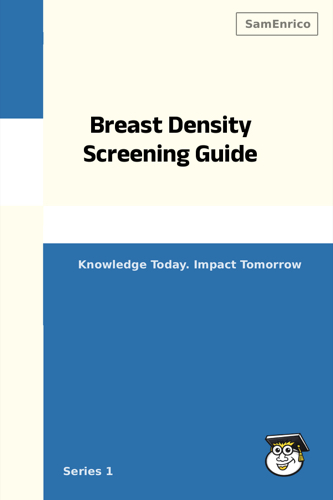
Breast Density Screening Guide eBook
Learn how dense tissue affects mammogram accuracy
by Carmona Mimi
Learn how dense tissue affects mammogram accuracy and when to request supplemental imaging.
Formats
Free sample
Chapter 1: The Letter Arrives...--The envelope was thin. That should have been Maria’s first clue.It arrived on a Tuesday in late September 2024, tucked between a credit card offer and a grocery store coupon. She almost threw it away. The return address said “Memorial Breast Imaging Center,” and since she’d had her annual mammogram just ten days earlier, she assumed it was a routine thank-you or a bill. She opened it standing over the recycling bin.Inside was a single page.
The top read: “Mammography Patient Notification – Breast Density Information Required by the U.S. Food and Drug Administration.”Maria skimmed. She was a fast reader, a habit from years of reviewing contracts at her job as a procurement manager. Her eyes landed on the key sentence: “Your mammogram shows that you have dense breast tissue.”Below that, the letter continued: “Dense breast tissue is common and normal. However, dense breast tissue can make it harder to find cancer on a mammogram and may increase your risk of developing breast cancer.
You should discuss this with your healthcare provider.”That was it. Four sentences. No explanation of what “dense” actually meant. No guidance on what to do next. No warning that her “normal” mammogram result—the one that had arrived in a separate letter just three days earlier, the one that said “No significant abnormalities detected”—might be less reliable than she thought.Maria folded the letter, put it in her desk drawer, and forgot about it for eight months.This is the story of what happened next.
More importantly, this is the story of what should have happened instead—and what you can do to make sure you never become Maria.The 40 Million On September 10, 2024, the FDA finalized a rule that fundamentally changed breast cancer screening in the United States. For the first time in history, every mammography facility in the country was required to notify every patient about their breast density. Not just some patients. Not just patients in the twenty-something states that already had density notification laws. Every single woman who received a mammogram after that date would get a letter like the one Maria received.That is approximately 40 million women per year.The intention behind the mandate was noble.
For three decades, a small but ferocious group of advocates—led by a woman named Dr. Nancy Cappello—had fought state by state to force radiologists to tell women when dense tissue made their mammograms less accurate. Dr. Cappello’s story was tragic and galvanizing: she had received annual mammograms for years, all reported as “normal,” until she felt a lump herself. The lump was stage 3 breast cancer.
Her dense tissue had hidden the tumor completely. She survived, but she dedicated the rest of her life to making sure other women didn’t suffer the same fate.The FDA mandate was the culmination of her work. In theory, it meant that every woman with dense breasts would finally have the information she needed to make informed decisions about her health.In practice, the mandate created a different problem: 40 million letters, and almost no one to explain what they meant.The Dangerous Gap Here is what Maria’s letter did NOT say:It did not tell her that “dense” is not a single category but a spectrum, ranging from scattered density (Category B, low risk) to heterogeneously dense (Category C, moderate risk) to extremely dense (Category D, high risk). It did not explain that a woman with Category C tissue has a meaningfully different risk profile and screening need than a woman with Category D. It did not tell her that mammography misses approximately 30-40% of cancers in Category C breasts and up to 50% in Category D breasts.
It did not mention supplemental imaging—ultrasound, MRI, or contrast-enhanced mammography—or explain when and why a woman might need these additional tests. It did not warn her that her “normal” mammogram result might be a false reassurance, a dangerous lullaby that could allow a growing tumor to go undetected for another year.Maria’s primary care doctor received the same letter, or at least a clinical version of it. But Dr. Patel, a well-meaning internist with a panel of 2,500 patients, had no more training in breast density than Maria did. Medical schools teach mammography interpretation to radiologists, not to primary care physicians.
Dr. Patel had received exactly forty-five minutes of breast imaging education during her entire residency, and none of it covered the nuances of BI-RADS density categories or the evidence for supplemental MRI.When Maria finally remembered the letter and brought it to her annual physical, Dr. Patel glanced at it and said what most doctors say when faced with a clinical question they cannot answer: “Don’t worry about it. Just keep getting your mammograms every year.”That advice was not malicious. It was not negligent by the standards of most primary care practices.
It was, however, dangerously incomplete. And it is the advice that millions of women are receiving right now as you read this book.The Anatomy of a Missed Cancer Eight months after Maria put the letter in her desk drawer, she was in the shower and felt something strange. A hardness. A spot in her left breast that had never been there before. It wasn’t a lump, exactly—not the classic pea-sized marble she had been taught to feel for in those pink brochure diagrams.
It felt more like a thickening. Like a ridge of gristle. She almost dismissed it.But something made her call her gynecologist. Perhaps it was the memory of that letter. Perhaps it was a primal instinct that women learn to trust only after they’ve ignored it once too often.The diagnostic mammogram that followed was different from the screening mammogram she’d had eight months earlier.
A screening mammogram takes two views of each breast, and a radiologist reads it days later. A diagnostic mammogram is performed with a radiologist in the room, reviewing images in real time, taking additional views, zooming in on suspicious areas.The radiologist, Dr. Chen, asked Maria to wait while he compared her new images to the ones from eight months ago. He came back with a furrowed brow. He pointed to a spot on the screen—a white smudge against a sea of white tissue.“See this?” he said.
“This is your tumor. And see how the tissue around it is also white? That’s your dense breast tissue. On your mammogram eight months ago, this tumor was probably the same size it is now. But it was invisible because it blended in.”Maria’s tumor was 1.7 centimeters.
That is small by clinical standards—stage 1, maybe stage 2. But it was not new. Dr. Chen estimated it had been growing for at least eighteen months, perhaps longer. It had been present at her last mammogram.
It had simply been hidden.The biopsy confirmed invasive ductal carcinoma, the most common type of breast cancer. Her oncologist, Dr. Williams, delivered the news with practiced gentleness. “The good news,” she said, “is that we caught this at stage 2. The bad news is that we could have caught it at stage 0 if…
This is the end of the free sample. Get the eBook to keep going. Buy now
About this book
Details
- Author
- Carmona Mimi
- Publisher
- SamEnrico
- Language
- English
- Genre
- Non-Fiction, Health & Wellness, Breast Density
- Released
- 2026-06-09
- Pages (approx.)
- 142
- Available as
- eBook, Audiobook

Read better in the ZLOADR app
Your eBooks on your phone or tablet. Sign in with your SamEnrico account and start reading.
More by Carmona Mimi
 Digital Communication CertificationCarmona Mimi$11.99
 The 30 Second Meeting ExitCarmona Mimi$11.99
 Pinterest VA Client Onboarding SystemsCarmona Mimi$11.99
 Weekly Time Blocking SystemCarmona Mimi$12.99
 Data Leak Live Chat Response ScriptsCarmona Mimi$11.99
 Beanie Baby Bonanza: The Rise and Fall of a Collectible EmpireCarmona Mimi$11.99
 The Vanishing Highway: The Unsolved Mystery of the 1971 Michigan MurdersCarmona Mimi$11.99
 Biomedical EngineeringCarmona Mimi$11.99Weekly Time Blocking SystemCarmona Mimi$12.99
 Sokowatch YC ApplicationCarmona Mimi$12.99
 Understanding Codas SyndromeCarmona Mimi$17.99