
Non-FictionSelf-HelpFinancial Psychology
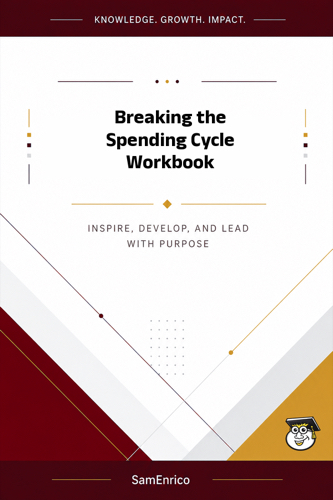
Breaking the Spending Cycle Workbook eBook
Identifies emotional triggers for compulsive purch
Identifies emotional triggers for compulsive purchases and builds healthier coping mechanisms.
Formats
Free sample
Chapter 1: The Hungry Ghost--–- The package arrives on a Tuesday. You didn't need it. You didn't even want it, not really. But for thirty-seven seconds between clicking "buy now" and seeing the confirmation screen, you felt something that looked like relief. Now the box sits on your kitchen counter, unopened, and the feeling has curdled into something heavier.
Shame, probably. Or the particular exhaustion that comes from hiding a bag in the back of your closet before your partner gets home. You tell yourself this is the last time. You have told yourself this before. You are not broken, and you are not weak.
You are a hungry ghost.This is not an insult. It is an ancient image from Buddhist psychology: a creature with a tiny mouth, a thin neck, and a vast, empty belly. No matter how much it consumes, the hunger never stops. The hungry ghost can eat a feast and feel nothing but the ache of an unfilled stomach. It can devour everything in sight and die of starvation anyway.For years, you have been trying to fill an emotional stomach with material objects.
You have been feeding yourself the wrong food. And then you have blamed yourself for still being hungry.This chapter will show you why that blame is misplaced. You will learn that overspending is rarely a math problem. It is a coping mechanism. You will be introduced to the single most important framework in this book: The Spending Loop.
You will complete your first workbook exercise—a simple two-column log that will reveal the emotional function hiding inside your seemingly practical purchases. And you will receive the first of many reframes: you are not greedy. You are not undisciplined. You are a hungry ghost who has been taught to eat rocks and call it dinner.The Myth of the Broken Budget Let us begin with a confession that most personal finance books will not make: budgets do not work for emotional spenders.They work beautifully for people whose relationship with money is purely transactional—people who overspend because they genuinely forget to track their coffee purchases or because they lack basic numerical fluency. For those readers, a spreadsheet is a cure.
But if you are reading this book, you have probably tried spreadsheets. You have tried cash envelopes, budgeting apps, the "snowball method," the "avalanche method," freezing your credit card in a block of ice, and deleting Amazon from your phone seventeen times. And here you are, still hiding packages.The reason is simple. A budget assumes that spending is a conscious choice made by a rational actor. But emotional spending is not a choice.
It is a compulsion. It is a reflex. It is what your brain has learned to do when it detects certain emotional states—boredom, loneliness, fear, exhaustion. Telling a compulsive spender to "just follow the budget" is like telling someone with a panic attack to "just breathe normally." The instruction is correct, but it arrives too late. The machinery has already taken over.This book is not a budget.
It is an owner's manual for that machinery.The Spending Loop: Your Personal Weather Pattern Every compulsive purchase follows the same invisible architecture. I call it The Spending Loop, and it will appear throughout this book as our central map. The loop has four stages:Stage One: Trigger. Something happens—or fails to happen. A fight with your partner.
An email from your boss that makes your stomach drop. Three hours of unstructured weekend time stretching out like a desert. A memory that surfaces unbidden. Your phone buzzes with a marketing text: "Your cart is about to expire." The trigger is always an emotion, though you may not recognize it as such at first. You just feel...
off. Uncomfortable. Like something needs to change.Stage Two: Urge. The discomfort crystallizes into a specific thought: I should buy something. Sometimes the thought arrives with a picture—a pair of boots, a new kitchen gadget, a book you will not read.
Sometimes it is just static, a generalized itch to open a browser or walk into a store. The urge feels urgent because it is biological. Your brain has learned that shopping produces a reliable dopamine spike, and dopamine is the molecule of anticipation. Your brain does not care about your bank account. Your brain wants the hit.Stage Three: Purchase.
You click. You swipe. You hand over the card. For a moment—sometimes several minutes, sometimes only seconds—you feel something that looks like relief. The discomfort is gone.
The static has cleared. You have done something. You have solved a problem. Except you have not solved anything. You have only deferred the discomfort to the next stage.Stage Four: Guilt.
The confirmation screen fades. The package arrives. Or worse, the package does not arrive for three days, and in those three days, the wanting evaporates. By the time you hold the object in your hands, it feels foreign. You do not recognize the person who wanted this.
And then the shame arrives: What is wrong with me? Why can't I stop? How much money have I wasted this month? That shame, if you are not careful, becomes the trigger for the next loop. You feel bad about spending, so you spend to feel better.
The loop spins again.This is not a character flaw. This is a learned cycle. And anything learned can be unlearned.Why "Budget Harder" Makes It Worse Here is the cruel irony that most financial advice misses. When you try to "budget harder" without interrupting the Spending Loop, you actually strengthen the loop. Let me explain.Shame is the fuel of the loop.
Stage Four guilt is what drives you back to Stage One. When you fail to follow a budget—and you will fail, because budgets are not designed for compulsive spenders—you feel ashamed. That shame creates a new trigger. And then you spend again to escape the shame. The loop tightens.I have watched this happen with hundreds of readers in testing groups.
A woman named Sarah (composite, like all examples here) came to me with $12,000 in credit card debt. She had tried every budget app on the market. Each time she blew her grocery budget, she would spend the rest of the week ordering takeout because "I already ruined it." Each time she saw her credit card balance, she would buy a small treat to make herself feel better. The budget was not her solution. The budget was her torture device.The first step out of the loop is not discipline.
It is stopping the shame. And the first step to stopping the shame is understanding that your spending is not a sin. It is a symptom.Functional Purchases vs. Emotional Rituals Not all spending is equal. To understand your own loop, you must learn to distinguish between two very different kinds of purchases.Functional purchases serve a clear, planned need.
You buy new work shoes because your old ones have holes. You replace a broken coffee maker because you cannot function without caffeine. You fill up your gas tank because you need to get to work. Functional purchases…
This is the end of the free sample. Get the eBook to keep going. Buy now
About this book
Details
- Author
- Sharkey Shawana
- Publisher
- SamEnrico
- Language
- English
- Genre
- Non-Fiction, Self-Help, Financial Psychology
- Released
- 2026-06-07
- Pages (approx.)
- 122
- Available as
- eBook, Audiobook

Read better in the ZLOADR app
Your eBooks on your phone or tablet. Sign in with your SamEnrico account and start reading.
More by Sharkey Shawana
 Benzodiazepine PAWS GuideSharkey Shawana$11.99
 Pay Inequity Anger GuideSharkey Shawana$11.99
 Evening Self Talk Reset WorkbookSharkey Shawana$11.99
 The Fear of Darkness GuideSharkey Shawana$11.99
 The Arsenic Heiresses: Poison, Property, and Deceit in Victorian EnglandSharkey Shawana$11.99
 Understanding Tyrosine-oxidase Temporary DeficiencySharkey Shawana$17.99
 VAT Risk Assessment MatrixSharkey Shawana$12.99
 London VC Pre Seed GuideSharkey Shawana$12.99
 Ultimate Handbook Guide to Andorra la Vella : (Andorra) Travel GuideSharkey Shawana$11.99
 Earth Pea HarvestingSharkey Shawana$11.99
You may also like
 Hong Kong Handover 1997Dunn Johnnie$11.99
 Zumba For Postnatal Recovery CourseNeal Christian$11.99
 Zumba for BeginnersLadner Nikia$11.99
 YouTube Comment Mining GuideHumes Pandora$12.99
 Worry Box MeditationCarlin Rudy$11.99
 Workplace Stress MeditationNguyen Lynn$11.99
 Workplace Stress and Sleep RepairHawley Ivory$11.99
 Workplace Perfectionism CureDelaney Jeffry$11.99
 Workplace Injustice Anger GuideWallen Isabelle$11.99
 Work Addiction and Burnout LinkGreenwood Ester$11.99
 Women in Yoga and WellnessBeattie Galina$11.99
 Women in Stand Up ComedyChun Evangeline$11.99