
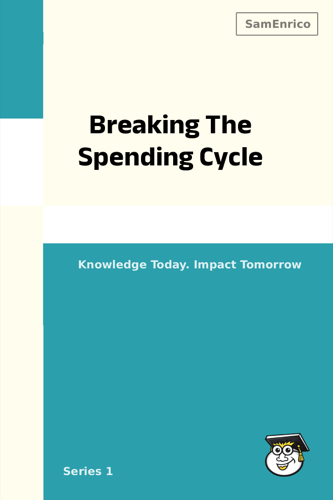
Breaking The Spending Cycle eBook
Identify emotional triggers that lead to compulsiv
Identify emotional triggers that lead to compulsive shopping and build healthier financial habits.
Formats
Free sample
Chapter 1: The Dopamine Trap--–- The first time I understood that wanting and having are two完全不同的事情 was not in a therapist’s office or a financial planning seminar. It was at 2:00 AM on a Tuesday, sitting on my bathroom floor in a one-bedroom apartment I could barely afford, surrounded by twelve unopened Amazon boxes. I didn’t need a single thing in those boxes. I couldn’t even remember ordering three of them. But for thirty glorious seconds after I clicked “Buy Now” on each one, I had felt something that resembled hope.
That was the problem. And if you are reading this book, that is probably your problem too.This is not a book about budgeting. It is not a book about couponing, or extreme frugality, or shaming yourself into submission. There are plenty of books that will tell you to “just stop spending” as if willpower were a light switch you have simply forgotten to flip. This book is not that.
This book is a field guide to the neurological war happening inside your skull every time you see a “limited time offer” or feel the urge to browse a sale section at midnight. It is about why you keep losing that war, and how to finally stop fighting yourself long enough to change the rules of the game.Let us begin with a confession that might make you uncomfortable: compulsive spending is not about money. Money is the symptom. The disease is a biochemical loop that has been hijacked by a trillion-dollar industry that understands your brain better than you do. And the first step to breaking that loop is understanding exactly how it works.
This chapter will give you the map of that loop, introduce you to the two very different types of spenders who get trapped in it, and help you identify which one you are. By the time you finish reading, you will never look at a “sale” sign the same way again.The Biochemistry of Regret Let us talk about dopamine. You have heard of it, probably as the “pleasure chemical,” but that is not quite right. Dopamine is not the chemical of pleasure. It is the chemical of anticipation.
It is the molecule of “maybe.” Every time you see something you want—a pair of shoes, a new gadget, a vacation package, even a notification that a package has shipped—your brain releases a small burst of dopamine. That burst feels like excitement, possibility, hope. It feels like this purchase will make things better.Here is the cruel trick: the dopamine rush peaks before you buy, not after. The moment you click “Buy Now” or hand over your credit card, dopamine levels begin to fall. They are replaced by a second chemical: cortisol, the stress hormone.
Cortisol is what creates the feeling of regret, shame, and anxiety that hits anywhere from ten minutes to two days after a purchase. That sick feeling in your stomach when you look at your bank account? That is cortisol. That whispered voice saying “Why did I do that again?” That is cortisol. The hangover after the high.This is not a moral failing.
This is biology. Your brain evolved this system millions of years ago to help you hunt for food, seek shelter, and pursue mates. The dopamine-cortisol loop kept your ancestors alive. The problem is that modern marketing has figured out how to trigger that loop on demand, hundreds of times per day, with no off switch. Every “flash sale,” every “only three left,” every perfectly timed email with a discount code is designed to spike your dopamine and delay your cortisol just long enough for you to complete the transaction.But here is what most books get wrong.
They assume that everyone experiences this loop the same way. They assume that all compulsive spending is the same behavior with the same cause. That is like saying all fires are the same because they all produce smoke. In reality, there are two distinct ways people get trapped in the spending cycle, and they require completely different solutions. You cannot treat a kitchen grease fire the same way you treat a forest fire.
And you cannot treat a Shopaholic the same way you treat a Spendaholic.The Two Faces of Compulsive Spending Meet Sarah. Sarah loves to browse. She spends hours on clothing websites, adding items to her cart, removing them, adding them back. She follows her favorite brands on Instagram and Tik Tok. She lives for the thrill of discovery—the moment she finds a perfect item she had not been looking for.
Sarah rarely buys the first thing she sees. She hunts. She compares. She waits for sales. And then, when the conditions are perfect, she strikes.
The purchase itself is almost an afterthought. The high was in the hunt.Meet James. James does not browse. He buys. When James feels stressed, anxious, or lonely, he opens Amazon, searches for whatever solution his brain has latched onto (a new kitchen gadget, a fitness tracker, a book he will never read), and buys it within sixty seconds.
He does not comparison shop. He does not wait for sales. He buys, closes the tab, and feels a brief wave of relief. The high is in the acquisition—the moment when the thing becomes his. The problem is that the relief never lasts.
Within days, the item arrives, and James feels nothing. Sometimes he does not even open the box.Sarah is a Shopaholic. James is a Spendaholic. They look similar on paper—both have credit card debt, both have closets full of unused items, both feel shame after a spending binge. But their internal experiences could not be more different.
Sarah is chasing excitement. The dopamine loop for her is triggered by novelty, discovery, and the thrill of the chase. James is trying to numb pain. His dopamine loop is triggered by the promise of relief from an uncomfortable emotional state.Why does this distinction matter? Because if you try to fix a Shopaholic with Spendaholic tools, you will fail.
Telling Sarah to “just stop browsing” is like telling an alcoholic to “just stop being thirsty.” Browsing is not a bad habit for her; it is the entire source of the high. Taking away browsing without replacing it with something equally engaging will leave her feeling empty, and she will relapse harder. Conversely, telling James to “wait 72 hours before buying” will work beautifully—because he does not care about the hunt. He just wants the pain to stop. The waiting period forces him to sit with his discomfort long enough for the urge to pass.You need to know which one you are.
By the end of this chapter, you will.The Excitement-Seeker vs. The Pain-Numb-er Let us go deeper into the neuroscience. Both Shopaholics and Spendaholics experience dopamine spikes before a purchase. That is universal. The difference lies in what triggers that spike.For the Excitement-Seeker (the Shopaholic), the trigger is novelty and possibility.
Their brains are wired to respond to new information, unexpected rewards, and the feeling of discovery. This is why they can spend three hours on a shopping website and buy nothing—the…
This is the end of the free sample. Get the eBook to keep going. Buy now
About this book
Details
- Author
- Huntington Cassondra
- Publisher
- SamEnrico
- Language
- English
- Genre
- Non-Fiction, Self-Help, Finance
- Released
- 2026-06-08
- Pages (approx.)
- 151
- Available as
- eBook, Audiobook

Read better in the ZLOADR app
Your eBooks on your phone or tablet. Sign in with your SamEnrico account and start reading.
More by Huntington Cassondra
 Caregiver Stress Relationship GuideHuntington Cassondra$11.99
 Uber Acceptance Rate StrategyHuntington Cassondra$11.99
 Operating Cash Flow GuideHuntington Cassondra$11.99
 Mobile Game Addiction FixHuntington Cassondra$11.99
 Value Based Inflation PricingHuntington Cassondra$11.99
 The Community Fridge FounderHuntington Cassondra$11.99
 Growth Mindset for ConstructionHuntington Cassondra$11.99
 The Wrongful Conviction of Simon Mokoena: A Fight for Justice in South AfricaHuntington Cassondra$11.99
 The Hollow Crown: A Queen’s Forgotten WarHuntington Cassondra$11.99
 How to Start a Anti-sprouting Products Business (Beginners Guide)Huntington Cassondra$11.99
 Venture Debt Prepayment GuideHuntington Cassondra$12.99
 Webhook and Notification API GuideHuntington Cassondra$12.99
You may also like
 Hong Kong Handover 1997Dunn Johnnie$11.99
 Zumba For Postnatal Recovery CourseNeal Christian$11.99
 Zumba for BeginnersLadner Nikia$11.99
 YouTube Comment Mining GuideHumes Pandora$12.99
 Worry Box MeditationCarlin Rudy$11.99
 Workplace Stress MeditationNguyen Lynn$11.99
 Workplace Stress and Sleep RepairHawley Ivory$11.99
 Workplace Perfectionism CureDelaney Jeffry$11.99
 Workplace Injustice Anger GuideWallen Isabelle$11.99
 Work Addiction and Burnout LinkGreenwood Ester$11.99
 Women in Yoga and WellnessBeattie Galina$11.99
 Women in Stand Up ComedyChun Evangeline$11.99