
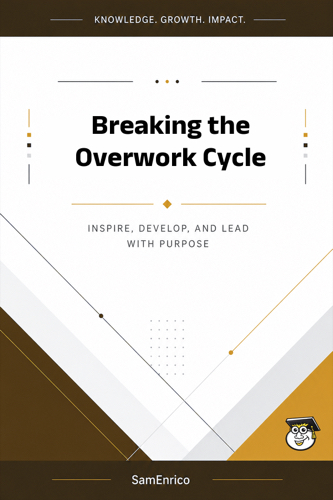
Non-FictionSelf-HelpBehavioral Change
Breaking the Overwork Cycle eBook
Teaches step by step methods to interrupt compulsi
by Ohler Dotty
Teaches step by step methods to interrupt compulsive working patterns.
Formats
Free sample
Chapter 1: The Best-Dressed Problem--–- It is a Tuesday evening, and you are still at your desk. The office is half-empty, the cleaning crew has already come and gone, and the only light comes from your screen and the emergency exit sign down the hall. You have answered forty-seven emails today, attended six meetings, produced a report that no one will read carefully, and yet you feel a familiar, gnawing sensation: it is not enough. You should do one more thing. Just one more task.
Then you can leave.But you have said that to yourself four times already today.Your phone buzzes. It is your partner, asking if you are coming home for dinner. You glance at the message, feel a flash of irritation—don't they understand how busy I am?—and set the phone face-down. You will reply later. First, this one email.
Then maybe that spreadsheet. Then—Three hours later, you drive home exhausted, eat cold leftovers standing over the sink, and fall into bed. Your partner is already asleep, facing away from you. You lie in the dark, heart still racing, mind still churning through tomorrow's to-do list. You cannot sleep.
You are thinking about the project due Friday. You are thinking about the client who seemed disappointed. You are thinking about the colleague who got the promotion you wanted.And somewhere, beneath the exhaustion, you feel a strange comfort. At least you are working hard. At least you are trying.
At least no one can say you are lazy.This is the overwork cycle. And this chapter will show you why it is the most dangerous addiction you have never been asked to quit.The Paradox at the Heart of Modern Work Let us begin with an uncomfortable truth: workaholism is the only addiction that society regularly rewards.If you were drinking a bottle of whiskey every night, your boss would be concerned. If you were gambling away your savings, your family would stage an intervention. If you were using cocaine to get through the workday, Human Resources would mandate treatment. But if you are sleeping four hours a night, answering emails at midnight, skipping your child's school play for a conference call, and feeling anxious whenever you are not being productive—we give you a promotion.
We call you dedicated. We hold you up as an example.This is the paradox at the heart of modern work: the very behaviors that destroy your health, your relationships, and eventually your performance are the same behaviors that earn you praise, bonuses, and status.The research is unambiguous. Bryan E. Robinson, one of the world's leading researchers on workaholism, has spent decades documenting how compulsive overworking follows the same neurological and psychological patterns as substance addiction. The difference is that no one tells the workaholic to stop.
The workaholic is too valuable. Too driven. Too essential. At least, that is what everyone says—including the workaholic themselves.But here is what we rarely say out loud: the workaholic is not essential. They are addicted.
And the organization that praises them is not their benefactor. It is their enabler.The Hard Worker Versus the Workaholic Before we go any further, we must make a critical distinction. Not everyone who works long hours is a workaholic. There is a profound difference between a hard worker and a workaholic, and understanding this difference is the first step toward breaking the cycle.The hard worker chooses to work intensely. They may put in fifty or sixty hours during a busy season, but they can stop.
When the work is done, they walk away without guilt, without anxiety, without the compulsive need to find another task. Their identity is not wrapped up in their productivity. They work hard because the situation demands it, not because they cannot bear the alternative.The workaholic, by contrast, does not choose to work. They are driven to work. The difference is between agency and compulsion.
The workaholic feels anxious, irritable, or empty when not working. They take work to bed—not just their laptop, but the mental rumination, the to-do list running on a loop behind their eyes. They grow impatient with non-work conversation because it feels like a distraction from what really matters. They measure their worth in output, their days in tasks completed, their lives in productivity metrics.The hard worker finishes the project and celebrates. The workaholic finishes the project and immediately panics about the next one.This distinction matters because our culture has systematically confused the two.
We see the workaholic's endless hours and call it dedication. We see the hard worker's boundaries and call it laziness. We have built an entire professional world that rewards compulsive behavior while punishing sustainable excellence.The Machine Mindset: How We Learned to Treat Humans Like Processors How did we get here? How did exhaustion become a status symbol and rest become a sign of weakness?The answer lies in what I call the Machine Mindset—a deep, often invisible belief that humans should function like computers or industrial equipment: always on, endlessly efficient, and indifferent to fatigue, emotion, or the need for recovery.The Machine Mindset has ancient roots. The Industrial Revolution trained factory owners to see workers as interchangeable parts.
The rise of scientific management turned human labor into a set of measurable, optimizable movements. But the Machine Mindset reached its full expression in the digital age, where smartphones, email, and productivity software have blurred every boundary between work and life.Consider the language we use. We talk about "bandwidth" and "processing power." We say we are "running at capacity" or "maxing out our CPU." We describe ourselves as "rebooting" after vacation. This is not innocent metaphor. It reveals a fundamental assumption: that the ideal human worker is one who never needs to stop, who never gets tired, who never has an off day.But humans are not machines.
Machines degrade predictably; humans burn out unpredictably. Machines can run 24/7 with proper maintenance; humans need sleep, rest, play, and meaning. Machines don't have emotions; humans do. And when we try to suppress those emotions through compulsive work, we do not become more efficient. We become more brittle.
More reactive. More likely to crash.The Machine Mindset is the cultural water we swim in. It tells you that being busy is the same as being valuable. It tells you that rest must be earned through productivity. It tells you that if you are not exhausted, you are not trying hard enough.
And it is wrong about all of it.The Work/Life Rubicon: Have You Already Crossed It?At some point, in every overworker's trajectory, there is a line. Not a line they choose to cross, but a line they drift across, slowly, invisibly, until one day they look up and realize they cannot remember the last time they felt truly off the clock.I call this the Work/Life Rubicon—named for the river Julius Caesar crossed when he committed to a path from which there was no easy return. Once you cross the Rubicon, your relationship with work has fundamentally changed. You are no longer someone who works hard. You are someone who cannot stop.How do you know if you…
This is the end of the free sample. Get the eBook to keep going. Buy now
About this book
Details
- Author
- Ohler Dotty
- Publisher
- SamEnrico
- Language
- English
- Genre
- Non-Fiction, Self-Help, Behavioral Change
- Released
- 2026-06-06
- Pages (approx.)
- 124
- Available as
- eBook, Audiobook

Read better in the ZLOADR app
Your eBooks on your phone or tablet. Sign in with your SamEnrico account and start reading.
More by Ohler Dotty
 Urgent Interruption Triage CourseOhler Dotty$11.99
 Loving Kindness Before SleepOhler Dotty$11.99
 Self Hypnosis for Yoga PracticeOhler Dotty$11.99
 The Sands of El Alamein: Rommel's Last Stand in the DesertOhler Dotty$11.99
 Ultimate Handbook Guide to Dali : (China) Travel GuideOhler Dotty$11.99
 Sign MakerOhler Dotty$11.99
 Cross Border Payment Reconciliation Errors GuideOhler Dotty$12.99
 How to Produce Air Hockey TablesOhler Dotty$11.99
You may also like
 Hong Kong Handover 1997Dunn Johnnie$11.99
 Zumba For Postnatal Recovery CourseNeal Christian$11.99
 Zumba for BeginnersLadner Nikia$11.99
 YouTube Comment Mining GuideHumes Pandora$12.99
 Worry Box MeditationCarlin Rudy$11.99
 Workplace Stress MeditationNguyen Lynn$11.99
 Workplace Stress and Sleep RepairHawley Ivory$11.99
 Workplace Perfectionism CureDelaney Jeffry$11.99
 Workplace Injustice Anger GuideWallen Isabelle$11.99
 Work Addiction and Burnout LinkGreenwood Ester$11.99
 Women in Yoga and WellnessBeattie Galina$11.99
 Women in Stand Up ComedyChun Evangeline$11.99