
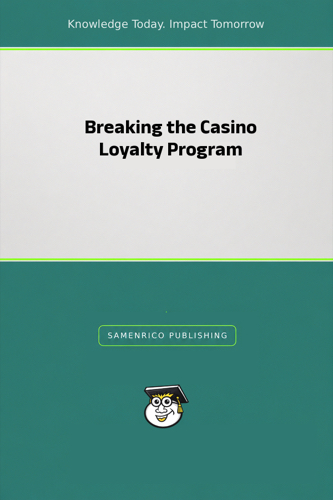
Non-FictionSelf-HelpLoyalty Detox
Breaking the Casino Loyalty Program eBook
Cancel casino memberships, forfeit points, and rem
Cancel casino memberships, forfeit points, and remove rewards program temptations.
Formats
Free sample
Chapter 1: The Five-Dollar Leash--–- The envelope arrived on a Tuesday. Standard postal issue, white with a cellophane window, nothing remarkable except for the casino logo embossed in gold foil on the back flap. Inside, a single sheet of heavy cardstock. "Congratulations, Valerie! You've earned $5 in FREE SLOT PLAY.
No purchase necessary. Just insert your player card at any machine."Valerie was a fifty-two-year-old middle school math teacher. She knew probability better than most of the people who would read this book. She had taught the law of large numbers to fourteen-year-olds for twenty-six years. And yet, when she saw that five-dollar voucher, she did not think about expected value.
She thought about the buffet. She thought about the way the lights reflected off the chrome edges of the slot machines. She thought about the sound of coins falling—even though coins hadn't fallen from slot machines in decades.She drove forty-five minutes to the riverboat casino on a Thursday night. She played the five dollars on a penny slot called Dancing Dragons. She won forty-three dollars.
Then she lost it. Then she pulled a twenty from her wallet. Then another. By the time she looked at her watch, three hours had passed, and she had lost four hundred and eighty dollars—almost an entire week's take-home pay after deductions.On the drive home, she said to herself: "But I only went for the free play."That sentence, spoken by millions of gamblers every single day, is the subject of this chapter. It is the most expensive sentence in the English language.The Mental Accounting Fallacy: Your Brain's Built-in Casino The human brain did not evolve in environments with free-play vouchers, loyalty points, or tier status.
It evolved in environments of scarcity, where a free piece of fruit meant survival and a free piece of meat meant the difference between feeding your children or watching them starve. When your brain encounters the word "free," it activates the same neural circuits that once responded to the discovery of a berry bush. That is not an excuse. That is a design flaw, and the casino industry has spent billions of dollars exploiting it.Mental accounting is the cognitive bias where people treat money differently depending on its source or intended use. You might find a twenty-dollar bill on the sidewalk and spend it on a luxury coffee drink, but you would never withdraw twenty dollars from your savings account for the same purpose.
The money is identical. The mental category is not.Casinos weaponize this bias by creating a new mental category: "house money." Money you received from the casino—whether as a free-play voucher, a comped meal, or a small win—feels different from money you earned at your job. It feels like a gift. It feels like you have nothing to lose because you never had anything invested.This is a lie.Every dollar the casino gives you is a dollar they expect to collect back with interest. The free-play voucher is not a gift; it is a down payment on your future losses.
The comped buffet is not a thank-you; it is an investment in your continued presence. The casino is not a generous uncle. It is a publicly traded corporation with a legal obligation to maximize shareholder value. That obligation is met by extracting as much money from you as possible, as efficiently as possible, for as long as possible.The Loss Rebate: How the Casino Turns Your Freebie Into Their Profit In the world of high-stakes gambling, there is a concept called the "loss rebate." A casino might offer a high roller a 10 percent rebate on any net losses at the end of a weekend. If you lose $100,000, the casino gives you back $10,000.
On its face, this sounds generous. It is not.The loss rebate works because it changes the gambler's risk calculation. When you know you will get back 10 percent of whatever you lose, you are willing to bet larger amounts. You are willing to stay longer. You are willing to chase losses because the rebate acts as a cushion.
The casino knows that the increased betting volume will more than offset the rebate payments. They have run the numbers. They always run the numbers.The free-play voucher is the mass-market version of the loss rebate. The casino gives you five dollars. That five dollars has a cost to them—negligible, given that they own the machines and the electricity and the labor is already sunk.
But to you, that five dollars feels like a rebate. It feels like you are playing with an advantage. And because you feel like you have nothing to lose, you are willing to risk money you would otherwise keep in your wallet.Valerie's five-dollar voucher cost the casino approximately zero dollars to produce. The marginal cost of printing the cardstock and paying for the postage was less than a dollar. That five-dollar voucher generated nearly five hundred dollars in losses.
The casino made a 50,000 percent return on its investment.That is not gambling. That is arithmetic.The Math Table: What "Free" Actually Costs Let us put aside emotion and look at the numbers. The following table is based on publicly available data from casino financial reports and academic studies of gambling behavior. These are not estimates. These are audited figures.Value of Comp Average Player Loss per Comp Dollar$5 free play$240 - $400$25 dinner buffet$750 - $1,250$100 hotel room$3,000 - $5,000$500 airline voucher$15,000 - $25,000One-night cruise package$8,000 - $12,000If you are reading this and thinking, "But I would never lose that much for a buffet," you are missing the point.
The average includes you. The casino does not need every player to lose thousands of dollars for a buffet. They need a small percentage of players to lose enormous amounts. The comps are the bait. The whales are the catch.
And the comps are designed to convert normal players into whales over time.The process is gradual. You accept a five-dollar voucher and lose fifty dollars. That feels like a bad night, not a systemic problem. You accept a twenty-five-dollar free-play offer and lose two hundred dollars. That feels unlucky.
You accept a hundred-dollar free-play offer and lose eight hundred dollars. That feels like you are due for a win. And then one day, you look at your bank statement and realize you have lost ten thousand dollars over eighteen months, and you cannot remember a single specific loss that felt like the turning point.There is no turning point. There is only the slow, steady extraction of value from a system designed to exploit your brain's vulnerabilities.Why "Earning Points" Is Always a Losing Proposition Every loyalty program in every industry exists to modify your behavior. Airline miles encourage you to fly the same carrier even when a competitor is cheaper.
Grocery store loyalty cards encourage you to shop at one chain instead of another. These programs are not charity. They are marketing.But casino loyalty programs are different in one critical way: the underlying product has a negative expected value for the consumer. Every spin of a slot machine, every hand of blackjack, every roll of the dice is mathematically designed to…
This is the end of the free sample. Get the eBook to keep going. Buy now
About this book
Details
- Author
- Albert Kanisha
- Publisher
- SamEnrico
- Language
- English
- Genre
- Non-Fiction, Self-Help, Loyalty Detox
- Released
- 2026-06-09
- Pages (approx.)
- 136
- Available as
- eBook, Audiobook

Read better in the ZLOADR app
Your eBooks on your phone or tablet. Sign in with your SamEnrico account and start reading.
More by Albert Kanisha
 Negative State Relief GuideAlbert Kanisha$11.99
 Energy Sector Transaction AnalysisAlbert Kanisha$11.99
 Ayurvedic Heart HealthAlbert Kanisha$11.99
 The Neighbor TraffickerAlbert Kanisha$11.99
 Birthday Spending AddictionAlbert Kanisha$11.99
 Riptide Escape SkillsAlbert Kanisha$11.99
 Cannabis BipolarAlbert Kanisha$11.99
 The Last Stand of the Ball Boys: The Untold Story of the 1972 ABA FinalsAlbert Kanisha$11.99
 The Clockmaker of Leiden: Huygens and the Birth of PrecisionAlbert Kanisha$11.99
 How to Produce Horse and Livestock TrailersAlbert Kanisha$11.99
 Service Providers Guide to Fireplace Installation & RepairAlbert Kanisha$11.99
 NVIDIA Remote Internship GuideAlbert Kanisha$12.99
You may also like
 Hong Kong Handover 1997Dunn Johnnie$11.99
 Zumba For Postnatal Recovery CourseNeal Christian$11.99
 Zumba for BeginnersLadner Nikia$11.99
 YouTube Comment Mining GuideHumes Pandora$12.99
 Worry Box MeditationCarlin Rudy$11.99
 Workplace Stress MeditationNguyen Lynn$11.99
 Workplace Stress and Sleep RepairHawley Ivory$11.99
 Workplace Perfectionism CureDelaney Jeffry$11.99
 Workplace Injustice Anger GuideWallen Isabelle$11.99
 Work Addiction and Burnout LinkGreenwood Ester$11.99
 Women in Yoga and WellnessBeattie Galina$11.99
 Women in Stand Up ComedyChun Evangeline$11.99