
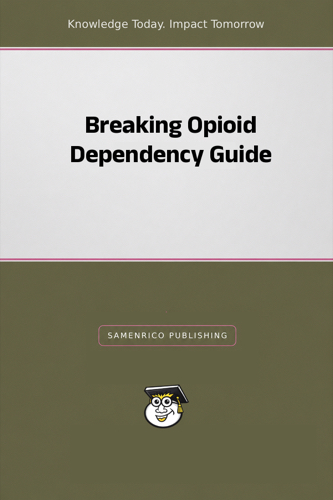
Breaking Opioid Dependency Guide eBook
Offers a step-by-step withdrawal and recovery plan
Offers a step-by-step withdrawal and recovery plan for prescription and illicit opioid use.
Formats
Free sample
Chapter 1: The Willpower Lie--–- You have probably said this to yourself at least once in the past week. Maybe you said it this morning, staring at your own reflection in a bathroom mirror, barely recognizing the person looking back. Maybe you said it last night, lying awake at 3 AM, heart racing, sweat soaking through your sheets, already planning how you would get well before the sun came up. Maybe you whispered it after you used again, even though you had promised yourself—sworn on everything you loved—that this time would be different.The sentence is simple. It feels true.
It goes like this: “If I just had more willpower, I could stop.”Behind that sentence is a story you have been told your entire life. It is the story of addiction that dominates movies, news reports, intervention television shows, and the whispered conversations in church basements and family kitchens. The story says that addiction is a moral failure. That people use because they are weak. That if you really wanted to stop—if you loved your children enough, if you cared about your job enough, if you had any self-respect at all—you would simply put down the pills or the powder and walk away.
The story says that recovery is a test of character, and if you keep failing that test, the problem is not the drug. The problem is you.That story is wrong. And it is killing people.Not metaphorically. Literally. The shame generated by the willpower myth keeps people from seeking help.
It drives people to hide their use until it is too late. It convinces people that because they have tried to quit and failed—sometimes dozens of times—they must be fundamentally broken, beyond repair, unworthy of treatment. And so they keep using, not because they want to, but because they believe the lie that their failure to quit proves they are hopeless.This chapter exists to destroy that lie. Not gently. Not politely.
With the full force of neuroscience, clinical evidence, and the lived experience of millions of people who have walked the path you are walking right now.The Truth That Changes Everything Here is what the willpower myth gets backwards. When you try to quit opioids using sheer determination, you are not fighting a bad habit or a character flaw. You are fighting against a brain that has been physically, structurally, chemically rewired. Opioids do not just make you feel good. They hijack the most ancient, most powerful survival circuits in your nervous system—the same circuits that drive you to eat when you are starving, drink when you are dying of thirst, and run when your life is in danger.Think about that for a moment.
When you are dehydrated, you do not need willpower to drink water. You feel thirst as an overwhelming, undeniable drive. Your body does not ask for your permission. It simply demands. That is what opioids do to your brain.
They trick your survival circuitry into treating the drug as if it were water, food, or air. The craving you feel is not a sign of moral weakness. It is a sign that your brain has been reprogrammed to believe that without opioids, you will die.This is not metaphor. This is measurable neuroscience. Positron emission tomography scans of the brains of people with opioid use disorder show dramatic changes in the reward pathway—a network of structures including the ventral tegmental area, the nucleus accumbens, and the prefrontal cortex.
Under normal conditions, this pathway releases dopamine in response to natural rewards: a good meal, a hug from someone you love, the satisfaction of completing a difficult task. Under the influence of chronic opioid use, the brain dramatically reduces its own dopamine production. It becomes dependent on the drug to achieve any level of reward at all.This is why people in withdrawal describe feeling not just sick, but dead inside. Anhedonia—the inability to feel pleasure—is not a character defect. It is a neurochemical fact.
Your brain has forgotten how to feel joy without opioids. And it will take time, and the right tools, to teach it again.The Learning Disorder Paradigm Now we arrive at the reframe that will carry you through this entire book. Maia Szalavitz, a neuroscientist and journalist in long-term recovery, wrote a book called Unbroken Brain that changed how many experts think about addiction. Her argument is simple and radical: addiction is not a moral failure, not a disease in the traditional sense like cancer or diabetes, but a learning disorder.Let that land.A learning disorder means that your brain has learned a pattern—a deeply ingrained, automatic, almost reflexive pattern—that connects a specific trigger (pain, boredom, loneliness, a time of day, a specific person) to a specific behavior (using opioids). That pattern was learned through repetition, the same way you learned to ride a bike or play a song on the guitar.
At first, it required effort and intention. Then, with enough practice, it became automatic. Your brain literally built physical pathways—collections of neurons that fire together—that make using feel as natural as breathing.Here is the good news. Brains that can learn maladaptive patterns can also learn adaptive ones. Neuroplasticity—the brain’s ability to reorganize itself by forming new neural connections throughout life—means that you are not stuck with the brain you have.
Every time you successfully resist a craving, every time you use the TAMERS method you will learn in Chapter 5, every time you choose a different response to a trigger, you are physically weakening the old pathway and strengthening a new one.This is not positive thinking. This is biology. Neuroplasticity has been demonstrated in hundreds of peer-reviewed studies. London taxi drivers, who must memorize the city’s complicated street grid, develop larger hippocampi—the brain region involved in spatial memory. Musicians who practice daily develop thicker cortical representations for their fingers.
Stroke survivors who do intensive physical therapy can rewire healthy brain regions to take over functions lost to damaged tissue.If a stroke survivor can learn to walk again after part of their brain has died, you can learn to live without opioids. The mechanism is the same. Repetition. Practice. Patience.
And a fundamental belief that change is possible—not because you are morally good enough, but because your brain is biologically capable.The Recovery Zone System: Your Roadmap Through This Book Before we go any further, you need a map. This book is organized around a simple framework called the Recovery Zone System. Think of it as a traffic light for your nervous system. Different stages of recovery require different tools, and the Zone System helps you know what to use and when.The Red Zone is acute distress. This includes active withdrawal, the first hours and days after you stop using, and any moment when a craving is so intense that you feel like you might physically break.
In the Red Zone, your only job is survival. You do not do deep emotional work in the Red Zone. You do not analyze your childhood trauma or write amends letters to people you…
This is the end of the free sample. Get the eBook to keep going. Buy now
About this book
Details
- Author
- Martindale Drucilla
- Publisher
- SamEnrico
- Language
- English
- Genre
- Non-Fiction, Self-Help, Addiction
- Released
- 2026-06-12
- Pages (approx.)
- 133
- Available as
- eBook, Audiobook

Read better in the ZLOADR app
Your eBooks on your phone or tablet. Sign in with your SamEnrico account and start reading.
More by Martindale Drucilla
 Imposter PTSD HypervigilanceMartindale Drucilla$11.99
 Rwandan Church SurvivorMartindale Drucilla$11.99
 LTC Insurance For Couples GuideMartindale Drucilla$11.99
 Gift Buying StrategyMartindale Drucilla$11.99
 All Nighters Memory DamageMartindale Drucilla$11.99
 The Sack of Rome 1527Martindale Drucilla$11.99
 Ceremonial Feast Leadership GuideMartindale Drucilla$11.99
 First Responder PTSD PreventionMartindale Drucilla$11.99
 The Last Letter: Agatha Christie’s Vanishing ActMartindale Drucilla$11.99
 The Iron Duke’s Gambit: Wellington’s Masterstroke at SalamancaMartindale Drucilla$11.99
 Echoes from the Dawn: Africa’s Cosmic Pioneers and the Birth of the UniverseMartindale Drucilla$11.99
 Growing Platystemon (Creamcups)Martindale Drucilla$11.99
You may also like
 Hong Kong Handover 1997Dunn Johnnie$11.99
 Zumba For Postnatal Recovery CourseNeal Christian$11.99
 Zumba for BeginnersLadner Nikia$11.99
 YouTube Comment Mining GuideHumes Pandora$12.99
 Worry Box MeditationCarlin Rudy$11.99
 Workplace Stress MeditationNguyen Lynn$11.99
 Workplace Stress and Sleep RepairHawley Ivory$11.99
 Workplace Perfectionism CureDelaney Jeffry$11.99
 Workplace Injustice Anger GuideWallen Isabelle$11.99
 Work Addiction and Burnout LinkGreenwood Ester$11.99
 Women in Yoga and WellnessBeattie Galina$11.99
 Women in Stand Up ComedyChun Evangeline$11.99