
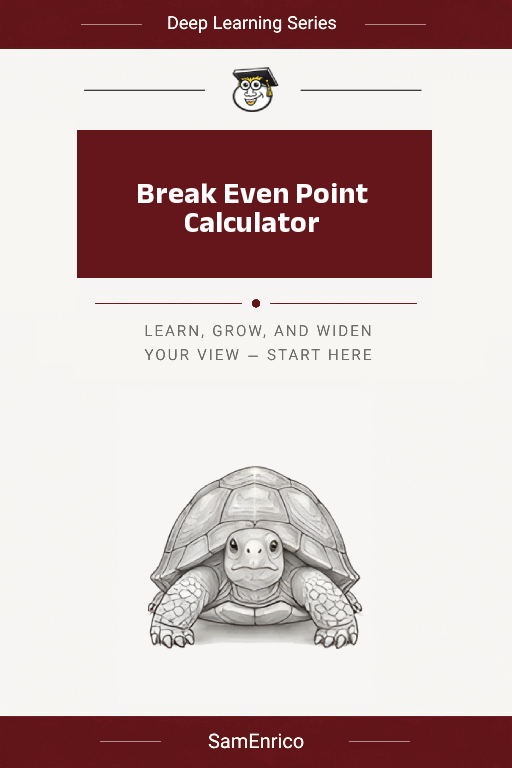
Non-FictionStudent's ShortcutCost Accounting
Break Even Point Calculator eBook
Find break even units using Fixed Costs divided by
by Abel Teressa
Find break even units using Fixed Costs divided by (Price minus Variable Cost per unit).
Formats
Free sample
Chapter 1: The Magic Place--–- Most business owners never find it. They spend years working harder than they ever imagined, sacrificing evenings and weekends, pouring their savings into inventory and equipment and marketing. They watch their revenue grow month after month. They celebrate when sales hit new records. And yet, at the end of every year, they look at their bank account and wonder where all the money went.
They are working more and earning less. They are busy, exhausted, and broke.They have not found the magic place.The magic place is called the break-even point. It is the level of sales where total revenue exactly equals total costs. No profit. No loss.
Every dollar beyond this point is profit. And every dollar below this point is loss. It sounds simple. It is simple. But most business owners have never calculated their break-even point.
They are flying blind, making decisions based on intuition and hope rather than mathematics and reality.This chapter will change that. You will learn what break-even really means, why it is the single most important number in your business, and how knowing it transforms every decision you make. By the end of this chapter, you will understand why most entrepreneurs fail—and how you will not be one of them.The Story of Two Coffee Shops Let me tell you about two coffee shop owners. Both opened their doors in the same month, on the same street, in the same mid-sized city. Both served similar coffee, similar pastries, and similar sandwiches.
Both had similar rent, similar equipment costs, and similar employee wages. On paper, they were identical businesses.But one knew her break-even point. The other did not.Maria, the first owner, had spent a week before opening calculating every cost she could think of. She listed her fixed costs: rent, equipment leases, insurance, her own salary, and the salaries of her two full-time employees. She calculated her variable costs: coffee beans, milk, pastries, cups, lids, and credit card fees.
She determined that her average contribution margin per cup—the amount left after subtracting variable costs from the selling price—was 2.50.Shedividedhermonthlyfixedcostsof2.50. She divided her monthly fixed costs of 2.50.Shedividedhermonthlyfixedcostsof6,250 by $2.50 and got 2,500. She needed to sell 2,500 cups of coffee every month just to break even.Maria tracked her sales daily. She knew that 2,500 cups per month meant about 84 cups per day. Every morning, she checked the previous day's count.
When sales lagged, she ran a promotion. When sales exceeded target, she banked the profit. She never made a major decision—hiring, price changes, new equipment—without running the break-even calculation first.David, the second owner, had never calculated his break-even point. He knew his rent. He knew what he paid for coffee beans.
But he had never added everything up. He priced his coffee a dollar less than Maria, thinking lower prices would bring more customers. He hired an extra employee because he felt busy. He added a line of expensive pastries without calculating how many he needed to sell to cover the cost.After six months, Maria was profitable. After six months, David was bankrupt.The difference was not luck.
It was not location. It was not even the quality of the coffee. The difference was that Maria knew her magic place. David did not.What Break-Even Really Means Let me give you the formal definition, because precision matters. The break-even point is the level of sales where total revenue equals total costs.
At that exact point, you make no profit and no loss. You have covered every expense—rent, payroll, materials, marketing, insurance, everything—but you have not yet made a dime of profit.Think of it as a line in the sand. Below that line, you are losing money. Every sale still helps—it covers some of your costs—but you are not yet in the black. Above that line, you are profitable.
Every sale after break-even puts money directly into your pocket.Here is the beautiful part: once you cross the break-even point, your profit grows faster than your sales. Why? Because your fixed costs are already covered. Every additional dollar of revenue after break-even flows mostly to profit. If your contribution margin is 30 percent, then after break-even, 30 cents of every dollar goes to profit.
Before break-even, that same 30 cents was going to cover fixed costs.This is why the break-even point is magic. It is the moment when your business stops fighting for survival and starts generating wealth.Why Most Entrepreneurs Fail The statistics are brutal. According to the Bureau of Labor Statistics, about 20 percent of small businesses fail in their first year. By the end of the fifth year, 50 percent have failed. By the end of the tenth year, 70 percent are gone.There are many reasons for these failures: undercapitalization, poor marketing, bad hiring, economic downturns.
But beneath all of them lies a common thread. Most failed business owners never knew their break-even point. They made decisions based on gut feelings rather than calculations. They lowered prices without understanding how many more units they needed to sell. They hired employees without knowing how much additional revenue was required to cover the new salaries.
They added products without calculating whether those products would ever become profitable.Businesses that track their break-even point are three times more likely to survive their first two years. That is not a coincidence. When you know your break-even point, you stop guessing. You stop hoping. You start managing.Break-Even as a Strategic Filter Here is the most important idea in this chapter: break-even is not just a calculation.
It is a strategic filter. Every major business decision should be evaluated through the lens of your break-even point.Before you launch a new product, run the break-even calculation. How many units do you need to sell to cover the fixed costs of developing and marketing that product? If the number is unrealistic, do not launch.Before you hire a new employee, run the break-even calculation. How much additional revenue do you need to generate to cover their salary, benefits, and training costs?
If you cannot see a path to that revenue, do not hire.Before you open a new location, run the break-even calculation. How many customers do you need per day to cover the additional rent, utilities, and staffing? If that number exceeds the traffic you have seen at similar locations, do not open.Before you lower your prices to compete, run the break-even calculation. How many additional units do you need to sell just to stay where you are? You might be surprised.
A 10 percent price cut often requires a 50 percent increase in volume just to break even. That is a dangerous trade.This filter saves businesses from costly mistakes. It forces you to confront reality before you commit resources. It replaces wishful thinking with cold, hard math.Break-Even vs. Cash Flow: A Critical Distinction Before we go further, I need to clarify something important.
Break-even is not the same as cash flow. They are related, but they are not the same, and confusing them can get you into trouble.Break-even tells you when you become profitable on an accounting basis. It uses accrual…
This is the end of the free sample. Get the eBook to keep going. Buy now
About this book
Details
- Author
- Abel Teressa
- Publisher
- SamEnrico
- Language
- English
- Genre
- Non-Fiction, Student's Shortcut, Cost Accounting
- Released
- 2026-06-01
- Pages (approx.)
- 129
- Available as
- eBook, Audiobook

Read better in the ZLOADR app
Your eBooks on your phone or tablet. Sign in with your SamEnrico account and start reading.
More by Abel Teressa
 Parkinson's Pain PracticeAbel Teressa$11.99
 Debugging Creative GuideAbel Teressa$11.99
 Gaming and DepressionAbel Teressa$11.99
 Email Wholesaling CampaignsAbel Teressa$11.99
 Blue Zone Cheese GuideAbel Teressa$11.99
 Faith and Pregnancy LossAbel Teressa$11.99
 Side Hustle Tax PrimerAbel Teressa$11.99
 Anger Restructuring for BorderlineAbel Teressa$11.99
 The Blood Price of Damascus: The Bounty Hunter Who Outwitted the Ottoman EmpireAbel Teressa$11.99
 A Collector's Handbook to the Alfa Romeo Alfetta SaloonAbel Teressa$11.99
 The Essential Guide to Drone )with Thx to Robert Conrod)Abel Teressa$11.99
 How to Produce Reptile and Amphibian SubstratesAbel Teressa$11.99
You may also like
 Hong Kong Handover 1997Dunn Johnnie$11.99
 Zumba For Postnatal Recovery CourseNeal Christian$11.99
 Zumba for BeginnersLadner Nikia$11.99
 YouTube Comment Mining GuideHumes Pandora$12.99
 Worry Box MeditationCarlin Rudy$11.99
 Workplace Stress MeditationNguyen Lynn$11.99
 Workplace Stress and Sleep RepairHawley Ivory$11.99
 Workplace Perfectionism CureDelaney Jeffry$11.99
 Workplace Injustice Anger GuideWallen Isabelle$11.99
 Work Addiction and Burnout LinkGreenwood Ester$11.99
 Women in Yoga and WellnessBeattie Galina$11.99
 Women in Stand Up ComedyChun Evangeline$11.99