
Non-FictionConsumer Mind ReportBrand Strategy
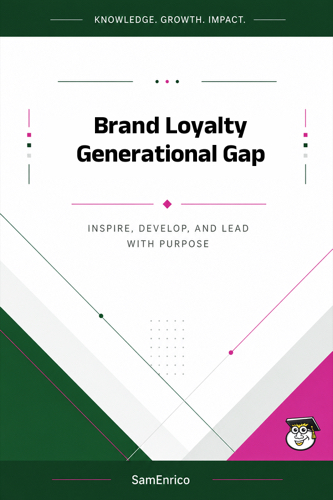
Brand Loyalty Generational Gap eBook
Understand why Boomers stay loyal while Gen Z swit
Understand why Boomers stay loyal while Gen Z switches brands frequently.
Formats
Free sample
Chapter 1: The Loyalty Chasm--–- The needle on the loyalty meter is moving—but not in the same direction for everyone.A Baby Boomer walks into a grocery store, picks up the same brand of ketchup she has bought for thirty years, and doesn't think twice. The bottle could be placed on any shelf, at any height, behind any competing product, and she would find it. She isn't comparing prices. She isn't scanning reviews. She isn't wondering if there is something better.
She already knows what she wants, and she wants what she already knows.A Gen Z shopper opens her phone. She needs laundry detergent. She scrolls through twelve reviews on Amazon, checks three Tik Tok unboxing videos, reads two Reddit threads comparing environmental impact, looks up the parent company's labor practices on a third-party app, and still can't decide whether to try a new direct-to-consumer brand that claims carbon neutrality or stick with the Tide she used at her parents' house.One purchase. Two completely different decision-making processes. One generation buys on autopilot.
The other buys on investigation.This is not a stereotype. It is not a generational insult dressed up as insight. It is a documented behavioral divide that is reshaping how brands must think about loyalty, trust, and customer retention. And it is one of the most consistently replicated findings in modern consumer research.The Numbers That Define the Divide Let us begin with the data, because the data does not lie. It also does not exaggerate.Recent survey research from Hall & Partners reveals that 66 percent of US consumers over the age of thirty say they always or mostly purchase the same brands.
Among Gen Z consumers—those born approximately between 1997 and 2012—that figure drops to 55 percent. An eleven-percentage-point gap separates the loyalty behaviors of older consumers from the youngest generation of adult shoppers.Eleven percentage points may not sound dramatic. But in the world of consumer goods, where market share is won and lost at the margins, eleven points is a chasm. It represents millions of dollars in potential revenue. It represents millions of customers who are up for grabs in ways they were not a generation ago.
It represents a fundamental shift in the relationship between consumer and brand.Even more revealing is the preference gap. When asked whether they prefer familiar brands over trying new ones, 70 percent of over-thirty consumers express that preference. Among Gen Z, that number falls to 63 percent. The gap between preference for familiar versus unknown brands is 40 percent among older consumers but narrows to just 25 percent among younger ones.Read that again. Older consumers are nearly twice as likely to stick with what they know.These numbers come from a 2024 study that surveyed thousands of consumers across the United States.
They are not outliers. They are consistent with a growing body of research from sources including the Boston Consulting Group, the Zeno Group, and the Ehrenberg-Bass Institute. The loyalty gap is real. It is measurable. And it is growing.What This Means for Brands For decades, brand loyalty was treated as a predictable asset.
The marketing playbook was simple: build a quality product, deliver consistent service, invest in advertising to build awareness, and customers would stay. Repeat purchases were assumed. Switching was the exception, not the rule.That model still works for Baby Boomers and Gen X. It no longer works for Millennials and Gen Z.This is not because younger consumers are less discerning. In fact, they are often more discerning—but in different ways.
They hold fewer favorite brands, but those brands matter more to their identity. Research from the Zeno Group found that Gen Z holds an average of only three to five brands they consider themselves truly loyal to, compared to eight to twelve for Boomers. The loyalty portfolio has shrunk, but the emotional investment per brand has deepened.Nearly six in ten Gen Zers report feeling a connection with people who use the same brands they do. Almost half admit to judging others by their brand choices. For them, brand loyalty is not about habit or convenience—it is about belonging, identity, and social signaling.A Boomer buys a Toyota because her last Toyota lasted two hundred thousand miles.
A Gen Z consumer buys a Patagonia jacket because of what it says about her values. One is loyalty to reliability. The other is loyalty to identity.Both are valid. But they require completely different brand strategies.The Generational Caveat Before we go further, a necessary word of caution about generational categories themselves.The birth years used throughout this book—Baby Boomers (approximately 1946-1964), Gen X (1965-1980), Millennials (1981-1996), and Gen Z (1997-2012)—are useful generalizations. They help us see patterns.
They help us understand the formative experiences that shaped each cohort's relationship with brands, trust, and technology.But they are not destiny. A person born in 1964 could identify as either a Boomer or a Gen X, depending on their cultural context. A young Millennial and an old Gen Z born a year apart may have more in common with each other than with the far ends of their generational labels. Within every generation, there is wide variability in income, education, geography, and life experience.The value of generational analysis is not in pigeonholing individuals. It is in understanding the water in which different cohorts learned to swim.
The Baby Boomer who grew up with three television channels and Saturday morning commercials learned a different set of consumer habits than the Gen Z who grew up with Tik Tok, Instagram, and the ability to fact-check a brand's sustainability claims in real time.With that caveat firmly in place, let us dive into the forces that created the loyalty chasm.The Silent Generation to Boomers: The Era of Broadcast Loyalty To understand why Boomers stay loyal, you have to understand the world in which they formed their consumer habits.The oldest Boomers came of age in the 1960s and 1970s. This was the golden age of mass marketing. Television was the dominant medium. A brand that could afford a prime-time commercial reached millions of households simultaneously. The message was one-directional: brand speaks, consumer listens.Choice was limited.
A grocery store carried two or three options for ketchup, not twenty. A department store offered a handful of television brands, not dozens. Switching required effort—physically going to a different store, asking a salesperson for recommendations, trusting word of mouth from friends and family. Information asymmetry favored the brand.In this environment, loyalty was rational. Once you found a product that worked, why risk switching?
The cost of researching alternatives was high. The reward was uncertain. Better to stick with the devil you knew.This is not just historical nostalgia. The habits formed in young adulthood tend to persist. Research in cognitive psychology shows that consumer preferences solidify in early adulthood and become increasingly resistant to change as we age.
A Boomer who chose Crest toothpaste at twenty-two is likely to still choose Crest at sixty-two—not because she has evaluated the alternatives recently, but because the habit is deeply encoded.Boomers also grew up with a different expectation of corporate behavior. Brands were not expected to have values beyond…
This is the end of the free sample. Get the eBook to keep going. Buy now
About this book
Details
- Author
- Amaya Nathalie
- Publisher
- SamEnrico
- Language
- English
- Genre
- Non-Fiction, Consumer Mind Report, Brand Strategy
- Released
- 2026-06-08
- Pages (approx.)
- 118
- Available as
- eBook, Audiobook

Read better in the ZLOADR app
Your eBooks on your phone or tablet. Sign in with your SamEnrico account and start reading.
More by Amaya Nathalie
 Imposter Syndrome Legacy GuideAmaya Nathalie$11.99
 Distraction Deflection Phrases WorkbookAmaya Nathalie$11.99
 Reverse Mortgage IncomeAmaya Nathalie$11.99
 Sleep Memory For Medical StudentsAmaya Nathalie$11.99
 Ray Charles GeorgiaAmaya Nathalie$11.99
 Anger in Co ParentingAmaya Nathalie$11.99
 Keto For Shift WorkersAmaya Nathalie$11.99
 The Last Broadcast: The Titanic's Forgotten Radio OperatorsAmaya Nathalie$11.99
 The Cairo Forger: The First Fingerprint Trial in the Middle EastAmaya Nathalie$11.99
 Understanding HeadacheAmaya Nathalie$11.99
 Degree vs Bootcamp Time CostAmaya Nathalie$12.99
 ARIPO Practice Tips GuideAmaya Nathalie$12.99
You may also like
 Hong Kong Handover 1997Dunn Johnnie$11.99
 Zumba For Postnatal Recovery CourseNeal Christian$11.99
 Zumba for BeginnersLadner Nikia$11.99
 YouTube Comment Mining GuideHumes Pandora$12.99
 Worry Box MeditationCarlin Rudy$11.99
 Workplace Stress MeditationNguyen Lynn$11.99
 Workplace Stress and Sleep RepairHawley Ivory$11.99
 Workplace Perfectionism CureDelaney Jeffry$11.99
 Workplace Injustice Anger GuideWallen Isabelle$11.99
 Work Addiction and Burnout LinkGreenwood Ester$11.99
 Women in Yoga and WellnessBeattie Galina$11.99
 Women in Stand Up ComedyChun Evangeline$11.99