
Non-FictionSelf-HelpIdea Generation
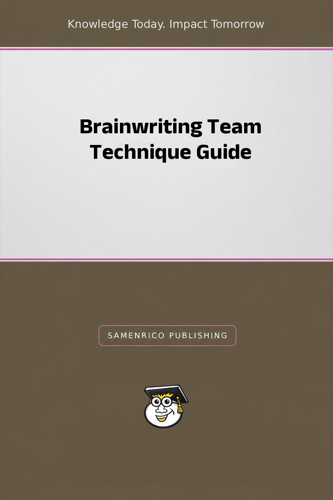
Brainwriting Team Technique Guide eBook
Generate more ideas with less bias using this writ
Generate more ideas with less bias using this written group creativity method.
Formats
Free sample
Chapter 1: The Brainstorming Funeral--Let us begin with a funeral.Not a literal one, of course. No one has died from a bad brainstorming session—although if you have ever sat through a three-hour “ideation workshop” where the loudest person in the room talked for ninety percent of the time, produced exactly one mediocre idea, and then received high-fives from everyone too exhausted to object, you may feel that something important did perish in that room. Your time died. Your energy died. And somewhere, buried under the weight of post-it notes arranged in a cute but meaningless grid, a genuinely good idea that you were too afraid to share also died.That is the funeral we are holding today.
We are burying traditional verbal brainstorming.Before you close this book in protest, hear this: I am not saying that groups should never talk to each other. That would be absurd. Conversation, debate, and collective sensemaking are essential to human collaboration. What I am saying—and what decades of peer-reviewed research unequivocally demonstrates—is that the specific activity most organizations call “brainstorming” does not work the way you think it works. It does not produce the most ideas.
It does not produce the best ideas. It does not include everyone’s ideas. And in many cases, it actively reduces the creative output of the very people you assembled to be creative.This is not opinion. This is not a hot take designed to sell books. This is settled science.So let us do something uncomfortable but necessary.
Let us look directly at the corpse of brainstorming, examine why it failed, and then—only then—begin the work of building something that actually works.The Origin Story We Have Been Told Wrong Every creativity book written in the last fifty years tells some version of the same origin story. In the 1950s, an advertising executive named Alex Osborn grew frustrated with how his teams generated ideas. People criticized too early. People held back. People settled for the first decent suggestion rather than pushing for something truly novel.
So Osborn invented a new method: brainstorming. The rules were simple. Generate as many ideas as possible. Withhold all criticism. Encourage wild and unusual ideas.
Build on the ideas of others. Osborn claimed that these four rules would double, triple, or even quadruple the creative output of any group.It is a lovely story. It is also, as we have learned in the decades since, largely wrong.The problem is not that Osborn was a fool. He was a clever observer of group dynamics who identified real problems: premature criticism does kill ideas, and social fear does silence people. The problem is that his proposed solution—the verbal, interactive, round-robin or free-for-all group discussion—does not actually solve those problems.
In some cases, it makes them worse.Let me show you what the research actually found.The Yale Study That Changed Everything In 1958, just five years after Osborn published his bestselling book Applied Imagination, a Yale researcher named Donald Taylor decided to test whether brainstorming actually worked. Taylor was not trying to destroy Osborn’s reputation. He was genuinely curious. He assembled groups of four people and gave them creative problems to solve. Some groups used Osborn’s four rules.
Other groups were told to work alone and then have their ideas pooled together. Taylor then compared the output.The results were devastating for brainstorming.The groups using Osborn’s verbal method produced significantly fewer ideas than the combined output of the same number of individuals working alone. Not slightly fewer. Not about the same. Significantly fewer.
And when Taylor measured the quality of ideas—using independent judges who did not know which ideas came from which condition—the verbal groups did not produce better ideas either. They produced the same quality, but less quantity.This finding has been replicated so many times across so many decades that it is no longer controversial among researchers who study group creativity. The phenomenon has a name: production blocking.Here is what production blocking means. When people generate ideas verbally in a group, only one person can speak at a time. While that person speaks, everyone else is forced to listen.
But human cognition does not pause conveniently. While you are listening to someone else’s idea, your own idea is forming, evolving, and—if you wait too long—decaying or disappearing entirely. By the time the first person finishes speaking, you may have forgotten your idea, decided it was not good enough, or become so influenced by the idea you just heard that your own original thought has been overwritten.This is not a character flaw. This is how memory and attention work. The average person can hold approximately four to seven discrete items in working memory at any given moment.
While you are processing someone else’s speech—decoding their words, evaluating their idea, deciding whether you agree—you are using up those working memory slots. The idea you were about to share gets pushed out. By the time the speaker finishes, your idea is gone.That is production blocking. And it happens in every single verbal brainstorming session, every single time, to every single participant, regardless of how creative or intelligent they are.The Second Killer: Evaluation Apprehension Production blocking is only half of the problem. The other half is something researchers call evaluation apprehension.This is a fancy term for a very simple human experience: the fear of being judged.
When you speak an idea out loud in front of other people, you are exposing yourself to potential ridicule, dismissal, or polite silence that feels worse than ridicule. Your brain knows this. Your brain has evolved over millions of years to care deeply about social standing and group acceptance. Being rejected by the tribe used to mean death. So your brain is wired to avoid saying anything that might cause the tribe to turn against you.In a verbal brainstorming session, evaluation apprehension manifests in predictable ways.
You hold back ideas that feel half-formed. You wait to see what other people say before committing to your own direction. You self-censor anything that feels too weird, too risky, or too different from the emerging consensus. You might not even notice yourself doing this. It happens automatically, beneath the level of conscious awareness.The cruel irony is that Osborn explicitly tried to solve this problem with his second rule: withhold all criticism.
But telling people not to be afraid of judgment does not make them unafraid of judgment. Fear is not a logical process that responds to instructions. It is an emotional and biological process that responds to perceived threat. And as long as other people are sitting across from you, watching you, and capable of forming opinions about you, the threat is real.There is only one reliable way to eliminate evaluation apprehension. Remove the audience.
Make the idea anonymous. Separate the idea from its creator.Brainwriting does exactly that.The Forty Percent Solution Now let me tell you about the research that should have ended the brainstorming debate decades ago.In 1987, two researchers named Paul Paulus and Huei-Chuan Cheng conducted a study that compared three conditions: verbal…
This is the end of the free sample. Get the eBook to keep going. Buy now
About this book
Details
- Author
- Sommer Merlin
- Publisher
- SamEnrico
- Language
- English
- Genre
- Non-Fiction, Self-Help, Idea Generation
- Released
- 2026-06-06
- Pages (approx.)
- 138
- Available as
- eBook, Audiobook

Read better in the ZLOADR app
Your eBooks on your phone or tablet. Sign in with your SamEnrico account and start reading.
More by Sommer Merlin
 Alcohol and Anger TriggersSommer Merlin$11.99
 Workaholism And Eating DisordersSommer Merlin$11.99
 Chet Atkins Guitar Gentleman GuideSommer Merlin$11.99
 Menopause Cold Flashes GuideSommer Merlin$11.99
 The Troll King's Last Lesson: A Wizened Sage of the Northern WastesSommer Merlin$11.99
 The Clockwork Cartographer: Franklin's Lost Expedition and the Birth of Mechanical ExplorationSommer Merlin$11.99
 How to Start a Pawnshops (principally Dealing In Second-hand Goods) (retail) Business (Beginners GuiSommer Merlin$11.99
 Associate Support AnalystSommer Merlin$11.99
 Post Win Execution HandbookSommer Merlin$12.99
 Energy Efficiency PricingSommer Merlin$12.99
 Understanding FructosuriaSommer Merlin$17.99
You may also like
 Hong Kong Handover 1997Dunn Johnnie$11.99
 Zumba For Postnatal Recovery CourseNeal Christian$11.99
 Zumba for BeginnersLadner Nikia$11.99
 YouTube Comment Mining GuideHumes Pandora$12.99
 Worry Box MeditationCarlin Rudy$11.99
 Workplace Stress MeditationNguyen Lynn$11.99
 Workplace Stress and Sleep RepairHawley Ivory$11.99
 Workplace Perfectionism CureDelaney Jeffry$11.99
 Workplace Injustice Anger GuideWallen Isabelle$11.99
 Work Addiction and Burnout LinkGreenwood Ester$11.99
 Women in Yoga and WellnessBeattie Galina$11.99
 Women in Stand Up ComedyChun Evangeline$11.99