
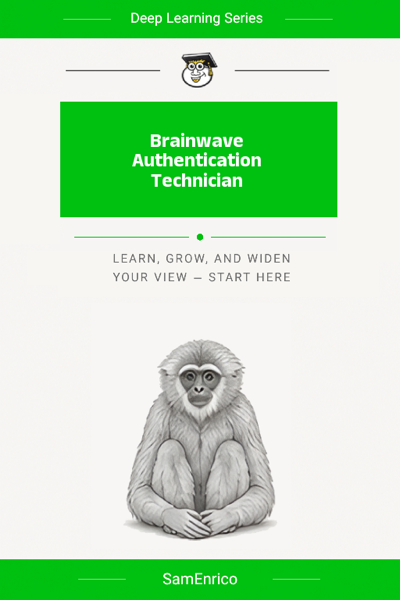
Non-FictionInformativeEducational
Brainwave Authentication Technician eBook
A Coursebook on Brainwave Authentication Technicia
A Coursebook on Brainwave Authentication Technician
Formats
Free sample
Chapter 1: The Last Password--–- The email arrived at 3:47 AM on a Tuesday. Marcus Chen, a senior systems architect at a mid-sized hedge fund, was asleep in his Chicago apartment. By 3:52 AM, someone in Belarus had used his stolen credentials to initiate a wire transfer of $4.7 million. The authentication log showed a successful fingerprint scan, a correct PIN entry, and a facial recognition match. All three factors were bypassed using a silicone fingerprint mold lifted from Marcus’s water glass at a conference, a hidden camera recording his PIN at an ATM, and a deepfake video generated from his public Linked In profile photos.Marcus didn't lose his job.
His company lost its clients. And Marcus became the person who taught his industry a brutal lesson: the password era ended years ago, but we kept pretending otherwise.This book exists because that lesson is about to be learned again — this time, with brainwaves.The Authentication Pyramid: Why Everything Above You Has Failed Before we can understand why brainwave authentication is the next frontier, we must first understand the graveyard of broken systems that came before it. The authentication pyramid has three layers, and every layer above the bottom has been cracked, spoofed, or social-engineered into irrelevance.Layer One: Knowledge-Based Authentication (Something You Know). Passwords, PINs, security questions. This layer is nearly useless today.
The average internet user has 100 passwords and reuses them across 40 separate accounts. Passwords are shared, written on sticky notes, phished via convincing emails, or guessed by brute-force algorithms. Security questions — “What was your first pet’s name?” — are public information to anyone with access to your social media. The NSA estimates that 95% of all data breaches begin with compromised credentials. The password is dead.
We just keep digging up the corpse.Layer Two: Token-Based Authentication (Something You Have). Smart cards, hardware tokens, authenticator apps on phones. This layer is stronger but still vulnerable. Hardware tokens can be lost, stolen, or cloned. Authenticator apps are phished in real-time by attackers who set up fake login pages that proxy the one-time code.
SIM-swapping attacks redirect SMS-based codes to the attacker’s phone. The hardware token is a step forward, but it’s still a thing that can be taken from you.Layer Three: Biometric Authentication (Something You Are). Fingerprints, facial recognition, iris scans, voice prints. This was supposed to be the solution — the thing that cannot be stolen because it is you. And yet, fingerprints are left on every surface you touch.
Facial recognition is fooled by high-quality photographs, videos, or 3D-printed masks. Iris scans require the user to look directly into a camera — and attackers have demonstrated iris spoofing using high-resolution printed contact lenses. Voice prints are cloned with three seconds of audio from a You Tube video.The fundamental problem with all three layers is the same: they authenticate a moment, not a person. A password entered correctly at 3:47 AM might be Marcus Chen, or it might be a hacker in Belarus who tricked him into typing it into a fake website. A fingerprint scanned at a turnstile might be the authorized employee, or it might be a lifted print on a silicone mold.
Biometrics added convenience, but they didn't solve the core vulnerability — the gap between authentication and continuous presence.The Fourth Layer: Neural Authentication (How You Think)Brainwave authentication, also called EEG biometrics, represents the fourth layer of the authentication pyramid. Instead of authenticating something you know, have, or are, it authenticates how you think.Here’s the critical insight: your brain’s electrical activity when you are calm is different from when you are anxious. When you visualize a red square versus a blue circle. When you silently recite your mother’s name versus when you imagine a rotating cube. These differences are not just random noise — they are consistent, measurable, and highly individual.But — and this is crucial — brainwave authentication is not magic.
It does not “read your thoughts” or “know your secrets.” An EEG headset measures the summed electrical activity of millions of neurons firing in synchrony. That signal is tiny, noisy, and requires significant processing to become useful. A technician cannot simply put a headset on someone and instantly know their identity any more than a photographer can point a camera at a crowd and instantly know everyone’s name. Both require calibration, feature extraction, and matching against a stored template.What brainwave authentication offers is something no other biometric can: continuous verification. A fingerprint is scanned once at login.
A face is recognized once at the door. But a brainwave signal is always there, always changing, always present for as long as the user is conscious and wearing the headset. This enables a system that authenticates you while you work — not just when you sit down.The Liveness Question: What the Brain Provides (and What It Doesn’t)One of the most persistent misconceptions in neural authentication is the belief that brainwaves are “alive by default” — that an EEG signal inherently proves a living human is present. This is both true and dangerously misleading.What is true: An EEG signal requires living neural tissue. A recording played from a file is not an EEG signal in the same way that a recording of rain is not actual rain.
The electrical activity of a brain has statistical properties — non-stationarity, fractal scaling, specific spectral distributions — that are extremely difficult to simulate perfectly.What is misleading: The claim that liveness is “automatic” suggests that a technician can simply trust the presence of any EEG signal. An attacker can record a legitimate user’s EEG during enrollment and replay that recording into the system during login. If the system does nothing to verify that the signal is currently being generated by a live human, the replay attack succeeds.Therefore, a well-designed brainwave authentication system must actively implement liveness detection. Chapter 4 covers this in depth, but the key techniques are:Challenge-response liveness: Ask the user to perform a specific mental task (e.g., “imagine rotating a cube for three seconds”) and verify the expected Event-Related Potential (ERP) appears at the correct latency and topography.Statistical liveness: Check for natural non-stationarity — brainwaves naturally change their statistical properties over seconds; a static recording does not.Consider this the first lesson of the course: liveness is a feature you add, not a property you inherit.The Three Authentication States: Enrollment, Verification, Identification Every authentication system, regardless of technology, operates in one of three states. A technician must understand all three because misconfiguration is a common source of security failures.State 1: Enrollment.
This is the setup phase. The user sits down, puts on the headset, and generates enough EEG data to create a template — a mathematical representation of their neural signature. Enrollment typically requires multiple sessions (e.g., three separate 10-minute recordings) to capture natural variability in the user’s brain state. A common technician error is enrolling a user in a single session while they are unusually calm or unusually stressed, creating a template that fails to match their typical state.State 2: Verification (1:1 Matching). This is the most common operational state.
The user claims an identity — “I am Alice” — and the system verifies that the current EEG matches Alice’s…
This is the end of the free sample. Get the eBook to keep going. Buy now
About this book
Details
- Author
- Stanton Ricki
- Publisher
- SamEnrico
- Language
- English
- Genre
- Non-Fiction, Informative, Educational
- Released
- 2026-05-06
- Pages (approx.)
- 158
- Available as
- eBook, Audiobook

Read better in the ZLOADR app
Your eBooks on your phone or tablet. Sign in with your SamEnrico account and start reading.
More by Stanton Ricki
 Germany Solar Panel Incentives GuideStanton Ricki$11.99
 Baby Swaddling Techniques GuideStanton Ricki$11.99
 Habit Stacking Weight LossStanton Ricki$11.99
 Swiss Green Incentives ManualStanton Ricki$11.99
 Innocence Project Massachusetts CasesStanton Ricki$11.99
 Wings Over the Sands: The Emirati Dreamers Who Conquered the AtlanticStanton Ricki$11.99
 The Silent Revolution: How Ray Kurzweil Predicted the FutureStanton Ricki$11.99
 Understanding Chromosome 18 RingStanton Ricki$17.99
 How to Start a Motor Tricycle and Parts Business (Beginners Guide)Stanton Ricki$11.99
 Newfoundland PNP for GradsStanton Ricki$12.99
 Annual PDP Refresh GuideStanton Ricki$12.99Newfoundland PNP for GradsStanton Ricki$12.99
You may also like
 Hong Kong Handover 1997Dunn Johnnie$11.99
 Zumba For Postnatal Recovery CourseNeal Christian$11.99
 Zumba for BeginnersLadner Nikia$11.99
 YouTube Comment Mining GuideHumes Pandora$12.99
 Worry Box MeditationCarlin Rudy$11.99
 Workplace Stress MeditationNguyen Lynn$11.99
 Workplace Stress and Sleep RepairHawley Ivory$11.99
 Workplace Perfectionism CureDelaney Jeffry$11.99
 Workplace Injustice Anger GuideWallen Isabelle$11.99
 Work Addiction and Burnout LinkGreenwood Ester$11.99
 Women in Yoga and WellnessBeattie Galina$11.99
 Women in Stand Up ComedyChun Evangeline$11.99