
Non-FictionSelf-HelpProblem Solving
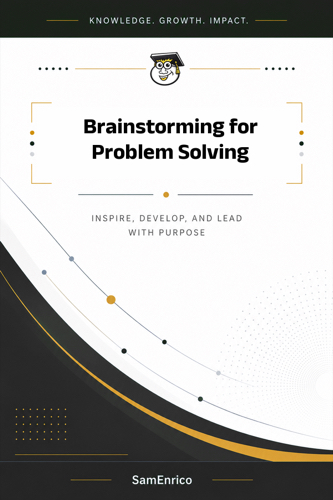
Brainstorming for Problem Solving eBook
Generate solution options for any challenge using
by Lipscomb Art
Generate solution options for any challenge using these methods.
Formats
Free sample
Chapter 1: The First Answer Trap--–- The email arrived at 9:47 AM on a Tuesday. Sarah, a product manager at a mid-sized software company, had a problem. Her team’s flagship feature—the one they had spent four months building—was generating more customer support tickets than any other part of the product. Users were confused. They were abandoning the feature after one use.
Her boss wanted answers by Friday.Sarah did what most smart, capable professionals do. She convened a meeting. Within thirty minutes, her team had identified the “obvious” problem: the feature’s onboarding screen was too complicated. The “obvious” solution? Simplify the onboarding screen.
Cut the number of steps from five to two. Add more tooltips. Change the button color from blue to green because “green means go.”Everyone nodded. The meeting ended. Sarah assigned tasks.
The team spent the next three days redesigning the onboarding flow. They pushed the update on Friday. Her boss was pleased with the quick turnaround.Nothing improved.Support tickets stayed the same. User abandonment remained unchanged. In fact, a new problem emerged: users who had been using the feature successfully before the update were now confused because the onboarding flow had changed.
Sarah had made things worse.Two months later, a competitor launched a similar feature with a radically different approach. Instead of simplifying the onboarding screen, they had eliminated it entirely. They used a different paradigm: progressive disclosure, revealing complexity only when users needed it. Their support tickets were 80 percent lower. Their user retention was three times higher.Sarah’s team had fallen into the First Answer Trap.They had identified a problem, generated a solution, and fallen in love with it—all within a single meeting.
They had never asked: “What else could this be?” They had never generated alternative options. They had never tested their assumption that the onboarding screen was the real culprit. They had grabbed the first plausible answer and defended it like a parent defending a child.This chapter is about why that happens, how to recognize it in yourself, and how to begin escaping it. Before you can learn any brainstorming method, you must first understand the enemy inside your own head.The Creative Downturn: You Used to Be a Genius There is a famous piece of research that haunts every creativity researcher. In the 1960s, George Land conducted a study of 1,600 children aged three to five years old.
He gave them a creativity test originally designed for NASA scientists to identify innovative engineers. The test measured divergent thinking—the ability to generate multiple, varied solutions to an open-ended problem.At age five, 98 percent of the children scored at the “genius” level for creativity.Land retested the same children at age ten. Only 30 percent scored at genius level.He retested them at age fifteen. Only 12 percent.He then tested 280,000 adults. Only 2 percent scored at genius level.Think about that for a moment.
The vast majority of human beings are born as creative geniuses. By the time they reach adulthood, the vast majority are not. Something happens between the playground and the boardroom. Something systematically destroys our ability to generate solution options.The culprit is not a creativity deficit. The culprit is conditioning.In school, you were rewarded for finding the single correct answer.
The test had one right response. The teacher had one expected outcome. The system did not reward ten different ways to solve a math problem; it rewarded the one way that matched the answer key. This is what psychologists call “convergent thinking”—narrowing down to a single correct answer. It is useful for multiple-choice tests.
It is disastrous for novel problems.In corporate life, the conditioning continues. You are rewarded for decisiveness, not exploration. The person who proposes the first solution becomes the “leader.” The person who asks “What if we tried something weird?” becomes the “distraction.” Meetings are judged by how quickly they end, not by how many options they generate. Failure is punished. Mistakes go on performance reviews.
The safest path is to find an answer that has worked before and repeat it.This is how you lose your creative genius. Not because your brain changed, but because your environment trained you to value speed over breadth, correctness over curiosity, and the single answer over the many options.The First Answer Trap Defined The First Answer Trap is a cognitive bias combined with an emotional attachment. It works like this:Step one: A problem appears. Your brain, which is a pattern-matching machine, immediately scans its memory for similar problems from the past. It retrieves the first plausible solution that has worked before, or that it has seen someone else use, or that feels intuitively correct.Step two: Your brain presents this solution to your conscious mind.
Because it arrived quickly and effortlessly, your brain tags it as “efficient” and “trustworthy.” This is the fluency heuristic: ideas that come easily feel more true, even when they aren’t.Step three: You begin to fall in love with your first answer. You invest mental energy in it. You start imagining how it will work. You anticipate the praise you will receive for solving the problem. The idea becomes part of your identity.
To abandon it now would feel like admitting failure.Step four: Any alternative idea is now evaluated not on its own merits, but against your first answer. The first answer is the default. The first answer is the baseline. Anything else must be demonstrably better to even be considered. And because you have already invested in the first answer, you are unconsciously biased to see flaws in alternatives and virtues in your original choice.Step five: You stop generating options entirely.
You move directly to execution. You solve the wrong problem, or you solve the right problem poorly, or you create new problems. And you never realize that you had a choice.The First Answer Trap is not laziness. It is not stupidity. It is a predictable, well-documented feature of how human brains work under pressure.
And it is the single biggest barrier to effective problem-solving.The Four Internal Blocks That Feed the Trap The First Answer Trap is powered by four internal blocks. Think of these as the engines that keep you stuck. Each one can operate on its own, but they usually work together.Perceptual Blocks: Seeing What You Expect to See Perceptual blocks occur when your brain filters reality to match your expectations. You literally do not see solutions that are right in front of you because your brain has decided they are irrelevant.The classic example is the “nine dots” puzzle. Connect nine dots arranged in a square using four straight lines without lifting your pen.
Most people cannot solve it because they unconsciously assume the lines must stay inside the square formed by the dots. The solution requires drawing lines outside the square. The perceptual block is the assumption of boundaries that do not exist.Perceptual blocks are why a hammer is only for nails, a chair is only for sitting, and a sticky note is only for reminders. When you see a problem, you see only the solutions that fit your existing categories. Everything else…
This is the end of the free sample. Get the eBook to keep going. Buy now
About this book
Details
- Author
- Lipscomb Art
- Publisher
- SamEnrico
- Language
- English
- Genre
- Non-Fiction, Self-Help, Problem Solving
- Released
- 2026-06-07
- Pages (approx.)
- 139
- Available as
- eBook, Audiobook

Read better in the ZLOADR app
Your eBooks on your phone or tablet. Sign in with your SamEnrico account and start reading.
More by Lipscomb Art
 Semion Mogilevich EmpireLipscomb Art$11.99
 Anger And Exercise PrescriptionLipscomb Art$11.99
 The Fashion Safety Stock GuideLipscomb Art$11.99
 British Siege Artillery RoleLipscomb Art$11.99
 Queen Victoria Empress IndiaLipscomb Art$11.99
 Jungian Dream Symbols GuideLipscomb Art$11.99
 Procrastination for AccountantsLipscomb Art$11.99
 Battle of the Runway: Vivienne Westwood and the Punk Revolution (1976-1988)Lipscomb Art$11.99
 The Last Second: Kerri Strug's Golden LeapLipscomb Art$11.99
 The Photographer's Guide to Lifestyle PhotographyLipscomb Art$11.99
 Guavas: When to Pick For Fresh Eating Vs. ProcessingLipscomb Art$11.99
 How to Produce Drywall AnchorsLipscomb Art$11.99
You may also like
 Hong Kong Handover 1997Dunn Johnnie$11.99
 Zumba For Postnatal Recovery CourseNeal Christian$11.99
 Zumba for BeginnersLadner Nikia$11.99
 YouTube Comment Mining GuideHumes Pandora$12.99
 Worry Box MeditationCarlin Rudy$11.99
 Workplace Stress MeditationNguyen Lynn$11.99
 Workplace Stress and Sleep RepairHawley Ivory$11.99
 Workplace Perfectionism CureDelaney Jeffry$11.99
 Workplace Injustice Anger GuideWallen Isabelle$11.99
 Work Addiction and Burnout LinkGreenwood Ester$11.99
 Women in Yoga and WellnessBeattie Galina$11.99
 Women in Stand Up ComedyChun Evangeline$11.99