
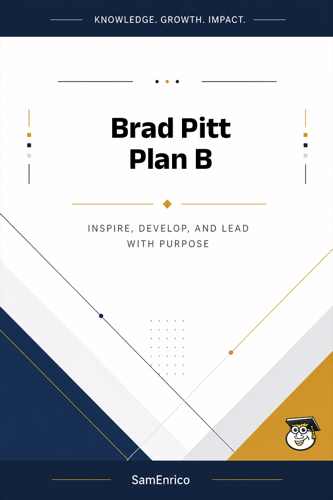
Brad Pitt Plan B eBook
Chronicles the actor's producing career and humani
Chronicles the actor's producing career and humanitarian work.
Formats
Free sample
Chapter 1: The Restless Jawline...-- In the spring of 1990, a 26-year-old Brad Pitt stood on the set of Thelma & Louise and discovered that being seen was not the same as being heard. He played J.D., the charming, cowboy-hatted drifter who seduces Geena Davis's character and steals her money. The role would make him famous. Women would clip his photo from magazines. Men would try to copy his hair.
But Pitt, standing in the Utah desert between takes, felt something closer to claustrophobia than triumph. He had done what the script asked. He had been pretty. He had been charming. And then he had waited for the director to say "cut" so he could do it again.
That waiting—the passive, obedient waiting of an actor—was already beginning to feel like a cage.The problem, Pitt would later tell friends, was not the work itself. He loved performance. He loved disappearing into a character. What he hated was the dependency. An actor, no matter how famous, waits for the phone to ring.
He waits for the casting director to approve him. He waits for the director to tell him where to stand, how to speak, when to cry. Even at the height of his heartthrob power, Pitt understood a brutal truth: he was the paint, not the painter. And paint, no matter how beautiful, does not choose the canvas.This chapter is about the making of that understanding. It is about how a young man from Springfield, Missouri—raised on truck stops and journalism classrooms—learned to see Hollywood not as a stage but as a supply chain.
It is about the difference between being the product and being the one who decides what gets produced. And it is about the first stirrings of what would become Brad Pitt's Plan B: the quiet, obsessive, often invisible work of building a career behind the camera while the world watched the face in front of it.The Education of a Regular Guy William Bradley Pitt was born on December 18, 1963, in Shawnee, Oklahoma, but he grew up in Springfield, Missouri, a city of rolling hills and conservative values, where the most famous landmark was the Bass Pro Shops headquarters and the most common ambition was a steady job. His father, Bill Pitt, ran a trucking company. His mother, Jane, was a school counselor. The family was solidly middle-class, deeply practical, and utterly unimpressed by pretense.
When young Brad announced he wanted to be an actor, his father reportedly said, "That's not a real job." It was not cruelty. It was a trucking company owner's honest assessment of a profession that produced nothing tangible, nothing you could load onto a trailer and deliver to a warehouse.That skepticism stayed with Pitt. Even after he dropped out of the University of Missouri—where he studied journalism and advertising, just one credit short of a degree—and drove to Los Angeles in a beat-up Datsun, he carried his father's voice in his head. Acting wasn't a real job. So he treated it like one.
He showed up early. He learned lines obsessively. He studied the crew, not just the other actors. While his peers waited in casting lines, Pitt waited near the craft services table, watching the assistant directors and line producers argue about budgets and schedules. He learned that a movie set is a factory.
The actors are the product, yes, but the real power belongs to the people who own the machines and sign the checks.His journalism training proved surprisingly useful. At Missouri, Pitt had learned to ask questions—who, what, where, when, why—and to structure a story from the ground up. He had learned that the best reporters are not the ones with the most charisma but the ones who listen carefully and connect dots that others miss. He brought that sensibility to every set. While other actors retreated to their trailers between takes, Pitt lingered near the camera, watching the director frame a shot, watching the editor's assistant log footage, watching the producer take phone calls about financing.
He was not being polite. He was being strategic. He was learning the anatomy of a film from the inside out.The Frustration of Being the Paint Pitt's breakthrough role in Thelma & Louise was a classic Hollywood trap: he was so good-looking that critics forgot to notice he could act. The New York Times called him "a striking specimen." Rolling Stone put him on the cover with the headline "Brad Pitt: The Sexiest Man Alive." He was grateful for the attention, but he was also quietly furious. No one asked him about his choices.
No one wanted to discuss how he had built J.D.'s casual menace from a mix of Southern charm and sociopathic detachment. They wanted to talk about his abs.The pattern repeated for the next several years. In A River Runs Through It (1992), he played the reckless younger brother Paul, and Robert Redford directed him with a gentle but firm hand. Pitt learned from Redford—an actor who had become a director, then a festival founder, then a political activist—that one could move from the front of the camera to a position of genuine authority. But the lesson was not yet actionable.
In Legends of the Fall (1994), he played Tristan, the brooding, long-haired middle son, and the film made him a global superstar. It also trapped him. The roles that came his way were variations on the same theme: the beautiful, tortured man whom women want and men want to be. Pitt took some of them—Interview with the Vampire (1994), Seven (1995)—but he was already looking for the exit.The turning point came on the set of Twelve Monkeys (1995), directed by Terry Gilliam. Gilliam was a madman in the best sense: a visual genius who treated every film as a guerrilla operation, rewriting scenes on napkins, stealing shots without permits, and bullying studios into funding his visions.
Pitt watched Gilliam operate and realized that chaos, when channeled correctly, could be a form of power. Gilliam did not ask for permission. He took it. More importantly, Gilliam understood that the director's vision was only as strong as the producer's willingness to fight for it. Pitt asked Gilliam, over beers one night, how he got Brazil made against Universal's active opposition.
Gilliam laughed and said, "You don't ask. You just do it and apologize later."Pitt filed that advice away. He also began to notice something about the directors he admired—Gilliam, David Fincher (Seven), the Coen brothers (Burn After Reading, much later). They all had producing partners. They all understood that the director's credit was artistic, but the producer's credit was practical.
The director dreamed. The producer built. And Pitt, who had grown up in a family of builders, knew which one he wanted to be.The Power of the Balance Sheet Most actors never look at a budget. They sign contracts, take their fees, and trust their agents to handle the numbers. Pitt was different.
Early in his career, he started asking to see the financing documents for his films. Not because he wanted more money—though he certainly negotiated hard—but because he wanted to understand…
This is the end of the free sample. Get the eBook to keep going. Buy now
About this book
Details
- Author
- Kowalski Keturah
- Publisher
- SamEnrico
- Language
- English
- Genre
- Non-Fiction, Biography, Producer
- Released
- 2026-06-05
- Pages (approx.)
- 98
- Available as
- eBook, Audiobook

Read better in the ZLOADR app
Your eBooks on your phone or tablet. Sign in with your SamEnrico account and start reading.
More by Kowalski Keturah
 Recovering From Being OverlookedKowalski Keturah$11.99
 Job Loss and FriendshipsKowalski Keturah$11.99
 Cross Addiction Prevention GuideKowalski Keturah$11.99
 Vitamin D Deficiency TestingKowalski Keturah$11.99
 Perimenopause Anxiety GuideKowalski Keturah$11.99
 Widow s Grief JournalKowalski Keturah$11.99
 Military Whistleblower StoryKowalski Keturah$11.99
 The Smugglers' Surf: The Secret Waves of 18th-Century EuropeKowalski Keturah$11.99
 The Cossack’s Last Letter: Love and Rebellion in the SteppeKowalski Keturah$11.99
 How to Produce Paint and CoatingKowalski Keturah$11.99
 How to Produce a MousetrapKowalski Keturah$11.99
 Boss Email Response TemplatesKowalski Keturah$12.99
You may also like
 Hong Kong Handover 1997Dunn Johnnie$11.99
 Zumba For Postnatal Recovery CourseNeal Christian$11.99
 Zumba for BeginnersLadner Nikia$11.99
 YouTube Comment Mining GuideHumes Pandora$12.99
 Worry Box MeditationCarlin Rudy$11.99
 Workplace Stress MeditationNguyen Lynn$11.99
 Workplace Stress and Sleep RepairHawley Ivory$11.99
 Workplace Perfectionism CureDelaney Jeffry$11.99
 Workplace Injustice Anger GuideWallen Isabelle$11.99
 Work Addiction and Burnout LinkGreenwood Ester$11.99
 Women in Yoga and WellnessBeattie Galina$11.99
 Women in Stand Up ComedyChun Evangeline$11.99