
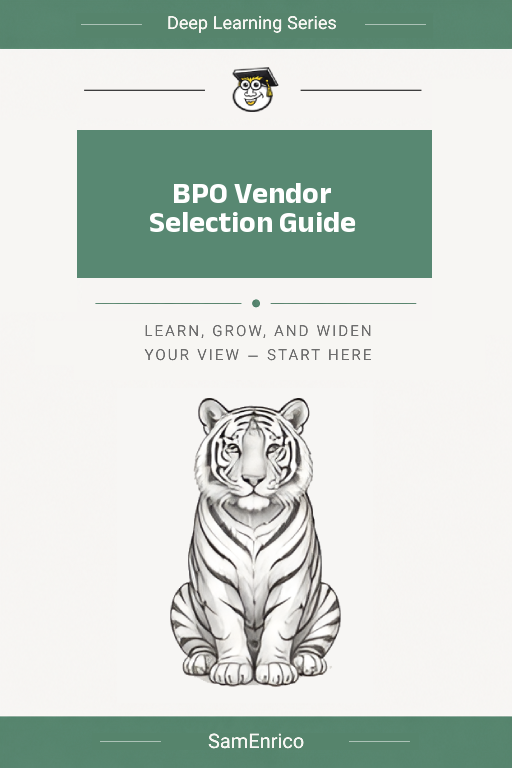
Non-FictionBusiness BriefVendor Selection
BPO Vendor Selection Guide eBook
Compare and select customer support BPO vendors in
Compare and select customer support BPO vendors in India and Jamaica based on quality and cost.
Formats
Free sample
Chapter 1: The Value Illusion--–- Every failed outsourcing engagement begins with the same seductive whisper: “We can get this done for half the price.” That whisper is rarely malicious. It is not delivered by a sinister consultant or a predatory vendor. It comes from inside your own building, often from well-intentioned finance or operations leaders who have been told, year after year, that labor arbitrage is the easiest lever to pull. And they are not wrong about the math. On paper, moving customer support from Kansas City to a BPO in India or Jamaica produces staggering savings.
A 22−per−hourdomesticagentbecomesa22-per-hour domestic agent becomes a 22−per−hourdomesticagentbecomesa10-per-hour offshore agent. Multiply that by 100 agents and 2,000 hours per year, and you have just “saved” $2.4 million. The spreadsheet is pristine. The board approves. The contract is signed.The problem is that customers do not live on spreadsheets.They live in the messy, emotional, unpredictable space where a frozen account, a lost package, or a confusing bill turns a rational human being into someone who just wants to scream at another human being who sounds like they care.
And when that customer discovers that the person on the other end of the line is reading from a script in a call center 9,000 miles away, with a tenuous grasp of the product and a mandate to keep the call under four minutes, something invisible but catastrophic happens. The customer does not blame the agent. The customer blames you. The brand that promised “we’re here for you” just revealed that “here” is a low-bid warehouse of burnout and churn.This chapter is not an argument against outsourcing. The author of this book has spent over a decade helping companies outsource successfully.
But the first and most critical step in that process has nothing to do with vendors, requests for proposals, or contract negotiations. The first step is confronting a dangerous illusion: that the value of outsourcing is measured primarily in cost reduction.This chapter dismantles that illusion. It introduces a framework for distinguishing between core and non-core customer support activities. It applies the Sociotechnical Innovation model to show how outsourcing, when done correctly, drives process improvement rather than just labor arbitrage. And it provides a practical decision matrix that will help you determine, before you ever speak to a vendor, which functions should stay in-house, which should go to India, and which should go to Jamaica.By the end of this chapter, you will understand why the most successful outsourcers treat BPO as a strategic capability, not a procurement line item.
You will also understand why the companies that fail—the 65 percent referenced throughout this book—almost always fail because they skipped the internal work described here.The $2.4 Million Mistake Let us examine the hypothetical $2.4 million savings from the opening paragraph more closely. That figure assumes that the offshore agents perform at exactly the same level as the domestic agents. It assumes no increase in customer churn. It assumes no additional management overhead. It assumes no brand damage.
And it assumes that the only thing customers want is a correct answer, delivered quickly, at the lowest possible cost.Every one of those assumptions is wrong.Real-world data from the Customer Contact Council, based on over 100,000 customer interactions across multiple industries, shows that the single strongest driver of customer loyalty is not speed or accuracy. It is effort. More specifically, it is how hard the customer has to work to get their problem solved. Customers who experience low effort are 94 percent more likely to repurchase and 88 percent more likely to increase their spending. Customers who experience high effort are 96 percent more likely to churn and 81 percent more likely to speak negatively about the brand.Now consider what happens when you outsource customer support to a vendor that has been selected primarily on cost.
That vendor is incentivized to minimize handle time, not maximize problem resolution. The agent is measured on how quickly they can end the call, not on whether the customer’s underlying issue is actually fixed. The quality assurance team samples maybe 2 percent of calls, and they are looking for compliance with the script, not empathy or creativity. The result is a support experience that feels, to the customer, like a series of escalating frustrations: hold times, transfers, scripted non-answers, and ultimately a problem that requires a second or third call.That is high effort. That is churn.
That is the hidden cost that never appears on the spreadsheet.The $2.4 million in savings, in other words, is not a savings at all. It is a loan against future revenue. And the interest rate is devastating.This is not to say that outsourcing cannot produce real, sustainable cost advantages. It can. But those advantages come from process improvement and specialization, not from simply paying people less to do the same work in the same way.
A well-designed BPO relationship should reduce your cost per interaction not because wages are lower, but because the vendor is better at running a contact center than you are. They have better training methodologies. They have better scheduling algorithms. They have better quality assurance systems. They have better attrition management programs.
And they have economies of scale that allow them to invest in technologies you cannot justify on your own.When you select a vendor on cost alone, you get none of those things. You get cheap labor and a lot of promises. When you select a vendor on value—on their ability to improve your customer experience while lowering your operational costs—you get a partner. And that is the fundamental shift this chapter requires: from procurement to partnership.Core vs. Non-Core: The First Cut Before you can evaluate any vendor, you must answer a deceptively simple question: What customer support activities are core to your brand, and which are non-core?The distinction is not about importance.
Everything in customer support is important to the customer who needs help. The distinction is about strategic differentiation. A core activity is one that directly shapes how customers perceive your brand and that you cannot trust to an external partner without risking that perception. A non-core activity is one that is necessary but not differentiating—something that must be done correctly but does not need to be done distinctively.Consider a luxury hotel brand. The check-in experience is core.
The way a guest is greeted, recognized, and welcomed sets the tone for the entire stay. That cannot be outsourced to a remote call center without destroying the brand promise. However, the reservation system—the process of checking availability, taking payment, and sending a confirmation email—is largely non-core. As long as it works accurately and efficiently, the customer does not care whether the person on the other end is a hotel employee or a BPO agent. The reservation does not define the brand.
The stay does.Now apply this logic to your own customer support operation. Ask yourself three questions about every interaction type:First, does this interaction involve sensitive or brand-critical information that, if mishandled, would cause irreparable harm? Account closures, fraud alerts, executive escalations—these are core. A mistake here is catastrophic.Second, does this interaction require deep, tacit knowledge of your product…
This is the end of the free sample. Get the eBook to keep going. Buy now
About this book
Details
- Author
- Duran Rayford
- Publisher
- SamEnrico
- Language
- English
- Genre
- Non-Fiction, Business Brief, Vendor Selection
- Released
- 2026-05-30
- Pages (approx.)
- 145
- Available as
- eBook, Audiobook

Read better in the ZLOADR app
Your eBooks on your phone or tablet. Sign in with your SamEnrico account and start reading.
More by Duran Rayford
 Workplace Habit CultureDuran Rayford$11.99
 Mindfulness For Impulsive People WorkbookDuran Rayford$11.99
 Sensitive Topic Navigation WorkbookDuran Rayford$11.99
 Walking Meditation for EmpathsDuran Rayford$11.99
 Competitive Matrix TemplateDuran Rayford$11.99
 The Djinn of the Empty Quarter: Whispers in the SandsDuran Rayford$11.99
 Endurance: Shackleton's Impossible Survival in the Frozen WastesDuran Rayford$11.99
 Ship FitterDuran Rayford$11.99
 Payment Dispute Resolution WorkbookDuran Rayford$12.99
 Understanding Granulomas, Congenital CerebralDuran Rayford$17.99
 How to Start a Bug Zappers Without Light Business (Beginners Guide)Duran Rayford$11.99
You may also like
 Hong Kong Handover 1997Dunn Johnnie$11.99
 Zumba For Postnatal Recovery CourseNeal Christian$11.99
 Zumba for BeginnersLadner Nikia$11.99
 YouTube Comment Mining GuideHumes Pandora$12.99
 Worry Box MeditationCarlin Rudy$11.99
 Workplace Stress MeditationNguyen Lynn$11.99
 Workplace Stress and Sleep RepairHawley Ivory$11.99
 Workplace Perfectionism CureDelaney Jeffry$11.99
 Workplace Injustice Anger GuideWallen Isabelle$11.99
 Work Addiction and Burnout LinkGreenwood Ester$11.99
 Women in Yoga and WellnessBeattie Galina$11.99
 Women in Stand Up ComedyChun Evangeline$11.99