
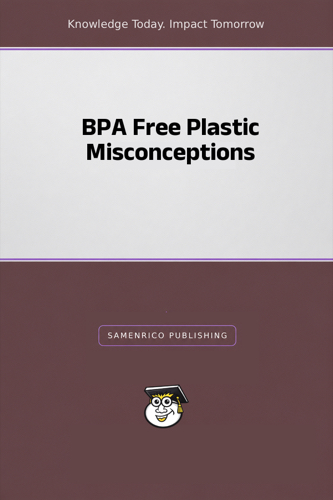
BPA Free Plastic Misconceptions Audiobook
Learn why BPS and BPF are no safer than BPA in pla
Learn why BPS and BPF are no safer than BPA in plastic containers.
Formats
Free sample
Chapter 1: The Chemistry of Regret...–- It began, as so many environmental crises do, not with a bang but with a headline. Sometime in the early 2000s, parents around the world found themselves staring at their infants' plastic bottles with a new and unsettling emotion: fear. The news reports were relentless. Scientists had discovered that bisphenol A—BPA, the invisible building block of shatterproof polycarbonate—was leaching out of baby bottles, sippy cups, and the linings of formula cans. It wasn't supposed to happen.
Plastics were supposed to be inert, stable, safe. But the data told a different story. BPA, it turned out, was a master of disguise. It looked like a plastic, but inside the human body, it behaved like a hormone. Specifically, it behaved like estrogen—the master regulator of reproduction, metabolism, brain development, and countless other systems.The panic was immediate and global.
Retailers pulled BPA-containing products from shelves. Parents emptied their cupboards into trash bags. And the chemical industry, never one to miss an opportunity, responded with breathtaking speed. Within months, a new label began appearing on water bottles, food containers, and baby products: "BPA-Free." It was a marketing triumph. The villain had been vanquished.
The hero—ordinary plastic, now purified—could return to its rightful place in the modern home.But here is the question that almost no one asked at the time, and that almost no one is asking today: replaced with what?This book is the answer to that question. And the answer is not reassuring.The Bait To understand how we arrived at this moment—standing in kitchen aisles, squinting at recycling symbols, trying to parse the difference between #7 plastic and "Tritan" and "Ecozen"—we have to go back to the beginning. Not to the 2000s, but to the 1930s, when a chemist named Dianne discovered that a compound called bisphenol A could mimic estrogen. At the time, it was a curiosity, a laboratory footnote. The pharmaceutical industry was more interested in developing synthetic estrogens for menopausal women, and BPA was too weak to be useful.
So it sat on the shelf, awaiting a different destiny.That destiny arrived during World War II, when the demand for durable, lightweight, shatterproof materials exploded. Polycarbonate plastic—made by polymerizing BPA with phosgene—turned out to be perfect for airplane windows, helmet visors, and electrical insulation. After the war, the applications multiplied. Polycarbonate became the material of choice…
This is the end of the free sample. Get the Audiobook to keep going. Buy now
About this book
Details
- Author
- Zimmer Delilah
- Publisher
- SamEnrico
- Language
- English
- Genre
- Non-Fiction, Health & Wellness
- Released
- 2026-06-08
- Pages (approx.)
- 143
- Available as
- eBook, Audiobook

Listen in the VoxFlicks app
Audiobooks and audio dramas wherever you go. Sign in with your SamEnrico account and press play.
More by Zimmer Delilah
 The Retirement Housing Virtual Tour SaleZimmer Delilah$11.99
 Parent Loss and AngerZimmer Delilah$11.99
 Resilience In RelationshipsZimmer Delilah$11.99
 Remote Work Introvert GuideZimmer Delilah$11.99
 Success Without Burnout for StudentsZimmer Delilah$11.99
 Pontiac Ottawa LeaderZimmer Delilah$11.99
 Assertive Salary NegotiationZimmer Delilah$11.99
 Love and Valor: The Forgotten Heroes of Monte CassinoZimmer Delilah$11.99
 The Lost Voyages of the Malian Navigator: Uncharted Oceans and Forgotten KingdomsZimmer Delilah$11.99
 A Collector's Handbook to the Messerschmitt Kr200Zimmer Delilah$11.99
 Service Providers Guide to Mobile PET GroomersZimmer Delilah$11.99
 How to Start a Ethnic and Minority Group Organisations Business (Beginners Guide)Zimmer Delilah$11.99
You may also like
 Hong Kong Handover 1997Dunn Johnnie$11.99
 Zumba For Postnatal Recovery CourseNeal Christian$11.99
 Zumba for BeginnersLadner Nikia$11.99
 YouTube Comment Mining GuideHumes Pandora$12.99
 Worry Box MeditationCarlin Rudy$11.99
 Workplace Stress MeditationNguyen Lynn$11.99
 Workplace Stress and Sleep RepairHawley Ivory$11.99
 Workplace Perfectionism CureDelaney Jeffry$11.99
 Workplace Injustice Anger GuideWallen Isabelle$11.99
 Work Addiction and Burnout LinkGreenwood Ester$11.99
 Women in Yoga and WellnessBeattie Galina$11.99
 Women in Stand Up ComedyChun Evangeline$11.99