
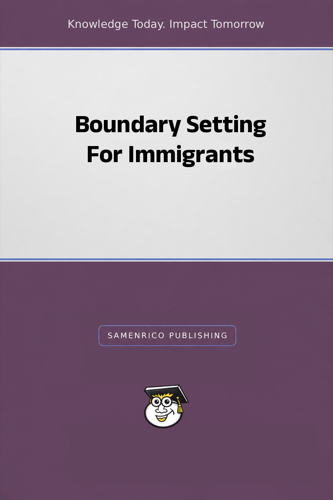
Boundary Setting For Immigrants eBook
Navigate cultural expectations of family obligatio
by Dobbs Eldon
Navigate cultural expectations of family obligation while protecting your mental health.
Formats
Free sample
Chapter 1: The Invisible Contract--Every immigrant child receives the same memo, though no one ever writes it down. You do not remember the exact moment you learned the terms, because there was no single conversation, no signed document, no witness to the exchange. The terms were absorbed through silence, through the weight of a parent's sigh after a long shift, through the way your mother's eyes softened when you brought home an A and tightened when you asked to stay late at a friend's house. By the time you were old enough to form the thought "I want something different," you already knew that wanting something different came with a cost.This is the invisible contract. It is not unique to immigrant families, but it is amplified within them to a degree that Western psychology rarely acknowledges.
The contract reads something like this: We left everything. We crossed oceans, learned new languages, swallowed our pride, worked jobs beneath our education, lost our names, our holidays, our parents' graves. We did this so you could have what we did not. Therefore, your success is our happiness. Your deviation is our betrayal.
Your independence is our loss. And you will spend the rest of your life trying to repay a debt that was never yours to sign.If you feel a tightness in your chest reading those words, you are not imagining things. That tightness is the contract activating. It is the feeling of being caught between two impossible poles: the pull of your own life, with its strange hobbies and inconvenient relationships and career choices that make no sense to anyone who sacrificed everything, and the pull of the family, which asks only that you remember what was given up for you. The contract does not ask for much, really.
Only your obedience. Only your proximity. Only your silence. Only your life, lived according to someone else's map.The first step toward freedom is not setting a boundary. It is seeing the contract in the first place.The Architecture of Unspoken Agreements Every family operates on a set of unspoken agreements.
In Western individualistic families, those agreements tend to center on autonomy: you grow up, you leave, you visit on holidays, you remain connected but separate. In collectivist immigrant families—particularly those from South Asian, East Asian, Southeast Asian, and many Middle Eastern and Latin American cultures—the agreements center on continuity. The family is not a collection of individuals who happen to share DNA. The family is a single organism, and you are a part of that organism. Parts do not secede.
Parts do not declare independence. Parts serve the whole.The invisible contract is not cruel in its intentions. It emerges from genuine sacrifice and genuine love. Your parents did give up everything. They did work jobs that broke their bodies and spirits.
They did lose the comfort of being understood in their mother tongue, the ease of walking streets they had known since childhood, the presence of grandparents who died while they were too far away to say goodbye. These losses are real. The gratitude you feel is appropriate. The problem is not the gratitude. The problem is what happens when gratitude becomes a lifetime sentence.The contract operates through three primary mechanisms, each more powerful than the last because each one bypasses logic and speaks directly to the nervous system.The Currency System Every family has a currency.
Money is the most obvious, but it is rarely the only one. Time is another currency: how often you call, how long you stay, whether you show up to the cousin's wedding three states away. Proximity is a currency: where you choose to live, whether you move "too far," whether you would consider returning to the homeland. Grandchildren are a currency, especially for parents who view the continuation of the family line as the ultimate proof that their sacrifice was worthwhile. Status is a currency: your job title, your salary, the prestige of your spouse's profession, the reputation of the university you attended.Your family's specific currency may be different, but you know what it is.
You know because you have felt the shift in your mother's voice when you told her your new salary. You have felt the silence when you mentioned you were not planning to have children. You have felt the coldness when you moved to a city that required a plane ticket rather than a two-hour drive. The contract uses currency as a measuring stick. When you pay in the accepted currency, you are a good child.
When you do not, the contract holds you in default.The cruelest feature of the currency system is that it requires continuous payment. There is no moment when the debt is marked "paid in full." You cannot earn enough money, call often enough, produce enough grandchildren, achieve enough status to finally hear the words: "You have done enough. You are free." The contract is structured like a credit card with no maximum limit and no payoff date. You make the minimum payment every month, the interest accumulates, and the balance never decreases. This is not an accident.
The contract is designed to bind you forever because the family's survival—in the psychological sense—depends on your continued compliance.Sacrifice as a Perpetual Loan Your parents' sacrifice was real. Let that land. It is not your job to deny their pain or diminish what they endured. They left their countries, their languages, their social standing, their extended families, their sense of belonging in the world. Many of them worked jobs that required them to swallow their dignity daily.
Many of them experienced racism, exploitation, loneliness, and the slow erosion of dreams they once held for themselves. This is not a manipulation. This is history.But here is the distinction that the contract obscures: sacrifice can be honored without being repaid. A gift can be received without becoming a loan. Your parents made choices.
Those choices were made out of love, yes, but also out of hope, and also out of circumstances that were not your fault. You did not ask to be born. You did not ask your parents to leave their homeland. You did not sign any document agreeing to exchange your autonomy for their approval. The sacrifice was theirs to make.
The repayment is not yours to owe.The contract transforms sacrifice into a perpetual loan by removing the possibility of voluntary repayment. In a normal loan, the borrower chooses to take the money, agrees to the terms, and knows when the debt will be settled. In the invisible contract, you did not choose to borrow. The terms were never explained. And the debt is structured so that no amount of repayment will ever satisfy it.
This is not a loan. This is a lifetime subscription to guilt.The Guilt That Runs in the Blood The contract's enforcement mechanism is guilt. Not the guilt of having done something wrong—that would be manageable, specific, repairable. The guilt of existing separately. The guilt of having needs that conflict with the family's needs.
The guilt of wanting a life that looks different from the life your parents imagined for you.This guilt is not…
This is the end of the free sample. Get the eBook to keep going. Buy now
About this book
Details
- Author
- Dobbs Eldon
- Publisher
- SamEnrico
- Language
- English
- Genre
- Non-Fiction, Self-Help, Immigrant
- Released
- 2026-06-09
- Pages (approx.)
- 120
- Available as
- eBook, Audiobook

Read better in the ZLOADR app
Your eBooks on your phone or tablet. Sign in with your SamEnrico account and start reading.
More by Dobbs Eldon
 Napping for Chronic MigraineDobbs Eldon$11.99
 Small Talk for College Dorm LifeDobbs Eldon$11.99
 iPhone Reminders GuideDobbs Eldon$11.99
 Bipolar Light Therapy GuideDobbs Eldon$11.99
 Zumba Party in PracticeDobbs Eldon$11.99
 Antidepressant Risks GuideDobbs Eldon$11.99
 Test Anxiety Memory FixDobbs Eldon$11.99
 Death Of Only ChildDobbs Eldon$11.99
 The Visionary Streets of L'Enfant: Designing a Capital for a NationDobbs Eldon$11.99
 The Last Broadcast: Y2K's Forgotten Radio WarDobbs Eldon$11.99
 The Last Stand of the Whale Wars: When Science Met JusticeDobbs Eldon$11.99
 How to Start a Plaster Business (Beginners Guide)Dobbs Eldon$11.99
You may also like
 Hong Kong Handover 1997Dunn Johnnie$11.99
 Zumba For Postnatal Recovery CourseNeal Christian$11.99
 Zumba for BeginnersLadner Nikia$11.99
 YouTube Comment Mining GuideHumes Pandora$12.99
 Worry Box MeditationCarlin Rudy$11.99
 Workplace Stress MeditationNguyen Lynn$11.99
 Workplace Stress and Sleep RepairHawley Ivory$11.99
 Workplace Perfectionism CureDelaney Jeffry$11.99
 Workplace Injustice Anger GuideWallen Isabelle$11.99
 Work Addiction and Burnout LinkGreenwood Ester$11.99
 Women in Yoga and WellnessBeattie Galina$11.99
 Women in Stand Up ComedyChun Evangeline$11.99