
Non-FictionBusiness BriefProfessional Boundaries
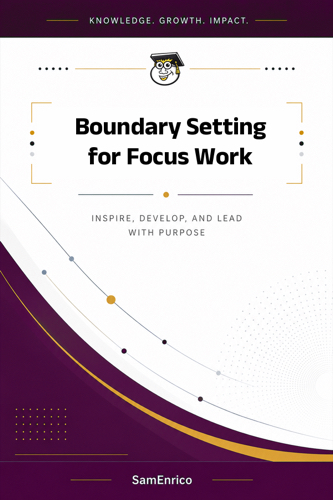
Boundary Setting for Focus Work eBook
Communicate deep work hours to colleagues and fami
by Coats Jamila
Communicate deep work hours to colleagues and family using clear signals.
Formats
Free sample
Chapter 1: The Open-Door Paradox--–- Sarah had done everything right. She was a senior marketing director at a midsize tech firm, respected by her peers, loved by her team, and consistently rated as “highly collaborative” on every performance review. She had an office with a door—a luxury in an open-plan world. She had noise-canceling headphones. She had a calendar meticulously color-coded with “Focus Time” blocks.
By all external metrics, Sarah had set herself up for deep work success.And yet, when she looked at her actual output at the end of each week—the strategic plan that remained half-written, the campaign analysis that was three days overdue, the creative brief that kept getting pushed to “tomorrow”—Sarah felt a quiet, creeping despair. She was working more hours than ever, often ten or eleven per day, but the work that actually moved the needle kept slipping through her fingers like water.The problem was not her skills. The problem was not her motivation. The problem was not even her calendar.The problem was the door.Or rather, the problem was what happened at that door. Every twenty-two minutes, on average, someone knocked.
Sometimes it was a direct report with a “quick question” about a slide deck. Sometimes it was a peer from product management who “just needed two minutes” to align on a timeline. Sometimes it was her own manager, popping in to “see how things were going.” And sometimes, most painfully, it was her phone buzzing with a Slack message from her partner at home, asking what she wanted for dinner or whether she had seen the vet’s reminder email.Each interruption felt small. Thirty seconds here. Two minutes there.
But Sarah had read Cal Newport’s work. She knew that every time she was pulled out of deep concentration, it took her an average of twenty-three minutes to fully re-engage. The math was brutal: a single two-minute interruption cost her nearly half an hour of productive time. And she was experiencing twenty to thirty interruptions per day.By Friday afternoon, Sarah had lost the equivalent of two full workdays to the cognitive tax of context switching. She was exhausted, behind, and secretly ashamed.
She had begun to believe that she was simply not capable of the kind of focused work that her role demanded.She was wrong. She was not the problem. Her signals were.The Great Misunderstanding of Modern Work Let me tell you something that will either relieve you or infuriate you: your inability to focus is not a character flaw. It is not a lack of discipline. It is not evidence that you are “bad at your job” or “not cut out for knowledge work.”It is, quite simply, a signal failure.The modern workplace—and, increasingly, the modern home—has been designed around an assumption that is catastrophically wrong: the assumption that other people can read your cognitive state.
Your colleagues cannot see that you are twenty minutes into solving a complex problem. Your manager cannot see that you have three tabs open and a half-written proposal that requires every ounce of your working memory. Your partner cannot see the difference between “checking email” and “building a quarterly forecast that will determine whether your team gets funded.”They see you sitting at a computer. That is all.And because they cannot see your cognitive load, they operate on the only information available to them: your availability signal. Or rather, the absence of one.Here is the central paradox of this book: the more “flexible” and “open” your work environment, the less actual deep work you accomplish.
Open-door policies, collaborative cultures, and flat hierarchies sound wonderful in theory. In practice, they create an interruption economy where the loudest, most persistent, or most anxious person gets your attention, regardless of the value of the work you were doing.This chapter will diagnose why “just telling people” never works, introduce the concept of Signal Erosion, and prepare you for the radical shift from reactive explaining to proactive signaling. By the end of this chapter, you will understand why your current approach is failing and why a different path is not only possible but surprisingly simple.The Deep Work / Shallow Work Distinction Before we can fix the problem, we need to name it precisely. For that, we turn to the single most important distinction in the entire field of productivity science.Deep work is professional activity performed in a distraction-free state that pushes your cognitive capabilities to their limit. These efforts create new value, improve your skills, and are difficult to replicate.
Examples include: writing a strategic plan, analyzing complex data, coding a new feature, designing a presentation from scratch, or solving an unfamiliar problem.Shallow work is logistical, performative busyness that can be performed while distracted. These efforts create little new value and are easy to replicate. Examples include: responding to email, scheduling meetings, updating status reports, routing information, or answering questions that have been answered before.Here is the brutal truth that most knowledge workers refuse to accept: shallow work feels productive, but it is not. Responding to thirty emails in an hour gives you a dopamine hit—a sense of closure, of progress, of being “on top of things.” But at the end of that hour, have you created anything of lasting value? Have you solved a problem that no one else could solve?
Have you moved your most important project forward?Almost certainly not.Deep work, by contrast, feels uncomfortable. It requires sustained attention, tolerance for frustration, and the willingness to sit with a problem that does not yet have a solution. It does not produce the same dopamine hit. But it produces results.The average knowledge worker spends approximately 60% of their time on shallow work. The highest performers spend closer to 20%.
That gap—forty percentage points—is not explained by intelligence, experience, or work ethic. It is explained by one thing: the ability to protect deep work from interruption.Which brings us back to the door.Why "Just Tell People" Fails Every Time If you are reading this book, you have almost certainly tried the most obvious solution: you have told people that you need to focus. You have said the words “I really need to get some work done” or “Can you please not interrupt me for the next hour” or “I’m going heads-down.”And it did not work.Why? Not because people are malicious. Not because they do not respect you.
Not because your work is unimportant. But because the phrase “I need to focus” has become what I call a weak signal.A weak signal has three characteristics. First, it is verbal rather than visual—it requires active processing rather than passive perception. Second, it is inconsistent—you use it sometimes but not others, and you enforce it variably. Third, and most destructively, it is overridden by your own behavior.Let me explain that third point carefully, because it is the key to everything that follows.When you say “don’t interrupt me” and then, five minutes later, you check your phone, respond to a Slack message, or engage in small talk with a passing colleague, you are not just breaking your own focus.…
This is the end of the free sample. Get the eBook to keep going. Buy now
About this book
Details
- Author
- Coats Jamila
- Publisher
- SamEnrico
- Language
- English
- Genre
- Non-Fiction, Business Brief, Professional Boundaries
- Released
- 2026-06-06
- Pages (approx.)
- 143
- Available as
- eBook, Audiobook

Read better in the ZLOADR app
Your eBooks on your phone or tablet. Sign in with your SamEnrico account and start reading.
More by Coats Jamila
 Market Share Weighted MappingCoats Jamila$11.99
 Remote Retreats for Religious DiversityCoats Jamila$11.99
 Polish Resistance Sewer EscapeCoats Jamila$11.99
 Study Music Neuroscience GuideCoats Jamila$11.99
 The Silent Spy: The Double Life of Mata HariCoats Jamila$11.99
 The Billionaire's Blueprint: How One Man Reshaped Global HealthCoats Jamila$11.99
 React Native EngineerCoats Jamila$11.99
 10 Ways to Use Cherry Brandy (Recipe Book)Coats Jamila$11.99
 Remote Team Budget AdjustmentCoats Jamila$12.99
 JEE Problem Solving FrameworkCoats Jamila$12.99
 Understanding Chromosome 1, 1p36 Deletion SyndromeCoats Jamila$17.99
You may also like
 Hong Kong Handover 1997Dunn Johnnie$11.99
 Zumba For Postnatal Recovery CourseNeal Christian$11.99
 Zumba for BeginnersLadner Nikia$11.99
 YouTube Comment Mining GuideHumes Pandora$12.99
 Worry Box MeditationCarlin Rudy$11.99
 Workplace Stress MeditationNguyen Lynn$11.99
 Workplace Stress and Sleep RepairHawley Ivory$11.99
 Workplace Perfectionism CureDelaney Jeffry$11.99
 Workplace Injustice Anger GuideWallen Isabelle$11.99
 Work Addiction and Burnout LinkGreenwood Ester$11.99
 Women in Yoga and WellnessBeattie Galina$11.99
 Women in Stand Up ComedyChun Evangeline$11.99