
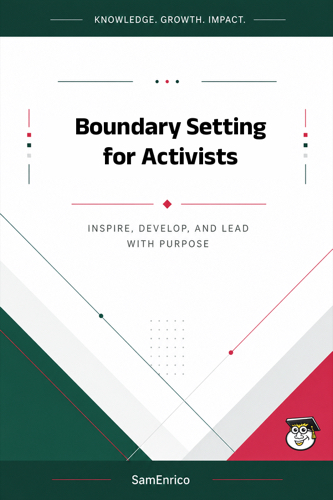
Boundary Setting for Activists eBook
Set limits on emotional labor, protest safety, and
by Nix Lavada
Set limits on emotional labor, protest safety, and burnout prevention in social justice work.
Formats
Free sample
Chapter 1: The Messiah's Empty Tank--–- The email arrived at 11:47 p.m. on a Tuesday. Maria had been staring at her screen for fourteen hours, jumping between a fundraising appeal, a legal support document for an arrested comrade, and a Slack thread where two long-time volunteers were accusing each other of bad faith. She hadn't eaten since a granola bar at 9 a.m. She hadn't replied to her sister's text from three days ago.
Her right eye had been twitching for two hours.The email was from a coalition partner she admired. "Maria, we need you to lead the rapid response team for the hearing on Friday. I know you're busy, but no one else understands the policy language like you do. Can you draft talking points by tomorrow night?"Maria's stomach clenched. Then came the familiar wave of heat – not anger, exactly, but something closer to righteousness.
Of course they need me. If I don't do this, who will? The hearing is in three days. The wrong words could cost us everything.She typed "Yes, on it" before she could think otherwise. Then she opened a new document and started writing.Six months later, Maria collapsed.
Not metaphorically – though she was emotionally hollowed out – but physically, on the floor of her kitchen, at 2 a.m., trying to make herself a sandwich before a 6 a.m. action planning call. Her body simply stopped cooperating. She lay there for an hour, crying, unable to move, finally calling a friend who drove her to the emergency room. The diagnosis: exhaustion, dehydration, and a stress-induced cardiac event.
She was thirty-one years old.The friend who picked her up – a veteran organizer named Diego – sat with her in the ER waiting room and said something she never forgot. "Maria, you didn't fail the movement. The movement failed you. And it failed you because we've all been lying to each other about what commitment looks like."The Lie We Tell Ourselves This book is not about leaving activism. It is about staying in it – for decades, for a lifetime, for the long, unglamorous work that actually changes systems.
And staying requires something that most activist cultures actively punish: the ability to set boundaries.Let us name the lie immediately. The lie is this: The more you sacrifice, the more you care. The more you hurt, the more you are committed. The more exhausted you are, the more honorable your work.This lie did not emerge from nowhere. It has roots in religious traditions of martyrdom, in revolutionary romanticism that glorifies the suffering revolutionary, and in the brutal logic of capitalism that measures worth by output.
But in contemporary social justice spaces, this lie has been polished until it shines like a virtue. We brag about how little sleep we got. We wear our exhaustion like a medal. We ask each other "How are you?" and expect the answer to be "Tired" – as if rest were a luxury only the privileged can afford.Here is the truth that Maria learned on her kitchen floor: The messiah complex – the belief that you, personally, must fix everything, and that no one else can or will – is not a sign of your dedication. It is a sign of your disconnection from collective power.If you believe you are irreplaceable, you have already lost.
Not because you are unimportant – you may be extraordinarily important – but because you have confused your role with your self. And that confusion is the fastest route to burnout.What This Chapter Will Do In this opening chapter, we will accomplish five things. First, we will diagnose the messiah complex – what it is, where it comes from, and why it feels like a virtue when it is actually a vulnerability. Second, we will explore urgency culture – the demand for immediate, constant action that keeps activists in a perpetual state of crisis response. Third, we will distinguish between urgency (reactionary panic) and importance (strategic, long-term pressure), a distinction that will serve as a foundation for every boundary skill in this book.
Fourth, we will introduce the Urgency vs. Importance Matrix, a practical tool for deciding what to say yes to and what to decline. And fifth, we will begin the work of separating your worth as a person from your productivity as an activist – the deepest boundary of all.By the end of this chapter, you will have a framework for recognizing when you are acting from messianic panic rather than strategic commitment. You will have a tool to help you say no. And you will have permission – real, earned, tactical permission – to stop believing that exhaustion is the same as effectiveness.Section One: The Messiah Complex – Why We Believe We Must Save Everything The messiah complex has many names in activist literature.
Some call it the "savior syndrome." Others call it "overfunctioning" or "heroic individualism." But whatever name you use, the pattern is recognizable: a person who believes that if they do not take responsibility for a problem, the problem will not be solved. They take on more than anyone else. They work longer hours. They say yes to every request. And deep down – often unacknowledged – they feel a flicker of resentment toward everyone who seems to be doing less.Where does this come from?The messiah complex is not a personality flaw.
It is a learned survival strategy, often rooted in childhood experiences of having to take care of adults or younger siblings. It is reinforced by activist cultures that reward availability and punish absence. And it is supercharged by the genuine urgency of the problems we face. When people are being evicted, when police are killing community members, when families are separated at borders – the idea of taking a nap can feel obscene.But here is the paradox: The more you act like a messiah, the less you build collective power.Consider the math. If you do everything yourself, you accomplish one person's worth of work.
You also teach everyone around you that you are the one who will handle it. Over time, others step back. Not because they are lazy, but because you have signaled – through your exhaustion, your martyrdom, your refusal to delegate – that you do not trust them to do it right. Your messiah complex becomes a self-fulfilling prophecy: you believe no one else can do it, so you do it, and because you do it, no one else learns how. Eventually, you collapse, and the movement loses not only you but also the institutional knowledge you never shared.The social justice twist: identity and obligation For activists whose identities are directly targeted by oppression, the messiah complex carries an additional weight.
A queer activist may feel that every moment not spent fighting homophobia is a betrayal of their community. A disabled activist may feel that resting is "giving in" to ableism. A Black activist may feel an overwhelming pressure to be excellent, tireless, and always available – because the movement has so few Black voices at the table.This is not paranoia. It is a real dynamic. Marginalized activists often are asked to do more, to carry more emotional labor, to represent entire communities in ways that their privileged counterparts are…
This is the end of the free sample. Get the eBook to keep going. Buy now
About this book
Details
- Author
- Nix Lavada
- Publisher
- SamEnrico
- Language
- English
- Genre
- Non-Fiction, Self-Help, Activism
- Released
- 2026-06-10
- Pages (approx.)
- 145
- Available as
- eBook, Audiobook

Read better in the ZLOADR app
Your eBooks on your phone or tablet. Sign in with your SamEnrico account and start reading.
More by Nix Lavada
 Stress Induced Nagging CycleNix Lavada$11.99
 EQ For Eating Disorder RecoveryNix Lavada$11.99
 Drug Dependency ExerciseNix Lavada$11.99
 The Learning Style StressNix Lavada$11.99
 Neuropathic Pain WorkbookNix Lavada$11.99
 US Germany Remote Tax GuideNix Lavada$11.99
 Light Therapy for BipolarNix Lavada$11.99
 Keyword Mnemonic Language GuideNix Lavada$11.99
 The Golden Age of Viennese Science: From Freud to the Quantum LeapNix Lavada$11.99
 The Whistleblower's Dilemma: Frances Haugen vs. FacebookNix Lavada$11.99
 Whispers in the Lamplight: The Djinn of Baghdad’s Forgotten QuarterNix Lavada$11.99
 The Mineral Guide to DiaboleiteNix Lavada$11.99
You may also like
 Hong Kong Handover 1997Dunn Johnnie$11.99
 Zumba For Postnatal Recovery CourseNeal Christian$11.99
 Zumba for BeginnersLadner Nikia$11.99
 YouTube Comment Mining GuideHumes Pandora$12.99
 Worry Box MeditationCarlin Rudy$11.99
 Workplace Stress MeditationNguyen Lynn$11.99
 Workplace Stress and Sleep RepairHawley Ivory$11.99
 Workplace Perfectionism CureDelaney Jeffry$11.99
 Workplace Injustice Anger GuideWallen Isabelle$11.99
 Work Addiction and Burnout LinkGreenwood Ester$11.99
 Women in Yoga and WellnessBeattie Galina$11.99
 Women in Stand Up ComedyChun Evangeline$11.99