
Non-FictionSelf-HelpEmpath Boundaries
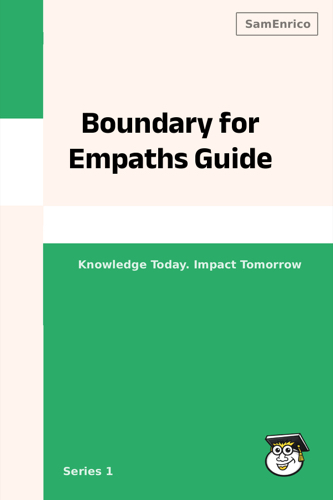
Boundary for Empaths Guide eBook
Stop absorbing others' emotions with this sensitiv
Stop absorbing others' emotions with this sensitive person boundary workbook.
Formats
Free sample
Chapter 1: The Porcupine’s Secret...--You have been told, probably since childhood, that you are "too sensitive." Maybe it was a parent who sighed when you cried at a commercial. Maybe it was a teacher who said you needed "thicker skin." Maybe it was a partner who said, "You're overthinking it again," or a boss who implied that your emotional reactions were unprofessional. Whatever the exact words, the message was the same: there is something wrong with the way you feel. And like most empaths, you believed it.You have spent years trying to fix yourself. You have tried to care less.
You have tried to "just let it go." You have told yourself that other people's problems are not your responsibility. And yet, despite your best intentions, you leave every social gathering exhausted. You wake up with the anxiety that belongs to someone else. You feel the tension in a room before anyone speaks. You know when your partner is upset before they say a word.
You carry the grief of people you barely know. You absorb the anger of strangers in traffic. You finish your day feeling like a wrung-out sponge—and you cannot figure out why everyone else seems to move through life with so much more energy than you have.Here is the truth that no one told you: you are not broken. You are not too sensitive. You are not weak.
And the solution is not to care less.You are a porcupine who was raised to believe she was a sponge.This is not a metaphor. It is a biological fact about the way your nervous system is wired. Fifteen to twenty percent of the human population is born with a trait called Sensory Processing Sensitivity (SPS). It is not a disorder. It is not a diagnosis.
It is a genetic variation, like being born with blue eyes or left-handedness. People with SPS process information more deeply. They notice subtleties that others miss. They are more affected by other people's moods. They have stronger emotional responses to art, music, and nature.
And they become overwhelmed more quickly by loud noises, bright lights, and chaotic environments.If you are reading this book, you are almost certainly in that fifteen to twenty percent. And you have been playing a losing game your entire life—because you have been trying to solve a boundary problem with a "care less" solution that was never designed for your nervous system.The Sponge Lie Let us name the lie explicitly. The lie is this: if you are a kind person, you should be available to everyone. You should listen without limit. You should absorb without complaint.
You should be a sponge.The sponge is a beautiful metaphor for empathy in theory. Sponges absorb. They hold liquid. They distribute it. But here is what the metaphor leaves out: sponges do not have a nervous system.
Sponges do not get exhausted. Sponges do not develop anxiety from absorbing too much of the wrong kind of liquid. And sponges certainly do not lose their sense of self in the process.You are not a sponge. You never were. You are a porcupine with a soft belly—an animal designed for sensitivity and protection in equal measure.
The porcupine's quills are not weapons. They are not aggression. They are information. They say, "This far, no further. You may look.
You may admire. But you may not crush me."Most empaths have been taught to retract their quills entirely. You were told that having boundaries made you mean. You were told that saying no made you selfish. You were told that protecting your energy was somehow a betrayal of your identity as a "good person." So you pulled your quills in, exposed your soft belly to the world, and wondered why you kept getting hurt.The purpose of this book is to teach you how to regrow your quills—not to become cold, not to stop caring, but to become a porcupine who can finally choose when to be soft and when to be protected.
Because here is the other truth no one told you: a porcupine who cannot raise her quills is not kind. She is prey.The Science of Feeling Too Much Before we go any further, let me show you the science behind what you experience every day. You deserve to know that this is not in your head. It is in your nervous system.In the early 1990s, psychologist Dr. Elaine Aron was studying why some people seemed to be deeply affected by their environments while others barely noticed.
She developed the concept of the Highly Sensitive Person (HSP), and her research revealed that sensitivity is a stable, heritable trait. Brain imaging studies have since confirmed that HSPs show greater activation in brain regions associated with awareness, empathy, and sensory processing. When an HSP sees a photo of a sad face, their brain lights up more intensely than a non-HSP's brain. When an HSP hears a loud noise, their startle response is stronger and lasts longer.One of the key mechanisms here is the mirror neuron system. Mirror neurons are brain cells that fire both when you perform an action and when you observe someone else performing that action.
They are the biological basis of empathy. When you see someone smile, your mirror neurons fire as if you were smiling. When you see someone in pain, your mirror neurons fire as if you were in pain. This is normal. This is human.But in empaths, the mirror neuron system is more active.
It fires more intensely and for longer durations. You do not just understand that someone is sad. You feel sad. And in cases of empathic absorption—which we will explore in depth in the next chapter—you may not even know that the sadness belongs to someone else. You simply feel sad and assume the feeling is yours.This is why you leave a party exhausted even though you had a "good time." This is why you feel drained after a tense meeting even though you barely spoke.
This is why you wake up with a headache on the morning of your friend's crisis. You are not imagining it. You are not weak. Your mirror neurons are simply doing what they were designed to do—but at a volume that most people never experience.The Three Kinds of Empathy (And Why One of Them Is Destroying You)To understand what is happening in your body, you need to distinguish between three different kinds of empathy. Most people use the word "empathy" as if it were one thing.
It is not.Cognitive Empathy is the ability to understand what another person is feeling. It is intellectual. It does not require you to feel anything yourself. When you say, "I understand that you are angry," without feeling angry, that is cognitive empathy. Therapists use cognitive empathy constantly.
It allows them to help clients without burning out.Emotional Empathy is the ability to feel what another person is feeling. It is the warm, connecting experience of shared emotion. When your child falls and cries, and you feel a pang of sadness, that is…
This is the end of the free sample. Get the eBook to keep going. Buy now
About this book
Details
- Author
- Whitson Raymonde
- Publisher
- SamEnrico
- Language
- English
- Genre
- Non-Fiction, Self-Help, Empath Boundaries
- Released
- 2026-06-09
- Pages (approx.)
- 137
- Available as
- eBook, Audiobook

Read better in the ZLOADR app
Your eBooks on your phone or tablet. Sign in with your SamEnrico account and start reading.
More by Whitson Raymonde
 Mayor of a Fairgrounds TownWhitson Raymonde$11.99
 The Creditor Call Coping GuideWhitson Raymonde$11.99
 Deep Work Hours GuideWhitson Raymonde$11.99
 The 90 Minute Nap CycleWhitson Raymonde$11.99
 Microbiome Sleep QualityWhitson Raymonde$11.99
 Thyroid Research UpdateWhitson Raymonde$11.99
 Social Media Fire LeadershipWhitson Raymonde$11.99
 Depression Sleep MemoryWhitson Raymonde$11.99
 The Corsair King: Hayreddin Barbarossa and the Siege of Tunis (1535)Whitson Raymonde$11.99
 The Billionaire's Shadow War: How a Tech Mogul Secretly Funded a CoupWhitson Raymonde$11.99
 Love Letters in the Sky: The WWII Balloon Bomb RomanceWhitson Raymonde$11.99
 Social Media MarketingWhitson Raymonde$11.99
You may also like
 Hong Kong Handover 1997Dunn Johnnie$11.99
 Zumba For Postnatal Recovery CourseNeal Christian$11.99
 Zumba for BeginnersLadner Nikia$11.99
 YouTube Comment Mining GuideHumes Pandora$12.99
 Worry Box MeditationCarlin Rudy$11.99
 Workplace Stress MeditationNguyen Lynn$11.99
 Workplace Stress and Sleep RepairHawley Ivory$11.99
 Workplace Perfectionism CureDelaney Jeffry$11.99
 Workplace Injustice Anger GuideWallen Isabelle$11.99
 Work Addiction and Burnout LinkGreenwood Ester$11.99
 Women in Yoga and WellnessBeattie Galina$11.99
 Women in Stand Up ComedyChun Evangeline$11.99