
Non-FictionSelf-HelpCodependency
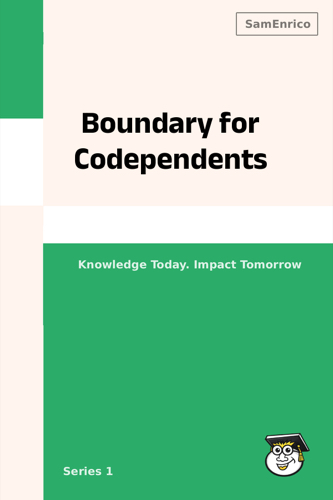
Boundary for Codependents eBook
Stop over functioning and let others solve their o
by Shea Mitsue
Stop over functioning and let others solve their own problems.
Formats
Free sample
Chapter 1: The Rescue Trap--–- The first time you realize you might be the problem, it will feel like betrayal. Not of someone else—of yourself. You have spent years, maybe decades, building an identity around being the helper, the fixer, the one who holds everything together. You have been praised for it. Thanked for it.
Needed for it. And now this book is asking you to consider that your greatest virtue might actually be a cage.Let me be clear about what this chapter is not. It is not an attack on kindness, generosity, or genuine care for others. Those are beautiful human capacities. What we are going to examine is something that wears kindness like a mask but operates very differently underneath: the compulsive, anxiety-driven need to manage other people's lives, emotions, and problems because your own sense of safety depends on their functioning.This is the Rescue Trap.
And if you have ever felt exhausted, resentful, and indispensable all at the same time, you have already been living inside it.The Day Everything Changed for Claire Before we dive into theory and models, let me tell you about Claire. Claire is not a real person—she is a composite of dozens of over-functioners I have studied and worked with. But her story is so common that you may feel like I am describing your life.Claire is a forty-two-year-old nurse manager. She is exceptional at her job. Her unit has the lowest turnover rate in the hospital because she covers shifts no one else wants, remembers everyone's birthdays, and has personally driven three different staff members to rehab over the years.
At home, she has a husband who has not made a decision about anything important in a decade and two teenage children who have learned that if they wait long enough, Mom will solve it. Her elderly mother calls every evening to report her blood pressure numbers and her loneliness in the same breath.Claire complains. Of course she complains. She is exhausted. She says things like "no one ever helps me" and "if I don't do it, it won't get done" and "I don't even know who I am anymore." Her friends tell her she needs to set boundaries.
Her therapist has been saying the same thing for three years. Claire agrees. She reads articles about self-care. She buys planners. She starts the year with intentions.And then someone needs her.
A coworker calls in sick. Her daughter forgets a permission slip. Her husband looks lost and helpless. Her mother's voice cracks. And Claire jumps.She jumps before she thinks.
She jumps because her chest tightens and her jaw clenches and something ancient and automatic says: if you don't fix this, something terrible will happen. She jumps because watching someone struggle feels unbearable. She jumps because she would rather be exhausted than guilty.Afterward, she is exhausted. And resentful. And quietly, secretly proud.
Because she did it. She saved the day again. She is the only one who could have handled that.This is the Rescue Trap. And Claire will not escape it by reading another article about self-care. She will not escape it by trying harder.
She will not escape it by buying a better planner. She will escape it only by recognizing that her helping is not what she thinks it is.The Drama Triangle: Your Unconscious Script The most useful model for understanding the Rescue Trap comes from psychiatrist Stephen Karpman, who in 1968 introduced what is now known as the Karpman Drama Triangle. The triangle has three roles: Victim, Rescuer, and Persecutor. Most people know about the Victim. Many have heard of the Rescuer.
Few realize that these roles are not fixed identities but positions in a game that everyone plays together.Let me break it down.The Victim is the person who appears helpless, oppressed, or incapable. The Victim says things like "I can't," "It's too hard," "Nothing ever works out for me," and "I don't know what to do." The Victim's emotional tone is a mixture of sadness, fear, and resentment. Crucially, the Victim does not actually want to become capable. The Victim wants to be rescued.The Rescuer is the person who steps in to save the Victim. The Rescuer says things like "Let me help you," "I'll take care of it," "Don't worry, I've got this," and "You couldn't have known how to handle that." The Rescuer's emotional tone is a mixture of anxiety, superiority, and exhaustion.
Crucially, the Rescuer does not actually want the Victim to become capable. The Rescuer wants to be needed.The Persecutor is the person who blames, criticizes, or attacks. The Persecutor says things like "This is your fault," "Why can't you get it together?" and "You're being ridiculous." The Persecutor's emotional tone is anger and contempt. In codependent systems, the Persecutor role often rotates—the Rescuer becomes the Persecutor when they burn out and start blaming the Victim for needing so much.Here is what most people miss: these three roles are not separate personalities. They are positions on a stage, and the players switch roles constantly.Claire starts as the Rescuer, solving her husband's problem.
When he fails to thank her appropriately, she becomes the Persecutor ("You're so helpless, I have to do everything"). When he withdraws into silence, she feels like the Victim ("No one appreciates me, I'm all alone"). Then someone else needs something, and she is back in the Rescuer role. Round and round. The drama never ends because the drama is the point.The drama is the point.
Let that land.If you are in the Drama Triangle, you are not solving problems. You are generating drama that keeps everyone stuck. The Victim stays helpless. The Rescuer stays exhausted. The Persecutor stays angry.
And no one grows, changes, or becomes more capable.The Difference Between Helping and Rescuing This is a critical distinction. Most codependents believe they are helping. They are not. Helping and rescuing look similar from the outside, but they operate from completely different internal states and produce completely different outcomes.Helping is temporary assistance that increases the other person's capacity to handle similar situations in the future. You help someone learn to fish.
You help someone find a resource. You help someone practice a skill. When you help, you feel calm and clear. You are not anxious about the outcome. You trust the other person to do their part.Rescuing is repeated intervention that decreases the other person's capacity over time.
You solve problems they could solve themselves. You take responsibility for outcomes they should own. You feel a physical urgency—the chest tightness, the jaw clench. You are not calm. You are anxious.
And you do not trust the other person to handle anything without you.Here is the brutal truth that this book will return to many times: rescuing is not an act of love. It is an act of control disguised as love.When you rescue someone, you are saying, without words: "I do not trust you to handle this. I am better at your life than you are. Your discomfort is intolerable to me, so I will remove it—not for your sake…
This is the end of the free sample. Get the eBook to keep going. Buy now
About this book
Details
- Author
- Shea Mitsue
- Publisher
- SamEnrico
- Language
- English
- Genre
- Non-Fiction, Self-Help, Codependency
- Released
- 2026-06-07
- Pages (approx.)
- 145
- Available as
- eBook, Audiobook

Read better in the ZLOADR app
Your eBooks on your phone or tablet. Sign in with your SamEnrico account and start reading.
More by Shea Mitsue
 Remote Worker Self AssessmentShea Mitsue$11.99
 Navigating Parent Loss First YearShea Mitsue$11.99
 Napping Environment SetupShea Mitsue$11.99
 Microbiome Autoimmune MarkersShea Mitsue$11.99
 Coping With Wage GarnishmentShea Mitsue$11.99
 Thyroid MistakesShea Mitsue$11.99
 Menopause Sleep MemoryShea Mitsue$11.99
 Key Executive Departure GuideShea Mitsue$11.99
 The Lionesses of Shanghai: How Women’s Football Roared to Life in 1920s AsiaShea Mitsue$11.99
 The Wolf and the Rose: A Viking Love Among the Flames of LindisfarneShea Mitsue$11.99
 The Pink Panther Heist: The 1972 Monaco Caper That Shocked the WorldShea Mitsue$11.99
 How to Become a DeburrerShea Mitsue$11.99
You may also like
 Hong Kong Handover 1997Dunn Johnnie$11.99
 Zumba For Postnatal Recovery CourseNeal Christian$11.99
 Zumba for BeginnersLadner Nikia$11.99
 YouTube Comment Mining GuideHumes Pandora$12.99
 Worry Box MeditationCarlin Rudy$11.99
 Workplace Stress MeditationNguyen Lynn$11.99
 Workplace Stress and Sleep RepairHawley Ivory$11.99
 Workplace Perfectionism CureDelaney Jeffry$11.99
 Workplace Injustice Anger GuideWallen Isabelle$11.99
 Work Addiction and Burnout LinkGreenwood Ester$11.99
 Women in Yoga and WellnessBeattie Galina$11.99
 Women in Stand Up ComedyChun Evangeline$11.99