
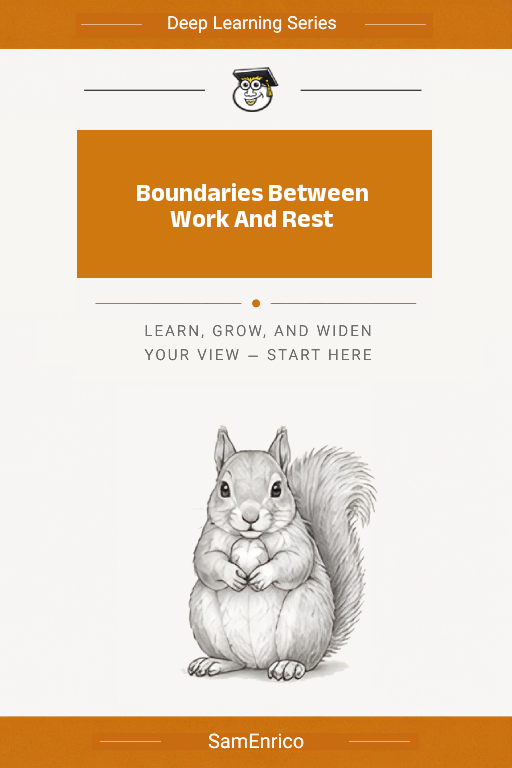
Boundaries Between Work And Rest eBook
Use separate devices and shutdown rituals to preve
by Wade Elias
Use separate devices and shutdown rituals to prevent startup stress from invading recovery time.
Formats
Free sample
Chapter 1: The Startup Trap--–- The notification arrived at 9:47 PM. A Slack message from a colleague in a later time zone: “Quick question about tomorrow’s deck—no rush.” The phone buzzed on the nightstand. Maria, a senior marketing director, picked it up. She told herself she would just glance at it. Two hours later, she was still awake, mentally rehearsing the deck, reorganizing slides, and feeling her heart race.
She had not replied to the message. She had not opened her laptop. But sleep was gone.Maria’s story is not unusual. It is, in fact, the new normal. And it reveals something profound about the modern crisis of rest.
Most people believe that burnout comes from doing too much work—from long hours, heavy workloads, and impossible deadlines. That is not wrong, but it is incomplete. The primary thief of rest is not the volume of work. It is something far more subtle, far more pervasive, and almost never discussed: startup stress.This chapter introduces the single most important concept in this book. Understanding it will change how you see every evening, every weekend, and every moment of attempted recovery.
And it will reveal why most boundary-setting advice fails.The Two Faces of Stress To understand why rest disappears, we must first split stress into two distinct categories. Most writing on burnout lumps all stress together. That is a mistake. The difference between these two types of stress is the difference between a manageable day and a sleepless night.Maintenance stress is the effort of doing work. It is the cognitive load of writing that report, debugging that code, leading that meeting, or responding to those twelve emails.
Maintenance stress is real. It drains energy. It requires focus. But it has a crucial feature: it exists during the work activity itself. When you stop typing, the maintenance stress of that specific task largely dissipates.
Your fingers rest. Your eyes rest. The direct demands of that task end.Startup stress is something else entirely. It is the dread, friction, and anticipatory anxiety of beginning a work session. It is the mental rehearsal of problems not yet solved.
It is the open loop of “I need to remember to do that tomorrow.” And unlike maintenance stress, startup stress does not end when you stop working. It lingers. It compounds. It follows you to the dinner table, into the living room, and under the covers.Here is the dangerous asymmetry: maintenance stress requires action to feel; startup stress requires only anticipation. You do not need to be working to feel startup stress.
You only need to know that work is waiting.When Maria checked her phone at 9:47 PM, she did not perform any maintenance work. She did not open the deck. She did not write a single word. But she activated startup stress. Her brain began previewing tomorrow’s first problem.
The Slack message was not a demand for immediate action. It was a seed. And that seed grew into two hours of wakefulness.Why Startup Stress Invades Rest More Than Workload This is the counterintuitive core of the argument: startup stress is more destructive to rest than workload stress. A person who worked ten intense hours but completed a clear shutdown ritual will often sleep better than a person who worked four scattered hours but left five open loops dangling.Consider two scenarios.Scenario A: You work a solid eight-hour day. You finish a major project.
You close your laptop, say “done,” and go for a walk. Your mind is tired but settled. You sleep well.Scenario B: You work only four hours. But during those four hours, you switch between seven different tasks. You leave three emails unanswered.
You remember a task you forgot. You see a message about a problem you will need to solve tomorrow but cannot solve tonight. You close your laptop with no ritual. You spend the evening half-watching television while mentally rehearsing tomorrow. You sleep poorly.Scenario B involved half the work but produced double the rest disruption.
Why? Because startup stress does not care about hours worked. It cares about unfinished psychological transitions.The research backs this up. A 2018 study in the Journal of Applied Psychology found that employees who reported high levels of “psychological detachment” from work during off-hours had significantly lower levels of fatigue and higher levels of life satisfaction—regardless of how many hours they had worked. The strongest predictor of poor detachment was not workload.
It was the inability to stop thinking about work tasks that remained open.Another study of over 1,000 workers found that the mere presence of a smartphone during off-hours—even when turned off—reduced cognitive performance on rest activities. The brain knew the device was there. It knew work was accessible. And that knowledge alone was enough to prevent deep recovery.Startup stress is the mechanism behind these findings. It is the cognitive residue of work that has not been properly closed.The Three Thieves of Rest If startup stress is the enemy, we need to name its weapons.
Through years of research and hundreds of client interviews, three specific thieves emerge again and again. They are the channels through which startup stress invades rest. And they are present in almost every modern knowledge worker’s life.Thief One: Accessibility Accessibility is the state of being reachable. When your work device is in your pocket, when your notifications are on, when your team knows they can message you at any hour, you are accessible. And accessibility alone generates startup stress.The reason is neurological.
The human brain is wired to monitor for potential threats. In the ancestral environment, that meant listening for predators. In the modern office, that means listening for the ping of an urgent message. When you are accessible, your brain never fully disengages. It remains in a state of low-grade vigilance, ready to respond.
This vigilance consumes energy. It prevents deep rest. And it keeps startup stress simmering just below the surface.Notice that accessibility creates stress even when no one contacts you. The possibility of contact is enough. A 2019 study found that participants who were told they might receive a work-related text during a rest period showed higher heart rates and lower self-reported relaxation than participants who were told they would not receive any texts.
The actual texts never came. The anticipation did the damage.Thief Two: Ambiguity Ambiguity is the state of not knowing what is pending. When you have unfinished tasks but no clear system for tracking them, your brain holds onto them. This is the Zeigarnik effect, named after the Russian psychologist who discovered that people remember unfinished tasks better than completed ones.Ambiguity is the open loop. It is the email you saw but did not answer.
It is the task you remembered but did not write down. It is the question you know you need to ask but have not yet formulated. Each ambiguous item is a tiny weight. Alone, each is light. Together, they form a cognitive burden that follows you into rest.The cruel irony of ambiguity is that it often arises from attempts to reduce future work.
You check email at 9 PM thinking, “I’ll just see what’s waiting so I’m prepared for tomorrow.” But that check…
This is the end of the free sample. Get the eBook to keep going. Buy now
About this book
Details
- Author
- Wade Elias
- Publisher
- SamEnrico
- Language
- English
- Genre
- Non-Fiction, Mental Wealth
- Released
- 2026-05-30
- Pages (approx.)
- 143
- Available as
- eBook, Audiobook

Read better in the ZLOADR app
Your eBooks on your phone or tablet. Sign in with your SamEnrico account and start reading.
More by Wade Elias
 Mindfulness Meditation for Beginners WorkbookWade Elias$11.99
 Meditation for Weekend AnxietyWade Elias$11.99
 The Study Break MethodWade Elias$11.99
 Loci for Legal MemoryWade Elias$11.99
 Benzo Withdrawal GuideWade Elias$11.99
 Religious Trauma Self WorthWade Elias$11.99
 Great Lakes Talent FlowWade Elias$11.99
 Metta For CustomersWade Elias$11.99
 Imagery Association GuideWade Elias$11.99
 The Double Agent Who Saved the WorldWade Elias$11.99
 The Stone and the Crown: How Kings and Builders Shaped Medieval EuropeWade Elias$11.99
 The Maori Maestros: A Love That Shattered the Sound of AotearoaWade Elias$11.99
You may also like
 Hong Kong Handover 1997Dunn Johnnie$11.99
 Zumba For Postnatal Recovery CourseNeal Christian$11.99
 Zumba for BeginnersLadner Nikia$11.99
 YouTube Comment Mining GuideHumes Pandora$12.99
 Worry Box MeditationCarlin Rudy$11.99
 Workplace Stress MeditationNguyen Lynn$11.99
 Workplace Stress and Sleep RepairHawley Ivory$11.99
 Workplace Perfectionism CureDelaney Jeffry$11.99
 Workplace Injustice Anger GuideWallen Isabelle$11.99
 Work Addiction and Burnout LinkGreenwood Ester$11.99
 Women in Yoga and WellnessBeattie Galina$11.99
 Women in Stand Up ComedyChun Evangeline$11.99