
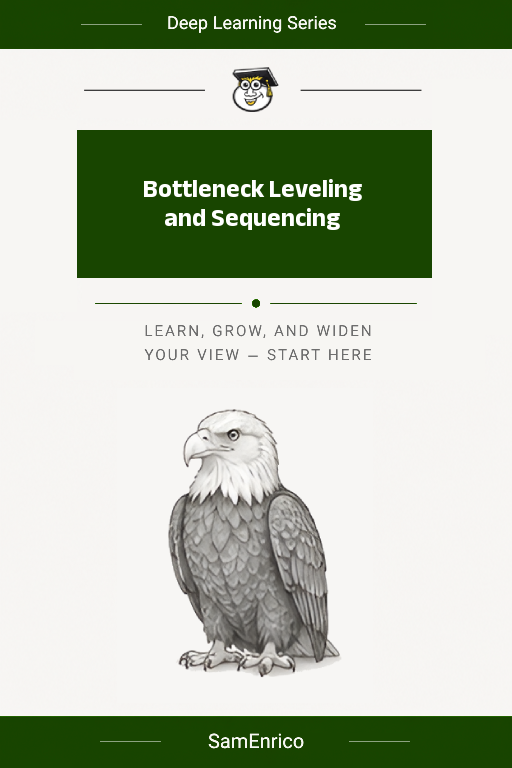
Non-FictionOperational Efficiency ManualTheory of Constraints
Bottleneck Leveling and Sequencing eBook
Focuses leveling and sequencing efforts on the con
Focuses leveling and sequencing efforts on the constraint resource, using drum-buffer-rope and buffer management to protect throughput.
Formats
Free sample
Chapter 1: The Herbie Inside--The first time I saw a factory kill itself with efficiency, I was twenty-four years old, wearing a brand-new white shirt, and standing in the middle of a metal stamping plant that smelled of cutting oil and desperation.My name is not important. What matters is that I had just been promoted to plant manager of Midwestern Dynamics, a seventy-five-person job shop that made brackets, housings, and custom stampings for agricultural equipment. The previous plant manager had lasted eleven months. The one before him had lasted eight. The owner, a chain-smoking former salesman named Harlan Metzger, had given me the job with a handshake and a warning: "Fix the delivery problem, or we close in six months."I had no idea what I was doing.
I had an engineering degree, two years as a production supervisor, and a shelf full of books about Lean manufacturing, Six Sigma, and Toyota Production System. I thought I knew how to run a factory. I was wrong.The problem, as Harlan explained it, was simple: we were shipping only sixty-two percent of orders on time. Our lead times had ballooned from four weeks to twelve. Our work-in-process inventory had grown so large that we had rented a second warehouse just to hold partially finished parts.
And our best people spent their entire days expediting—running from machine to machine, begging operators to skip setups, pushing hot orders ahead of cold ones, creating a chaos that felt like a five-alarm fire that never went out.I walked the floor on my first morning, clipboard in hand, determined to apply everything I had learned. I measured machine utilization. I calculated overall equipment effectiveness. I identified our most expensive resources and made sure they never stopped running. Within two weeks, I had every machine in the plant running at ninety-four percent utilization or higher.
The operators were working overtime. The lights never went off.And our on-time delivery dropped to fifty-one percent.I did not understand. By every metric I knew, we were improving. Utilization was up. Idle time was down.
Labor efficiency was at record levels. So why was the factory falling apart?What I did not know—what no one had taught me in engineering school or in any of those Lean books—was that I had just committed the most common and most catastrophic error in operations management. I had optimized every part of the system and destroyed the performance of the whole.This chapter will show you why that happens. It will introduce you to a simple metaphor—a troop of boy scouts on a hike—that reveals the hidden logic of dependent events and statistical fluctuations. You will learn why keeping everyone busy is the fastest way to kill throughput, why local efficiency is the enemy of global performance, and how a slow walker named Herbie can save your factory.
By the end, you will never look at a utilization report the same way again.The Herbie Principle The story comes from a book called The Goal, written by an Israeli physicist named Eliyahu Goldratt. It is the only business novel ever to become a genuine phenomenon, and for good reason: it contains a single scene that explains, more clearly than any textbook, why most factories fail.A troop of boy scouts is on a hike. They are strung out along a forest trail, with the fastest boys at the front and the slowest—a chubby, overburdened kid named Herbie—at the back. The scoutmaster wants the troop to stay together, so he orders the fast boys to slow down and wait for Herbie. But the gap keeps growing.
The fast boys get impatient. They speed up again. The gap widens. The troop becomes a scattered mess.The scoutmaster eventually figures out the problem: the troop's speed is not determined by the fastest hiker. It is determined by the slowest.
Herbie is the constraint. Until you manage Herbie, nothing else matters.This is the Herbie Principle: In any sequence of dependent events, the throughput of the entire system is limited by the slowest link. Every other link running faster than Herbie does not help. It only creates excess work-in-process that piles up behind the constraint.Now translate that to a factory. Every product moves through a series of operations: cut, stamp, weld, grind, assemble, pack.
Each operation depends on the one before it. If the stamping machine is Herbie—the slowest operation—then running the cutting machine at twice the speed of the stamper does not produce more finished goods. It only produces a mountain of cut parts waiting to be stamped.But here is the twist that destroys most factories: standard cost accounting rewards you for running the cutting machine at full speed. Your utilization metrics go up. Your efficiency reports look great.
Your supervisors get bonuses for keeping everyone busy. So you run the cutter flat out, building inventory that the stamper cannot process, increasing lead times, consuming cash, and delaying shipments.You have made the entire system worse by making one part of it better.The Dice-and-Bucket Demonstration This is not theory. It is arithmetic. And the best way to understand it is to run a simple simulation that you can replicate on a spreadsheet or with a handful of dice and six buckets.Imagine a production line with five stations in sequence: Station A, then B, then C, then D, then E. Each station processes one part per minute on average.
But nothing in manufacturing is perfectly predictable. Processing times vary. Sometimes a station takes thirty seconds. Sometimes it takes ninety seconds. The average is sixty seconds, but the actual time for each part is random.Now here is the question: If each station averages sixty seconds per part, what is the average throughput of the line?If you said one part per minute, you are wrong.
And that wrong answer is why factories fail.The reason is statistical fluctuation. When processing times vary randomly, the slowest station in any given minute determines the output for that minute. But the slowest station changes from minute to minute. The result is that the line's average throughput is always less than the average capacity of any single station.Let me show you the math. Suppose each station has a fifty percent chance of taking forty seconds and a fifty percent chance of taking eighty seconds.
The average is sixty seconds. But when you line them up, the probability that all five stations have a fast cycle (forty seconds) in the same minute is 0.5 to the fifth power, or 3.125%. Most of the time, at least one station will be slow, and that slow station will set the pace for that cycle.Run the simulation for one hundred parts. You will find that the line produces somewhere between eighty and eighty-five parts per hundred minutes—not one hundred. The system loses fifteen to twenty percent of its theoretical capacity simply because of random variation.Now add a real bottleneck.
Make Station C thirty percent slower than the others. Your throughput drops to Station C's speed, period. But here is the kicker: if you then speed up Station C to…
This is the end of the free sample. Get the eBook to keep going. Buy now
About this book
Details
- Author
- Briones Glenn
- Publisher
- SamEnrico
- Language
- English
- Genre
- Non-Fiction, Operational Efficiency Manual, Theory of Constraints
- Released
- 2026-05-30
- Pages (approx.)
- 159
- Available as
- eBook, Audiobook

Read better in the ZLOADR app
Your eBooks on your phone or tablet. Sign in with your SamEnrico account and start reading.
More by Briones Glenn
 Legal Planning Memory ProtectionBriones Glenn$11.99
 Walking Meditation For Diabetes GuideBriones Glenn$11.99
 Forgiveness for GaslightingBriones Glenn$11.99
 ABC Model for Anger ManagementBriones Glenn$11.99
 Delhi Under Rebel Rule GuideBriones Glenn$11.99
 The Jade Serpent and the Knight of the Celestial CourtBriones Glenn$11.99
 Understanding OchronosisBriones Glenn$17.99
 Toy American Eskimo BreedingBriones Glenn$11.99
 German Semester Ticket GuideBriones Glenn$12.99
 10 Ways to Use Croutons (Recipe Book)Briones Glenn$11.99
You may also like
 Hong Kong Handover 1997Dunn Johnnie$11.99
 Zumba For Postnatal Recovery CourseNeal Christian$11.99
 Zumba for BeginnersLadner Nikia$11.99
 YouTube Comment Mining GuideHumes Pandora$12.99
 Worry Box MeditationCarlin Rudy$11.99
 Workplace Stress MeditationNguyen Lynn$11.99
 Workplace Stress and Sleep RepairHawley Ivory$11.99
 Workplace Perfectionism CureDelaney Jeffry$11.99
 Workplace Injustice Anger GuideWallen Isabelle$11.99
 Work Addiction and Burnout LinkGreenwood Ester$11.99
 Women in Yoga and WellnessBeattie Galina$11.99
 Women in Stand Up ComedyChun Evangeline$11.99