
Non-FictionHistorySouthern Africa
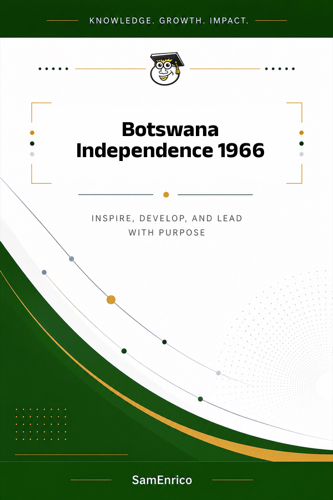
Botswana Independence 1966 Audiobook
Traces Seretse Khama's leadership of one of Africa
by Vitale Peg
Traces Seretse Khama's leadership of one of Africa's most stable democracies.
Formats
Free sample
Chapter 1: The Clay That Binds--In the dusty heat of Serowe, in the year 1921, a child was born who carried the weight of centuries on his small shoulders. The Bamangwato people, the largest of the Tswana nations, gathered to welcome their new prince, and the elders whispered that his name—Seretse, meaning "the clay that binds together"—was a prophecy. They did not yet know how literally that prophecy would be fulfilled, nor how far the clay would have to travel to find its binding purpose.The Kingdom Under the Sun To understand Seretse Khama, one must first understand the world that made him—a world of vast Kalahari horizons, of cattle lowing at dusk, of elders speaking around fires under acacia trees, and of a royal lineage that had mastered the art of survival against impossible odds.The Bamangwato people had lived in southern Africa for centuries, their migration patterns following water and grazing land. By the nineteenth century, they had settled in the region that would become northeastern Botswana, with their capital at Shoshong and later at Serowe, a town their great chief Khama III founded in 1903. Serowe was not merely a settlement; it was a statement.
Built on the slopes of a long ridge overlooking the open plains, its layout reflected order, defense, and community. The chief's compound sat at the center, and radiating outward were the wards of the different family groups, each with its own headman and its own kgotla—the traditional public gathering place where decisions were made through discussion and consensus.The social structure of the Bamangwato was sophisticated. The kgosi (chief) held authority, but that authority was never absolute. He was expected to consult, to listen, to be persuaded by the weight of argument rather than the force of decree. The kgotla system, which would later become a cornerstone of Botswana's democracy, was already ancient when Seretse was born.
In the kgotla, any adult man—and in practice, though rarely recorded, women also voiced opinions—could speak. The chief would sit and hear everyone. Debate would continue until a consensus emerged. No one was forced. No one was silenced.
The goal was not victory but agreement.This was the political culture into which Seretse was born. It taught him that leadership was not about commanding but about persuading, not about ruling but about serving. Decades later, when he walked through the streets of Gaborone…
This is the end of the free sample. Get the Audiobook to keep going. Buy now
About this book
Details
- Author
- Vitale Peg
- Publisher
- SamEnrico
- Language
- English
- Genre
- Non-Fiction, History, Southern Africa
- Released
- 2026-06-06
- Pages (approx.)
- 137
- Available as
- eBook, Audiobook

Listen in the VoxFlicks app
Audiobooks and audio dramas wherever you go. Sign in with your SamEnrico account and press play.
More by Vitale Peg
 Tire Track Trace EvidenceVitale Peg$11.99
 Dentist Stress ManagementVitale Peg$11.99
 Self Hypnosis Induction MethodsVitale Peg$11.99
 Nathan Lane Comedy KingVitale Peg$11.99
 Understanding Alcohol TriggersVitale Peg$11.99
 Holidays After Infant LossVitale Peg$11.99
 Child Loss For MothersVitale Peg$11.99
 Mokami no Kage: The Shadow Puppets of Edo's Golden AgeVitale Peg$11.99
 The Tactical Genius of Jorge Jesus: How a Portuguese Maestro Revolutionized Middle Eastern FootballVitale Peg$11.99
 How to Produce Scrub CapsVitale Peg$11.99
 How to Produce Floor Heating Systems and PartsVitale Peg$11.99
 A Collector's Handbook to the Austin SevenVitale Peg$11.99
You may also like
 Hong Kong Handover 1997Dunn Johnnie$11.99
 Zumba For Postnatal Recovery CourseNeal Christian$11.99
 Zumba for BeginnersLadner Nikia$11.99
 YouTube Comment Mining GuideHumes Pandora$12.99
 Worry Box MeditationCarlin Rudy$11.99
 Workplace Stress MeditationNguyen Lynn$11.99
 Workplace Stress and Sleep RepairHawley Ivory$11.99
 Workplace Perfectionism CureDelaney Jeffry$11.99
 Workplace Injustice Anger GuideWallen Isabelle$11.99
 Work Addiction and Burnout LinkGreenwood Ester$11.99
 Women in Yoga and WellnessBeattie Galina$11.99
 Women in Stand Up ComedyChun Evangeline$11.99