
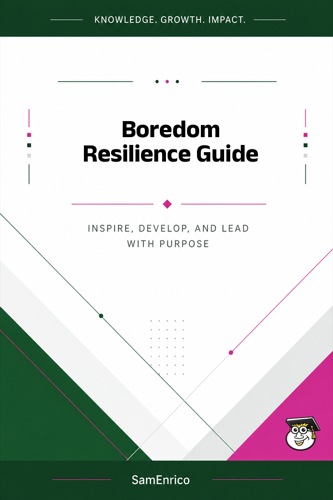
Boredom Resilience Guide eBook
Persist through tedious but necessary tasks withou
by Goff Karan
Persist through tedious but necessary tasks without quitting.
Formats
Free sample
Chapter 1: The Electric Shock Question--–- In 2014, a group of university researchers made a discovery that should have made headlines in every business magazine and productivity blog. Instead, it was buried in an academic journal, read by a few hundred psychologists, and promptly forgotten by everyone who needed it most.The study was simple, almost cruel in its design. They asked volunteers to sit alone in a room for fifteen minutes. No phone. No book.
No music. No writing implement. Just a chair, four walls, and their own thoughts. That was the entire task. Sit and think.Before the session began, the researchers offered an alternative.
Each participant was given a mild electric shock generator. The shock wasn't dangerous—it felt like a static electricity jolt from a doorknob. And they were told: if you find the fifteen minutes of sitting alone too unpleasant, you can press this button and shock yourself instead.Here is what happened. Two-thirds of the men and one-quarter of the women chose to shock themselves rather than sit quietly with their thoughts. One participant shocked himself 190 times in fifteen minutes.
He pressed the button every 4.7 seconds. He preferred physical pain to the absence of stimulation.Let that land.The average person in the modern world would rather feel a mild electric shock than sit alone in a room for the length of a coffee break. And yet, every day, millions of us sit down to do work that is only marginally more stimulating than that empty room. We open spreadsheets. We clear out inboxes.
We enter data. We reconcile receipts. We format documents. We sit through mandatory training videos. We attend meetings that could have been emails.And then we quit.Not because the work is hard.
Not because we lack the skills. Not because we are lazy. But because the work is boring. And our brains, it turns out, have been wired to treat boredom as an emergency.The Pain of Nothing Let me tell you about your insula. It is a small region deep inside your brain, roughly the size and shape of a cashew, tucked behind your temples.
For most of human history, the insula did something very useful: it detected pain. When you touched a hot stove, your insula lit up. When you stubbed your toe, your insula fired. When you were hungry, lonely, or socially rejected, your insula processed those signals too. Its job was to say: something is wrong.
pay attention. make it stop.Then the neuroscientists put people into brain scanners and asked them to perform boring tasks.The insula lit up.Not a little. Not a flicker. The same region that screams when you touch a hot stove screams when you sit through a tedious spreadsheet reconciliation. Your brain, neurologically speaking, cannot reliably tell the difference between mild physical pain and intense boredom.
The same alarm system activates. The same distress signal broadcasts. The same impulse to escape floods your awareness.This is not a metaphor. This is neurobiology.When you are bored, your brain is genuinely suffering. Not metaphorically suffering.
Not "first-world problem" suffering. Your insula is sending a pain signal that says: this situation is intolerable, do something else, get out, move, check your phone, open a new tab, stand up, walk away, quit.And then you quit. And you call yourself lazy. And you scroll Instagram for thirty minutes and feel vaguely ashamed.But you are not lazy. You are responding exactly as your biology trained you to respond.
The problem is that your biology was trained in a world without spreadsheets. Your insula evolved to detect real threats: predators, social exclusion, physical injury. It never evolved to handle a pivot table. It never evolved to handle a five-hour training module on compliance regulations. It never evolved to handle the thousand tiny acts of bureaucratic tedium that modern work demands.So your brain does the only thing it knows how to do.
It sounds the alarm. It treats boredom as danger. And you, being a rational person who trusts their own nervous system, believe the alarm. You escape. You quit.
You blame yourself.This book is going to teach you to stop believing the alarm.Novelty Withdrawal: The Hidden Addiction There is another piece to this puzzle, and it is the piece that explains why boredom has become so much worse in the last fifteen years.Your brain runs on dopamine. You have heard this before. But here is what most people misunderstand: dopamine is not primarily a pleasure chemical. It is a motivation and anticipation chemical. Dopamine is what your brain releases when it expects a reward.
It is the molecule of wanting, not liking. And dopamine responds most powerfully to one specific pattern: variable rewards.Slot machines exploit this. Social media exploits this. Email exploits this. Every time you open your phone and see a notification—but you don't know what it is—your dopamine system fires.
Every time you refresh a page and something might be new, your dopamine system fires. Every time you check Slack and there could be a message from someone important, your dopamine system fires. The uncertainty is what makes it addictive.Now consider what happens when you close your phone and open a spreadsheet.The variable rewards disappear. The uncertainty vanishes. The maybe something interesting becomes definitely nothing interesting for the foreseeable future.
Your dopamine system, which has been fed a steady diet of unpredictable novelty for hours every day, suddenly goes cold turkey. It crashes.This is called novelty withdrawal. It is a real phenomenon. The same neural circuits that produce withdrawal symptoms in substance addiction activate when a heavy social media user sits down to do boring work. You feel restless.
You feel irritable. You feel a vague sense of panic, like you are missing something important. Your hand twitches toward your phone. Your eyes drift to the clock. You think: I'll just check one thing.That feeling is not weakness.
That feeling is withdrawal. Your brain is craving the variable rewards it has been trained to expect. And because you cannot name the feeling—because you have never been taught that "boredom" is often just dopamine withdrawal—you interpret the discomfort as a sign that you should stop. You think: I'm not in the mood. I can't focus.
This task is unbearable.But the task isn't unbearable. The withdrawal is unbearable. And the withdrawal passes.Decoding "I'm Bored"Let me teach you a translation. From now on, when you catch yourself thinking or saying "I'm bored," I want you to pause and ask: what does that actually mean?In almost every case, "I'm bored" is not a statement about the task. It is a statement about the gap between your current level of stimulation and your brain's expected level of stimulation.
You are not bored because the spreadsheet is inherently soul-crushing. You are bored because thirty seconds ago you were scrolling Tik Tok, and Tik Tok has a higher stimulation density than any spreadsheet in human history. You are not bored because the training video is poorly made. You are bored because your brain has been trained to expect a dopamine hit every…
This is the end of the free sample. Get the eBook to keep going. Buy now
About this book
Details
- Author
- Goff Karan
- Publisher
- SamEnrico
- Language
- English
- Genre
- Non-Fiction, Self-Help, Boredom
- Released
- 2026-06-08
- Pages (approx.)
- 143
- Available as
- eBook, Audiobook

Read better in the ZLOADR app
Your eBooks on your phone or tablet. Sign in with your SamEnrico account and start reading.
More by Goff Karan
 Abortion Complicated GriefGoff Karan$11.99
 Horseback Trail RideGoff Karan$11.99
 Conversation Starters for RoommatesGoff Karan$11.99
 Caffeine Anxiety LinkGoff Karan$11.99
 GAD And First DatesGoff Karan$11.99
 Nurse Workaholism GuideGoff Karan$11.99
 Excess Business Loss Limitation GuideGoff Karan$11.99
 The Golden Quill: How the Poets of Great Zimbabwe Shaped a Literary DynastyGoff Karan$11.99
 The Last Pharaoh's Hoard: Cleopatra's Obsession with the Lost Treasures of AlexandriaGoff Karan$11.99
 How to Start a Mental Health Specialist (private Practice) Business (Beginners Guide)Goff Karan$11.99
 Vendor Penalty Clauses GuideGoff Karan$12.99
 SunCulture Solar Exit GuideGoff Karan$12.99
You may also like
 Hong Kong Handover 1997Dunn Johnnie$11.99
 Zumba For Postnatal Recovery CourseNeal Christian$11.99
 Zumba for BeginnersLadner Nikia$11.99
 YouTube Comment Mining GuideHumes Pandora$12.99
 Worry Box MeditationCarlin Rudy$11.99
 Workplace Stress MeditationNguyen Lynn$11.99
 Workplace Stress and Sleep RepairHawley Ivory$11.99
 Workplace Perfectionism CureDelaney Jeffry$11.99
 Workplace Injustice Anger GuideWallen Isabelle$11.99
 Work Addiction and Burnout LinkGreenwood Ester$11.99
 Women in Yoga and WellnessBeattie Galina$11.99
 Women in Stand Up ComedyChun Evangeline$11.99